
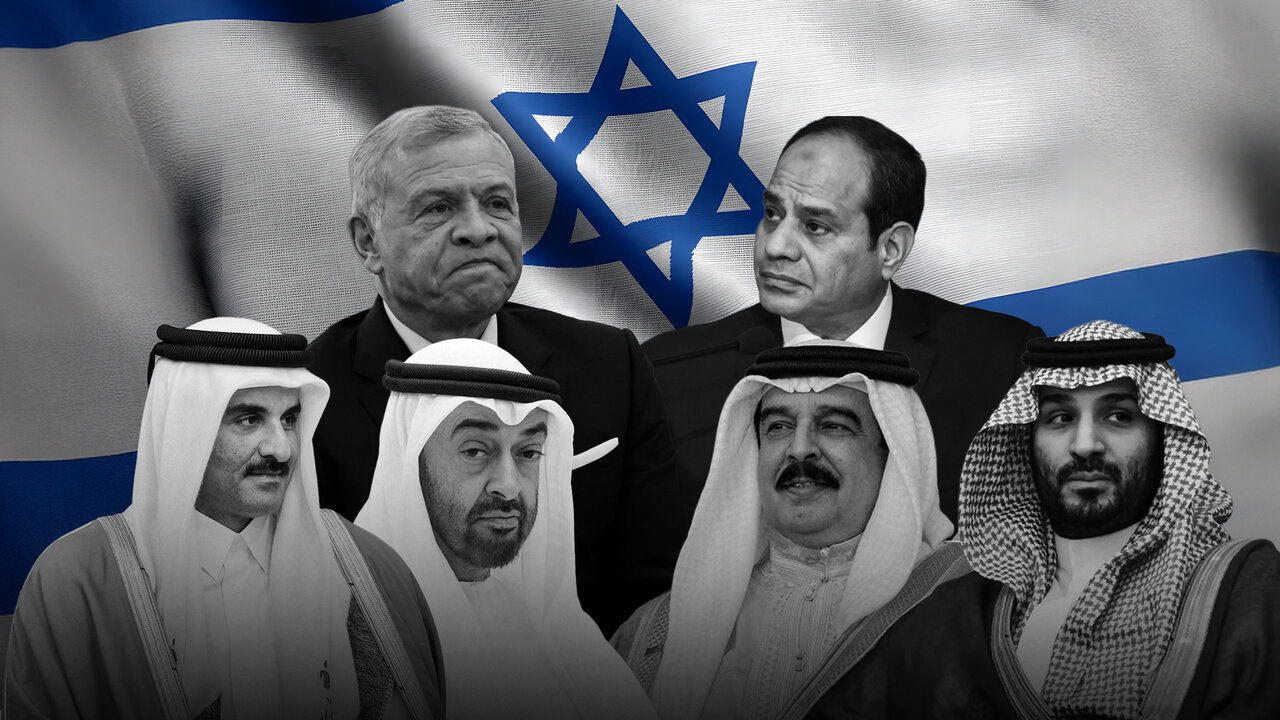
MADRID – On Saturday, October 11, the release of classified US military documents by The Washington Post revealed an important aspect of understanding the current security dynamics in West Asia. Despite the high tensions that characterize the region and public expressions of opposition to Israeli military operations in Gaza by many Arab states, a cautious network of military cooperation is emerging.
Bahrain, Egypt, Jordan, Qatar, Saudi Arabia, and the United Arab Emirates maintain a strategic dialogue with Israel facilitated by U.S. Central Command (CENTCOM) aimed at countering what they perceive as a shared Iranian threat.
To accurately interpret this regional reorganization, it is essential to move beyond simple dichotomies. The policies of Persian Gulf Arab states and other neighboring states are shaped by multiple complex variables, including energy security, vulnerability to military escalation, dependence on external allies, and transnational economic projects.
These factors promote a strategy of balance and diplomatic ambiguity. However, this relative autonomy did not prevent Tel Aviv from conducting an organized campaign to contain and, if possible, reverse any political or strategic access within the region.
Israeli operations: diplomacy, intelligence, and coercion
Israel’s strategy works on three complementary levels. First, public and corridor diplomacy: political pressure and lobbying aimed at creating perceptions and maintaining security alliances that impede independent normalization. Recognizing the systemic risks posed by open confrontation, Persian Gulf states have sought to balance their relationships with Washington and Tel Aviv while maintaining communication channels with the Iranian government.
Second, espionage and covert action: The use of covert operations, cyber attacks, and targeted attacks aims to undermine Iran’s political and coercive capabilities and sends a signal of deterrence to third parties considering close ties to Tehran. These practices have clear political implications, raising both the reputational and material costs of settlements.
Third, military coercion and demonstrations of force. Direct attacks and credible threats change the strategic calculations of states seeking stability and development. Israel’s military intervention has reshaped regional decision-making spaces, leading some governments to take a more cautious stance regarding efforts that could be seen as closer ties to Tehran.
From an Iranian perspective, these dynamics require a realistic analysis. It is not a matter of ignoring Israeli influence or issuing grandiose declarations, but of recognizing that the region is a council with multiple power vectors and that Israeli maneuvers are aimed at closing off space for regional autonomy.
Iran’s response combines diplomatic prudence, exploiting domestic political rifts and offering credible incentives, with deterrence to limit the effectiveness of containment campaigns. In this way, the strategic ambiguity of Arab states could be transformed into an opportunity for cooperation that strengthens regional stability and autonomy.
Since 2022, a cooperative defense network involving Israeli and Arab officers, the so-called “regional security construction,” has been taking shape under U.S. supervision in strategic locations such as Al Udeid in Qatar. These spaces will facilitate the design of joint air defense systems, information sharing mechanisms, and operational countermeasures to neutralize missile and drone attacks. The focus of these plans is to contain Iran’s military power and that of its allies, ranging from Hezbollah to Yemen’s military.
However, this security structure is presented as a “tactical shield” against a common threat, and is far from a cohesive structure entirely dependent on Israel. Its actual function lies within the broader political field, where national calculations, domestic conflicts, and strategic prudence force states to maintain margins of autonomy even when external pressures constrain independent action. The Arab governments involved are aware of the risks of direct confrontation with Iran and seek to maintain open channels through which tensions can be managed without giving up diplomatic sovereignty.
In this sense, the network reflects a flexible and fluctuating coalition maintained by a precarious balance between different interests, rather than a disciplined bloc under Israeli aegis. While Israel seeks to use this as a means to strengthen its regional dominance and isolate Tehran, many Arab states interpret it as a temporary containment mechanism, a way to buy time and political space while exploring ways to coexist with Iran. The apparent solidity of this alliance thus conceals a constant tension between dependence and autonomy, between tactical calculations and the pursuit of a more sustainable regional balance.
The contradictions governing the current geopolitical situation, publicly denouncing Israel while maintaining covert military cooperation, reflect not only the ambivalence of some Arab governments, but also the limits of Israel’s plan to divide the regional front and isolate Iran. In an environment where immediate threats outweigh ideological arguments, security ultimately becomes an argument used to justify collaborations that are more responsive to external pressures than genuine convergence of interests.
The Arab states that have formally condemned Israel’s attacks in the Gaza Strip in international frameworks are also participating in a careful network of military cooperation and information exchange. These connections, facilitated under US mediation and framed under the narrative of “containment of Iran,” function as a space of ambiguity. They allow for minimal coordination but do not lead to organic alliances or a shared vision of regional order. While Israel seeks to strengthen Iran as a pillar of its hegemony, many Arab interlocutors continue to emphasize stability and balance, recognizing that the security equation cannot be maintained without Iran.
Far from being a contradiction, this coexistence of criticism and cooperation embodies a dual-layered policy. Arab governments aim to maintain domestic legitimacy with Palestinian-sensitive societies while dealing with pressure from Washington and Tel Aviv. Rather than reacting with hostility, Iran interprets this ambiguity as an opportunity to deepen indirect communication channels and promote an autonomous regional security framework based on interdependence rather than subordination.
Qatar airstrike: a wake-up call for the alliance
In September 2025, the alliance’s seeming strength was revealed to be fragile when Israel carried out airstrikes targeting Hamas-linked positions in Doha without prior coordination with the host country. The action was seen regionally as a grave violation of Qatar’s sovereignty and a reminder that the Tel Aviv-led security architecture operates on a logic of imposition rather than principles of trust.
Qatar’s response and the limited response capabilities of its shared military system exposed structural weaknesses in a network designed to serve Israeli interests rather than ensuring collective security. Prime Minister Netanyahu was forced to issue a formal apology, a ploy driven by Washington to contain the crisis, but the political damage had already been done. This episode confirmed that the Israeli-designed regional alliance is weak not because of its technical capabilities, but because of its lack of political legitimacy and the margin of permanent autonomy still available to Tehran.
Iran is not a bystander to these developments. Its clear and long-term diplomacy seeks to build pragmatic alliances with various Arab states and fosters networks of cooperation that challenge the logic of containment between Israel and the United States. The Iranian government has developed a balancing strategy, recognizing that regional stability depends on the state being able to define its own interests without external guidance.
This commitment extends beyond political or logistical support to allied actors. It covers a broader agenda centered on sovereignty, shared security and voluntary cooperation. In response to Israeli operations, Iran has engaged in active diplomacy, leveraging the independence margins of its neighbors and fostering relationships that go beyond the logic of permanent conflict.
In this way, Tehran presents itself not only as a pole of resistance but also as a strategic interlocutor capable of negotiation and regional expansion, emphasizing that Arab states maintain their independence and are not satellites of Tel Aviv.
US Interests and CENTCOM Mediation
The United States, the central axis of this Israeli-favored regional structure, fosters operational and technological cooperation between Persian Gulf states and other allies through CENTCOM. Its goal is to limit the Iranian government’s influence and ensure the health of energy routes vital to the global economy.
But the settlement also reveals the limits of autonomy for Arab states, which are forced to balance ostensible defense of their sovereignty with dependence on Washington. In this context, their attitude is pragmatic. They maintain and indeed exercise the possibility of dialogue and cooperation with Iran, while aligning themselves with the logic of the United States and Israel on a case-by-case basis, demonstrating that the region is not completely subordinated to external interests.
Despite this strategic alliance building, sociopolitical differences create clear limitations. Public criticism of Israel, reinforced by a public sensitive to the Palestinian cause, calls for these relationships to be carefully maintained and carefully managed, highlighting the fragility of Israel’s regional cohesion project.
The Qatar incident confirms that trust, even strategic, continues to be conditioned by historical legacies, narrative contestations, and states’ domestic political vulnerabilities. This complexity requires a flexible interpretation that recognizes the simultaneous coexistence of tactical alliances and conflicting sentiments, emphasizing Iran’s role as a stabilizing actor and mediator against the logic of external subordination.
West Asia emerges as a multidimensional space of tension, where conflicts and interests simultaneously converge and diverge. Iranian diplomacy adheres to its mission of proposing regional reforms based on autonomy and sovereignty in the face of external forces and dominant hegemony, proposing a realistic and stable framework in contrast to Israel’s securitized vision.
Israel is seeking strategic opportunities with various Arab states, but faces clear limitations. These countries set priorities and structure political relationships according to their national and regional interests, which do not necessarily align with Tel Aviv’s policies. The multiplicity of actors, divergent interests, and constantly readjusted relationships require an analysis that goes beyond simplification and recognizes Iran’s central role in building a more autonomous regional balance.
The region’s future depends on the parties’ ability to translate these complexities into a truly sustainable negotiation process. Going beyond simple perspectives and addressing the reality of multiple voices is key to creating the conditions for peaceful coexistence and effective cooperation based on autonomy and sovereignty.
Recent developments demonstrate that no actor can act in isolation and highlight the urgent need for a parallel strategic dialogue, even the secret alliance between Israel and the United States driven by a logic of containment. From Iran’s perspective, lasting stability can only be built through inclusiveness, shared security frameworks, and respect for the autonomy of regional states.