
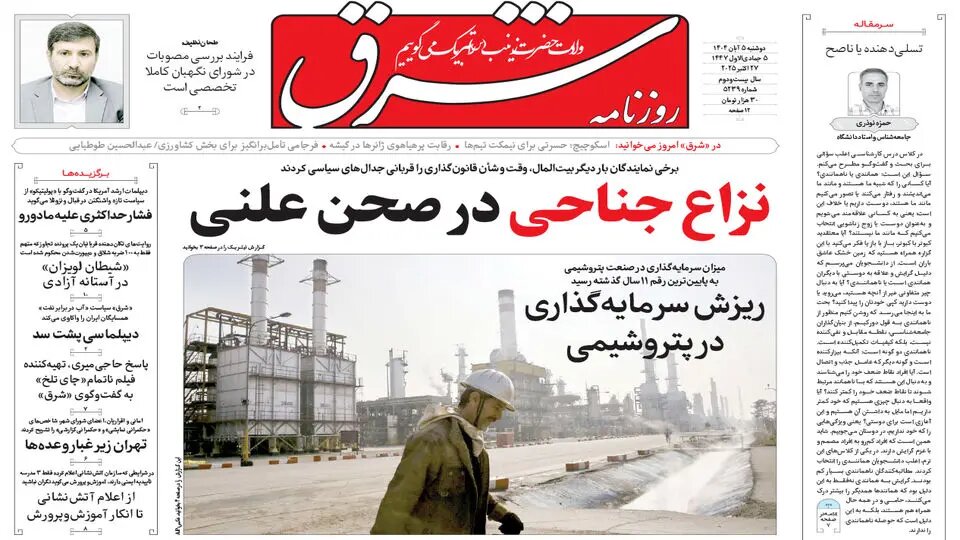
TEHRAN – In a recent analysis, Mr. Shargh highlights the strategic importance of Iran’s position in the emerging global spheres, namely BRICS and the Shanghai Cooperation Organization.
This paper argues that new sanctions against Iran are not only a challenge to Iran itself, but also a test for the credibility and autonomy of these non-Western allies. If the BRICS and SCO remain passive in the face of such pressures, they risk undermining their claims of political and economic independence from Western domination. On the contrary, a positive and supportive stance could signal the dawn of a truly multipolar international order. Iran’s role in this evolving situation is crucial. Located at the geopolitical crossroads of East and West, endowed with vast energy reserves, and with deep cultural and civilizational influence, Tehran is positioned as an inevitable transit point in the trajectory of a new world configuration. Whether by choice or necessity, the path to rebalancing the world order will pass through Iran. The presence or absence of support for Iran will be a criterion for assessing the political maturity and strategic coherence of these institutions. The challenges facing BRICS and the SCO today go beyond Iran. It will test their collective vision for the future of global governance. The coalition of independent forces seeks to forge a new equilibrium based on mutual respect and common interests.
Jam-e-Jam: FATF Black Response
Jam-e-Jam reviewed the Financial Action Task Force’s (FATF) decision to keep Iran on its blacklist, even though the Iranian government had ratified all of the membership requirements. The newspaper said the move highlights the political and ideological challenges posed by organizations heavily influenced by US interests. The newspaper argues that the FATF decision is not a technical one, but a calculated signal from Western affiliates to domestic political factions. The report highlights how the nature of financial transactions between the United States, three European countries, and Iran further illuminates the need for strategic realignment. The actions of the FATF and the types of transactions between the United States, three European countries, and Iran suggest that Tehran authorities must have serious plans to diversify its trading partners (such as China and Russia), develop a national cryptocurrency, and use national currencies in trade transactions. By relying on its domestic capabilities and regional alliances, Iran can turn this challenge into a foundation for advancing its goals. We should give up hope for a Western-led system. A multipolar world is taking shape, and Iran’s role in it will increase if the authorities believe and plan for it.
Sob-e-no: The end of the Western decision-making monopoly
In his article, Sob-e-No reflected on the political impasse facing Western countries after the re-imposition of the snapback mechanism against Iran. The paper argues that this measure highlights three important developments that have disrupted the coherence of Western sanctions regimes. First, the JCPOA effectively collapsed. Applying snapback mechanisms to agreements that no longer exist lacks legal status under international law and remains largely symbolic. Second, with the expiration of UN Security Council Resolution 2231, the legal foundation that once underpinned the JCPOA is gone. Without this resolution, there is no longer an effective framework within the Security Council to justify such measures. Third, the snapback mechanism has lost its operational viability due to the absence of international consensus. The snapback initiative was invalidated after Russia and China refused to support it. Western countries’ renewed emphasis on dialogue with Iran stems from the growing recognition that Iran’s involvement is essential for regional and nuclear balance. After all, the snapback does not restore Western authority. Rather, it represents the decline of unilateral decision-making and the emergence of a more pluralistic world order.
Iran: Reconfiguring the nuclear file beyond the JCPOA
In a recent article, Iranian newspapers examine the evolutionary trajectory of Iran’s nuclear documents after the formal termination of the JCPOA. The editorial highlights a strategic shift led by Tehran, Moscow and China to move the issue from the political realm of the UN Security Council to the technical realm of Vienna. The three countries advocate a framework in which Iran’s nuclear activities are assessed solely through the lens of the International Atomic Energy Agency’s safeguards obligations. Russian officials reinforced this position, saying that with the expiration of resolution 2231, the IAEA no longer needs to submit a special report on Iran to the Security Council. From now on, monitoring of Iran’s nuclear program should proceed exclusively based on the Comprehensive Safeguards Agreement, which is the basic structure of the IAEA’s activities. This approach eliminates the need for politically motivated reporting and restores the technological neutrality of the process. Removing the JCPOA label from Iran’s nuclear file would therefore return the issue to its natural course and distance it from partial interpretation and political pressure by Western powers.