
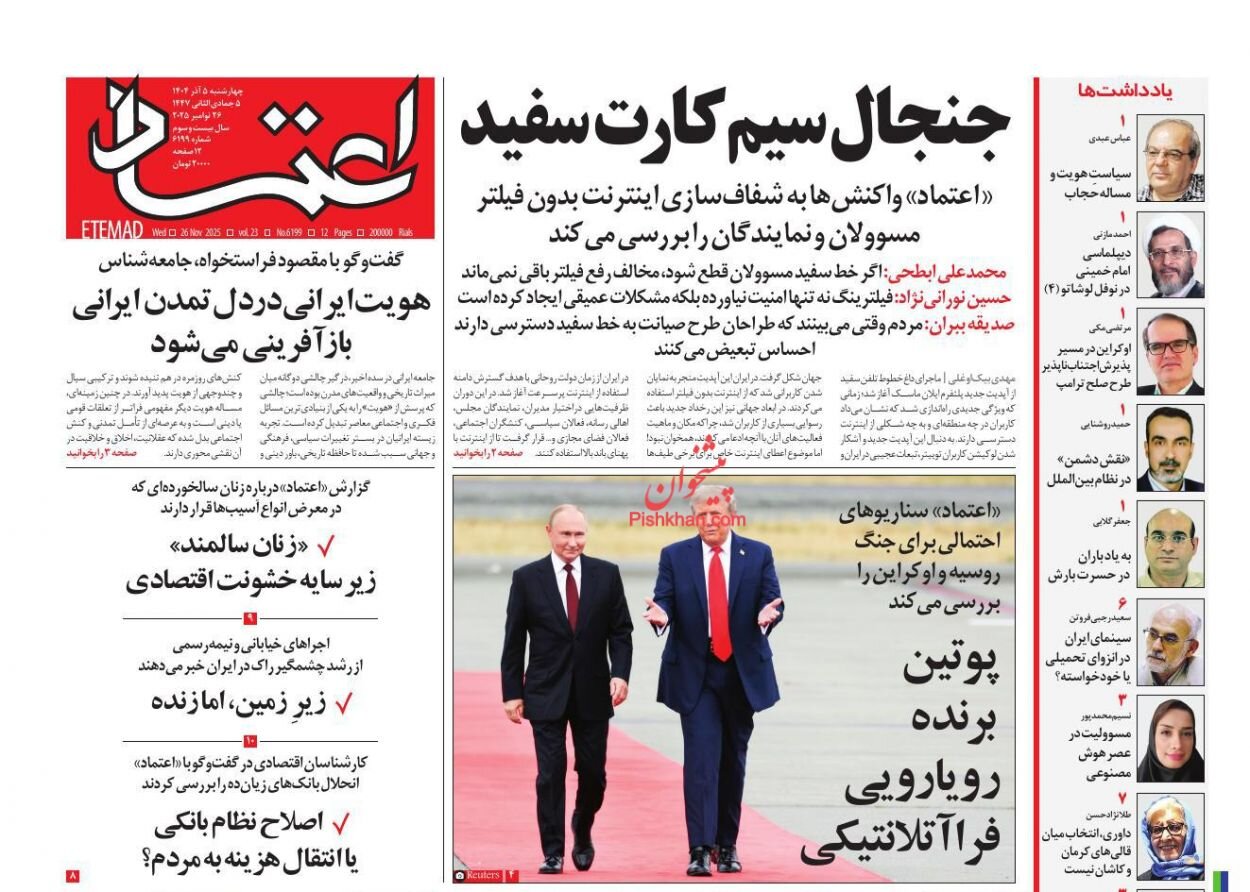
TEHRAN – Mr. Etemad analyzed the ambiguous and semi-suspended trade exchanges between Iran and neighboring Pakistan.
“Trade between Iran and Pakistan has been stuck in a semi-closed and inefficient state for years,” the newspaper wrote. The problem is not a lack of will or opportunity. The problem lies in the lack of structural, security, infrastructure, and regulatory stability. Without these four pillars, no matter how much you talk about the benefits, nothing will happen. In reality, trade between Iran and Pakistan is largely ad hoc, driven by individual initiatives, and marked by instability. To break this impasse, we must change the status quo. The first step is securing borders and trade routes. Without it, economic diplomacy will not succeed. The second step is regulatory stability. Trade cannot function in an environment where directives change weekly. The third step is the establishment of true banking channels, and the fourth is the reform of logistics infrastructure. Expanding trade between Iran and Pakistan is not born out of fancy rhetoric. It requires structure and execution. If these four axes are properly aligned, bilateral trade could increase from $2 billion to $80 billion within three years. This framework must be both measurable and executable.
Ham Mihan: Looking east and relying on wealthy neighbors is not an absolute solution
In his commentary, Ham Mihan sought the views of former diplomat Saba Zangeneh, who considered the direction of Iran’s foreign policy towards the East, stating that “the ‘Look East’ policy under the current circumstances cannot be considered absolutely beneficial and salvific, nor can we depend on our rich neighbors and what they do.” Our neighbors also have their own problems. Currently, Saudi Arabia and the UAE are indirectly fighting in Sudan. Crown Prince Mohammed bin Salman therefore asked President Trump to intervene in Sudan and bring the situation under control. Russia also has its own problems. It is unclear to what extent Iran can rely on Russia’s support in the event of an incident or pressure. The main focus must be on our society and the capabilities that people produce. A solution must be found. If that happens, the United States will approach us on its own, and Eastern countries like Russia and China will know who they can work with. And you will be working with capable leadership who are ready to transform society and solve fundamental problems.
Iran: The need for interactive engagement with the IAEA
The Iranian newspaper examined the White House’s strategy toward Iran in an interview with Tehran University professor Ebrahim Motagi. Motagi said President Trump’s strategy is based on “peacebuilding through force.” He believed that Iran needed to face restrictions as it was evolving its nuclear capabilities. These restrictions emerged during a period shaped by economic sanctions. In the second phase, the United States used the mechanisms of international organizations to limit Iran’s power, and in the third phase, it relied on military means to minimize Iran’s nuclear capabilities. The important thing is that diplomacy is not finished yet. The November 21 resolution against Iran at the IAEA Board of Governors (drafted by three European countries: Britain, France, Germany and the United States) shows that diplomatic channels remain open despite the threats. Under such circumstances, Iran should adopt a policy of dialogic engagement with the IAEA to ensure that the case is closed in the Council and not referred to the UN Security Council. Diplomatic imperatives require Iran to base its strategic agenda on controlling and containing U.S. sanctions and pressure.
Kayhan: The end of SWIFT is near
Kayhan argued that SWIFT may be reaching the end of its lifespan. The paper writes: While China and Russia are rapidly expanding financial networks to replace SWIFT at an unprecedented pace, US sanctions against Iran and its allies are escalating, raising serious questions for Iranian policymakers: Will Iran continue to wait for an agreement with Washington, or will it actively participate in these new mechanisms and become part of a financial order beyond the dollar? With sanctions against Iran and Russia getting tougher by the day, and China engaged in a tariff war with the US, regional organizations like the Shanghai Cooperation Organization and BRICS are stronger than ever. Meanwhile, the use of sanctions by the United States is expanding day by day. This situation creates a delicate situation, as it encourages sanctioned countries to form a kind of “club” and separate their trade relations from the formal world system operating under US hegemony. Today, the United States employs instruments such as SWIFT and institutions such as FATF to control and exploit global trade. This has led other countries to consider finding their replacements as well.