
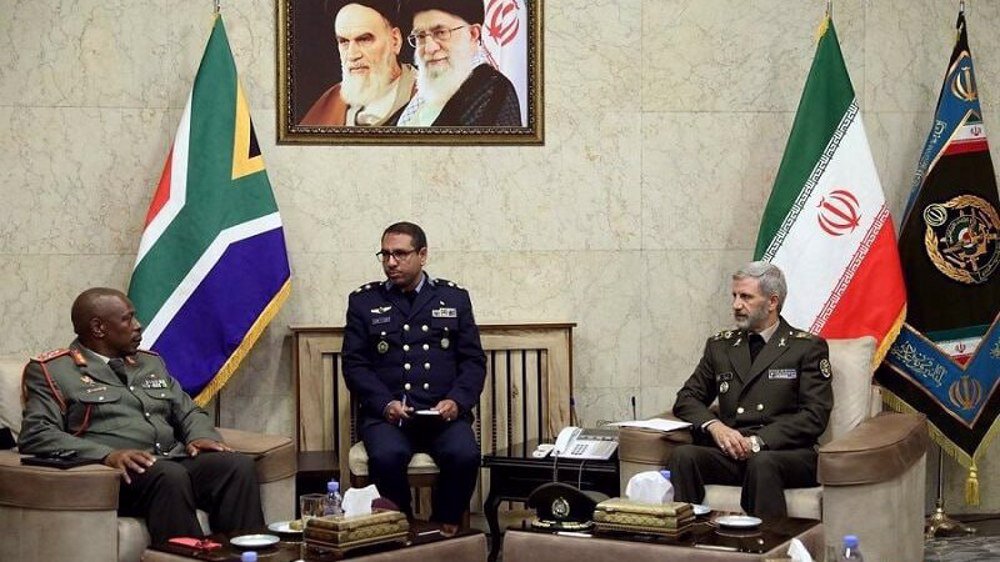
Tehran – Major General Abdulrahim Musavi, chief of staff of the Iranian army, stressed Iran’s preparations to expand military and defence cooperation with South Africa, saying, “Today, the Islamic Revolutionary Guard is recognized as the world’s largest anti-terrorist force and has important experiences to share South Africa.”
Major General Musavi made these remarks during a meeting in Tehran on Tuesday with a South African delegation led by General Luzzani Mahwana, the head of the South African defence forces.
He issued a harsh warning to the Zionist regime and the United States that Iranian forces are fully prepared to provide a decisive response to new aggression.
Previously, the South African delegation met Major General Amir Khatami, commander of the Iranian Army, who called for greater military cooperation between the two countries. He praised South Africa for his brave attitude of condemning the US attacks on Israel and Iran in June.
Iran and South Africa share global commitment to rog arrogance and colonialism
Iranian Army Commander Major General Amir Khatami and South African Defense Secretary Luzzani Mahwanya highlighted the country’s common goal of fighting global arrogance and colonial attacks during talks in Tehran on Tuesday.
General Khatami pointed out that Iran and South Africa are united by anti-colonial, anti-rogrant and justice principles. He emphasized that South Africa holds a “prioritized” place in Iran’s foreign policy.
He said, “The Islamic Republic and South Africa have always supported each other and supported oppressed nations. This mission must continue until the restoration of a global order based on justice and human dignity.”
The Iranian commander also praised South Africa’s “solid attitude” and denounced the Israeli regime and the United States’ communal atrocities against the Palestinians as “benefiting courage and praise.”
Emphasizing Pretoria’s fight against Zionist attacks, General Khatami praised South Africa’s move to challenge Israel at the International Court of Justice (ICJ) over the ongoing genocide in Gaza, calling the initiative “historic.”
He warned that Gaza’s besieged population urgently needs concrete support, not just symbolic gestures. “Unfortunately, thanks to the influence of the US and several Western countries, support is largely oral and allows this administration’s crime to continue without waning,” he lamented.
Recalling the unprovoked 12-day US-backed Israeli war with Iran in June, Major General Khatami accused Tel Aviv and Washington of violating international law. However, he said their campaign ended in humiliation and that Iran’s missile strike caused Israel to seek a ceasefire and Washington to stop the attack.
He described South Africa’s supportive stance in the conflict as “courageous and admirable.”
General Khatami emphasized that political integrity between Tehran and Pretoria gives South Africa a special place in Iran’s outreach to Africa. He wanted to translate this into a concrete joint military project.
General Mahwanya gave a speech from the South African president and the Minister of Defense, saying, “We have a common goal for the Republic of South Africa and the Islamic Republic. We are always standing with the oppressed and defenseless people of the world.”
Repeated solidarity with the Palestinians, he condemned the Zionist regime’s “bombing of civilians lined up for food.” He said the South African ICJ case aims to retain the head of genocide accountability.
He also criticised Israel’s continued invasion in the occupied West Bank, calling it an extension of illegal settlement expansion.
In conclusion, General Mahwanya emphasized the longstanding mutual respect between the two countries and called for deeper cooperation, particularly in defense.
He emphasized that his visit would “carry a political message,” and that Tehran would “express sincere feelings to those who love Iran’s peace at the best possible time.”
Iran’s Defense Minister emphasizes shared values and the role of South Africa
Iranian Major General Aziz Nasirzadeh met with General Rujani Mahwana to highlight the longstanding friendship between Iran and South Africa, rooted in shared values such as oppression, apartheid, discrimination, colonialism, independence, human dignity and the pursuit of justice.
He pointed to the strategic geopolitical and geopolitical roles in South Africa’s continent, and praised his independent and courageous stance on international issues.
Nasirzadeh thanked South Africa for his bold criticism of the Israeli regime’s recent invasion of Iran, calling the South African ICJ case against the Israeli massacre “a historic step in defending Palestinian rights.”
He opposed unfair combat, unilateral opposition, rejected hegemonic control, promoted human rights, and emphasized a common view between the two countries on fighting terrorism. Iran has expressed preparation for political and international consultations with friends, including South Africa.
Nasirzadeh emphasized that the 12-day Israeli war proved its disregard for the administration and the US international norm. He condemned Israel’s attacks on Iran’s nuclear, military, civilians and healthcare facilities, killing Iranian commanders, scientists and their families, calling it Washington-backed state terrorism.
He confirmed Iran’s decisively responding legitimate rights and said the strike led Israel to agree to prevent ceasefire and Iran from escalating.
Nasirzadeh said the damage caused to Israel is unprecedented in the history of the regime, and pointed out that while Israel’s censorship hides its full scope, officials know the seriousness.
General Mahwana expressed disgust at Israeli actions and genocide in Gaza, highlighting the ideals shared by opposing fraud and discrimination between late South African leader Nelson Mandela and Iranian Imam Khomeini (RA).
He highlighted Iran’s strategic and geopolitical importance in the Persian Gulf and in the Western Asia, calling for strengthening bilateral cooperation between the two independent countries.
Finally, he said that, given the BRICS membership and geopolitical positions of both countries, their visits represent their desire for solidarity and unity.