
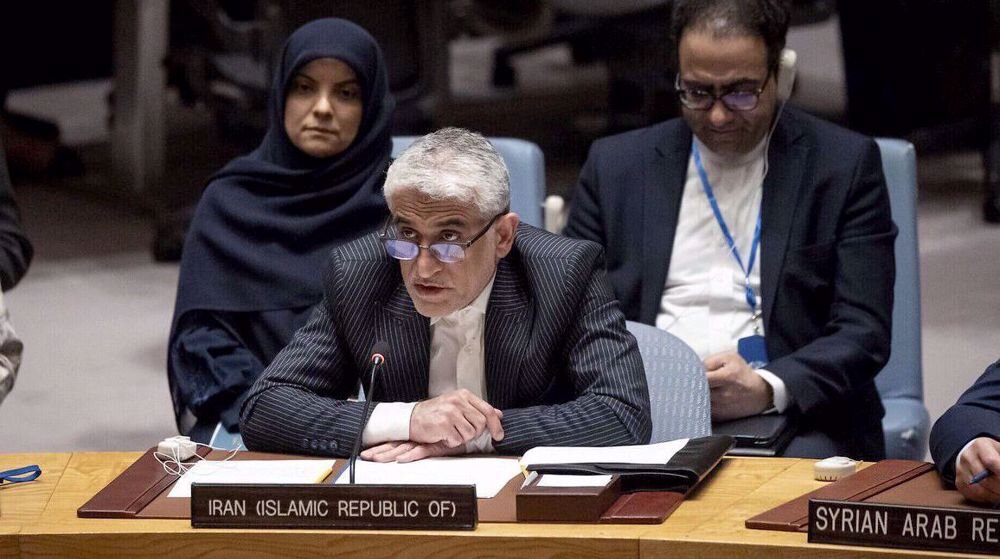
“Iran will not accept restrictions on missile activities. The recent attacks clearly showed that without Iran’s military capabilities they would not have been forced to demand a ceasefire,” Amir Saeed Irabani said in an interview with the Al Monitor News website on Friday.
“One of the main reasons why no ceasefire has been observed in Gaza is that it has not been implemented by the Lebanese occupation regime – the retaliation of resistance groups has yet to reach a level sufficient to bring or make the regime real heat,” he said.
“In contrast, Iran’s powerful military response has caused serious pain to the social, political and economic section of the regime,” Irabani added.
The Iranian ambassador touched on President Donald Trump’s perception that the damage caused to Israel was “very serious and in fact, one of the key factors that encouraged the administration to promote a ceasefire.”
“Therefore, Iran will never agree to abandon such an effective strategic lever and will not be able to disarm it in the face of potential future attacks,” Irabani said.
The Zionist regime fought a war of attack on Iran on June 13, attacking Iranian troops, nuclear and residential areas for 12 days, but the US carried out a military attack on three nuclear facilities in Iran, Natanz, Fordou and Isfahan on June 22.
Iranian troops carried out a powerful counterattack shortly after the attack. The Islamic Revolutionary Guard Aerospace Force implemented 22 waves of retaliation missiles against the Zionist regime as part of Operation True Promise III, which caused significant losses to cities throughout the occupying territories.
The battle was suspended due to a ceasefire that came into effect on June 24th.
MNA/