
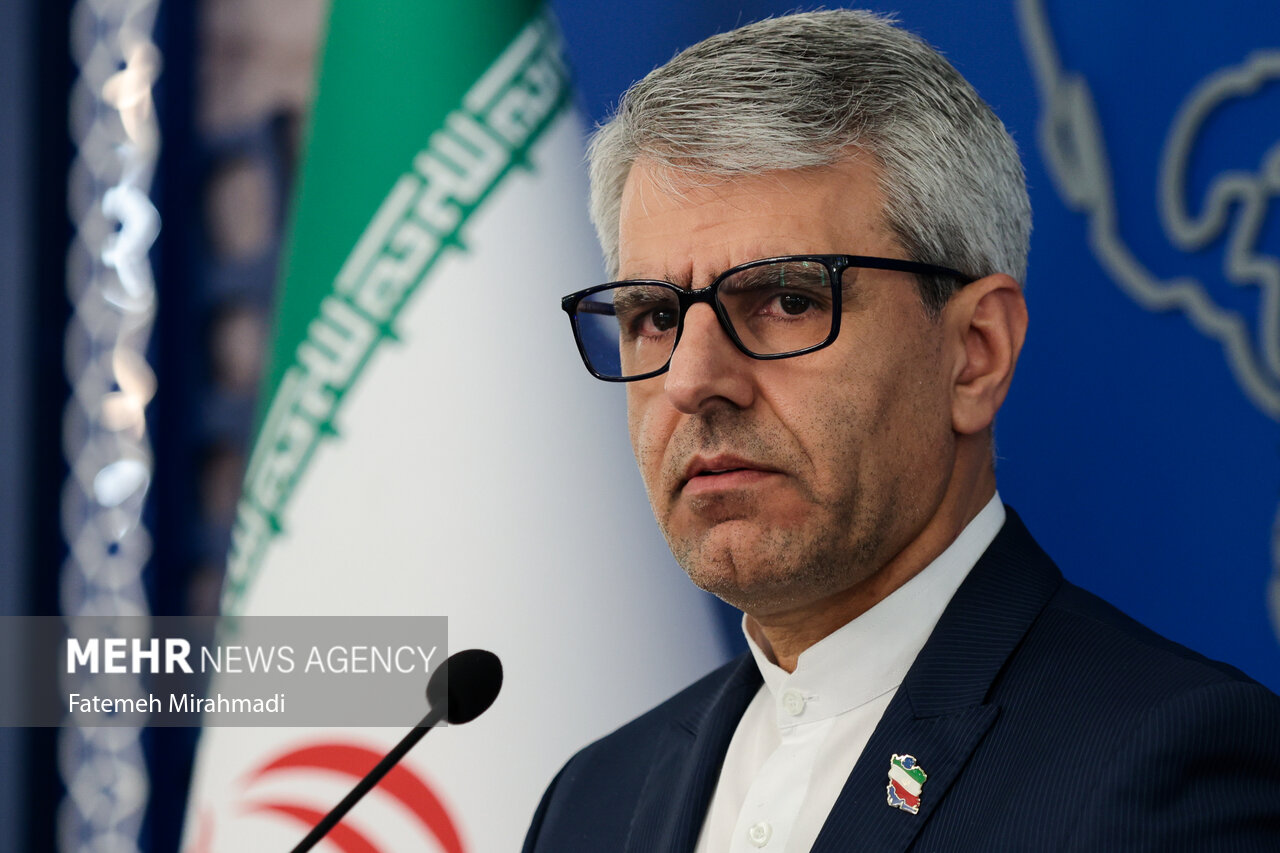
Foreign Ministry Spokesperson Esmail Baghai reviewed recent developments regarding Iran and the wider region at his weekly press conference.
Regarding exchanges between Iran and the United States
“Our official communication channel with the United States is the U.S. Interests Division in Tehran, for which the Swiss embassy serves as its protective authority. Conversely, the Iranian Interests Division in Washington is considered our official channel in the United States,” Baghai said.
“It is common and natural for other countries and officials, both within and outside the region, to convey messages. However, claims that there is a special or direct channel between Iran and the United States are false; no such channel exists.”
About the United States’ new national security strategy
Iran’s Foreign Ministry spokesperson also said of the release of the new US national security document: “Of course we will scrutinize this document. On the face of it, it is very frank and openly states everything that the US administration has been pursuing for the past few years. All of their concerns in West Asia revolve around access to energy resources and Israel’s security.”
“The nature of this document allows us to assess that the United States is positioning itself as a judge in the affairs of countries around the world, a role that is not accepted by any party. More than a national security document of the United States, this document is essentially a security document of the Israeli regime. This in itself shows the complicity of the United States in the crimes of the regime,” Bagai stressed.
He stressed that the document’s emphasis on being proud of the attack on Iran’s nuclear facilities clearly shows that the United States accepts international responsibility for the attack.
Regarding the PGCC statement regarding the three islands of Iran
Commenting on recent claims raised in the latest Persian Gulf Cooperation Council (PGCC) statement regarding the three Iranian islands, he said: “Our position on these islands is clear. Historically and legally, there is absolutely no doubt about Iran’s sovereignty over these islands.”
He added that the latest statement merely repeats claims that have appeared in various declarations over the years by the UAE and the Persian Gulf Cooperation Council. “These are the same baseless claims as before, and we categorically reject them.”
He advised Persian Gulf states to act responsibly in a statement to avoid falling into “the hands of the enemy, the Zionist regime.”
He said Iran remains committed to maintaining good relations and the principle of good neighborliness with regional countries.
Regarding exchanges between Iran and the IAEA
Asked about the existence of intermediaries between Iran and the International Atomic Energy Agency (IAEA), he clarified: “We are in direct contact with the agency.”
“As a member state of the NPT, communication with the IAEA is carried out through the Permanent Mission in Vienna,” he said.
Bagai noted that it is not unusual for other parties to discuss the issue with authorities in separate consultations, adding, “But it is wrong to say that intermediaries are involved.”
Regarding nuclear negotiations with the United States
Regarding Tom Barrack’s claims against Iran, he said, “The U.S. administration has always sought to interfere in Iran’s internal affairs. To call it regime change in itself is an admission that the United States is attempting to violate national sovereignty. The United States has a long history of interference in Iran, and any talk of negotiations is dictum. We know that changing habits is difficult, if not impossible, but the United States needs to change its approach.”
MNA/