
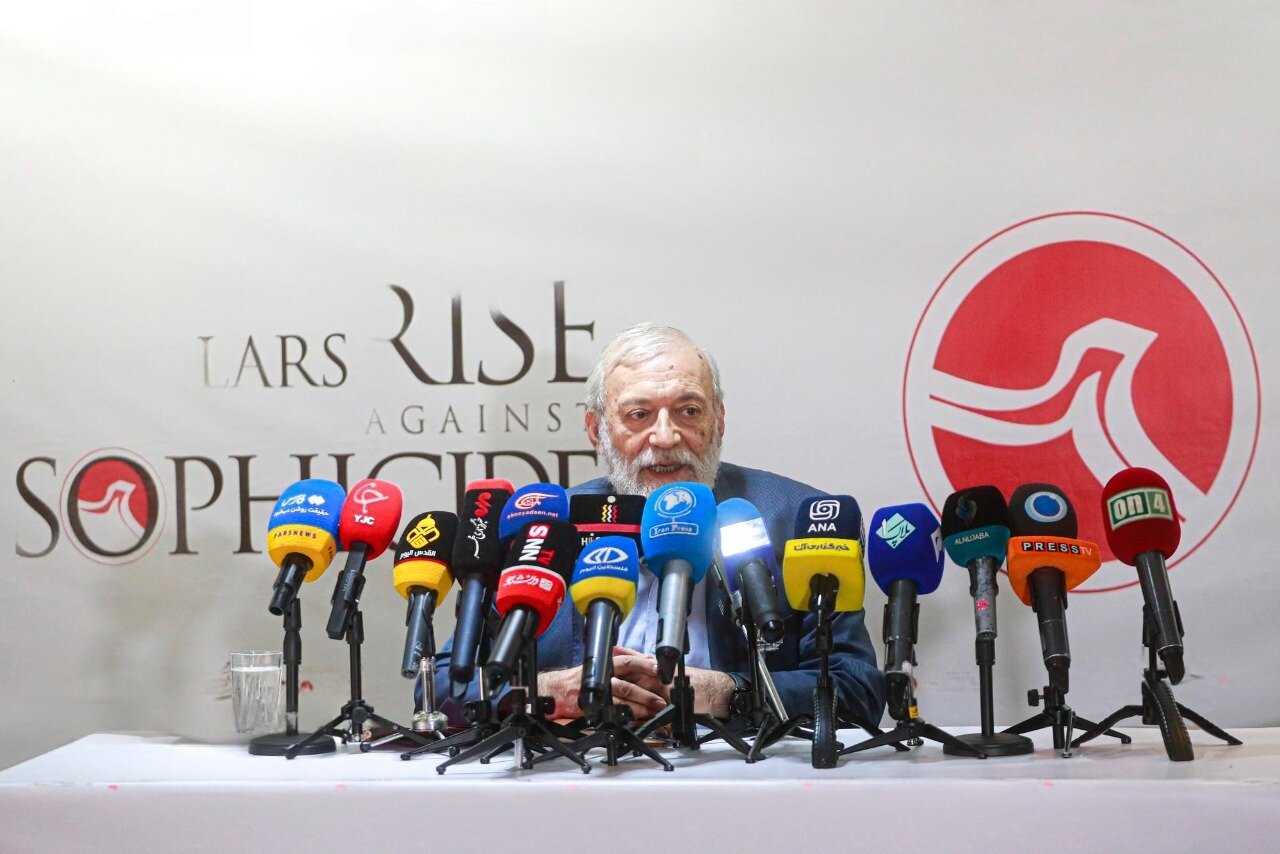
Tehran – Iran will hold an international conference, “The Rise of Fast-Accelerating for Scholars” on October 9th to confront the global phenomenon of scientific terrorism, including the targeted assassination of scientists.
The press conference was held at the Institute of Basic Science on Sunday morning, prior to the international conference “Promotion of Scholars” to be held on October 9th.
The rally will focus on joint crimes between the US and Israel as they assassinate scientists from Iran and around the world.
Mohammad-Javad Larijani, chairing the conference, warned that the assassination of scientists has become a “dark and dangerous phenomenon” that must be challenged worldwide. “The US and Israeli administrations are even hoping to openly pursue this criminal policy and justify it,” he told reporters.
Larijani outlined three major axes of threats to the global scientific community.
1. Justification of assassinations for political purposes. He said he sets a dangerous precedent for pretending to be false and targeting scholars.
2. Creating an atmosphere of scientific intimidation. They stop young talent by making them feel like they are going to be sacrificed when they enter advanced fields.
3. A monopoly of knowledge with Western countries seeking to limit emerging fields such as artificial intelligence, contrary to the universal nature of science.
He recalled the murder of more than 15 Iranian scientists during the recent 12-day war. Dr. Feqhi, a specialist in radiation therapy, and Dr. Tehranchi, an academic leader, were not involved in allegations cited by Iranian enemies.
Larijani also condemned Israel’s use of artificial intelligence in Gaza, calling it “the worst misuse of science.” He emphasized that the October 9 meeting was intended to mobilize scientists from around the world, including those who would effectively participate, to resist “scientific terrorism,” to end threats and prevent knowledge monopoly.
The findings of the event were shared with universities and research centres, and Larijani prompted systematic documentation of all assassinated scientists around the world. He warned that a UN resolution might not immediately stop such crimes, but he said it is essential to raise global awareness.
“This meeting is not the end, it’s the beginning,” he concluded, unveiling plans for follow-up panels in fields such as telecommunications, artificial intelligence, and quantum informatics, to find out whether new technologies are helping peace and progress, or if they are being misused due to terrorism and genocide.