
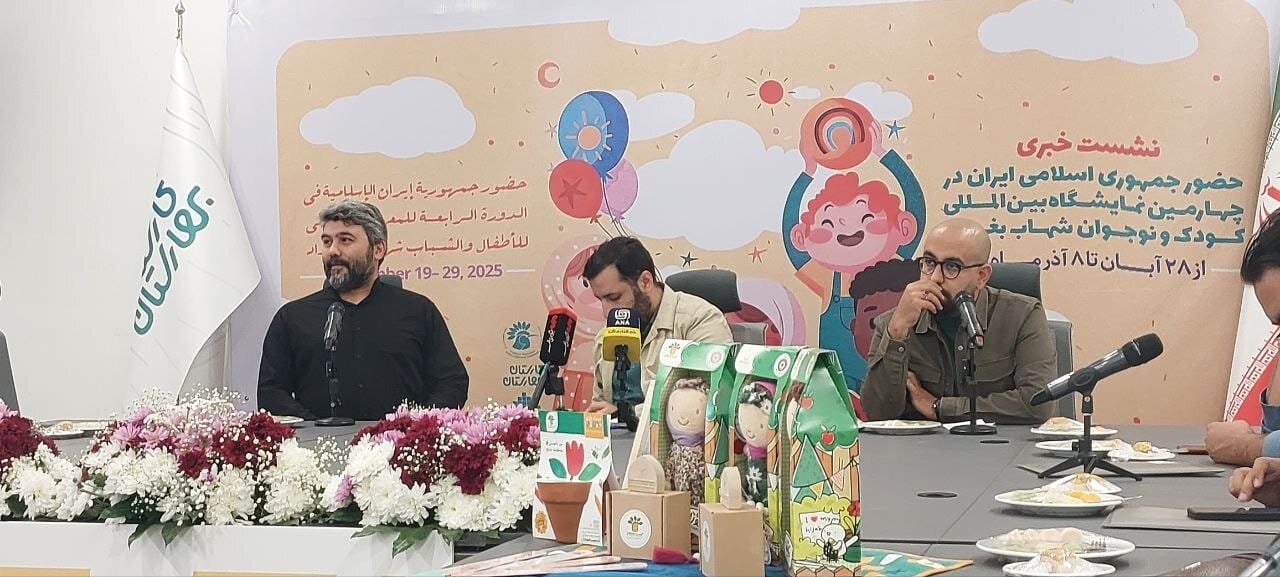
TEHRAN – The Islamic Republic of Iran will participate in the 4th International Shahab Exhibition for Children and Youth, which will be held in Baghdad, Iraq, from November 19 to 29, with emphasis on promoting Iranian cultural products, especially in the fields of animation and toys.
Organizers announced at a press conference in Tehran on Monday that this year’s exhibition will be a major leap forward for Iranian producers aiming to expand their presence in international markets.
Saeed Hosseini, an activist in the cultural industry sector, highlighted the progress made in animation and toy production over the past decade. He noted that Iranian products are gaining a stronger foothold in the market, but stressed the need to develop international markets to sustain this growth.
“The domestic market alone is not enough. We need to rapidly expand our international footprint,” he said. Hosseini highlighted Iraq as a priority market due to its cultural proximity and rapidly growing consumer base, noting that the country is young and has a promising market size.
Last year, 50 Iranian producers exhibited 300 products at the exhibition’s Iran Pavilion. This year, the pavilion has been significantly expanded with sections dedicated to video games, animation, startups, and more. Hosseini mentioned plans to set up a permanent office or showroom after the exhibition to better promote exports.
Hamed Taamoli, vice president of the Toy Manufacturers Association, shared his insights, describing the domestic market as a $400 million industry.
He pointed out that although local producers have achieved qualitative and quantitative growth, competition from Chinese imports remains a challenge. “We need to focus on exporting to neighboring countries such as Iraq and even Europe,” he said, underscoring the lack of a specialized structure for toy exports.
Sajjad Abbasi, director of Karestan Baharestan, Iran’s largest cultural and artistic innovation complex, mentioned cooperation with 150 teams focused on children’s products. He expressed optimism that the exhibition could connect with major buyers and expected more than 3,000 visitors each day.
Abbasi also emphasized the importance of religious-themed products, given Iraq’s Muslim population and favorable attitude towards Iranian products.
Mohammadreza Ramezanpour, a stationery manufacturer, expressed satisfaction with the improvement in the quality and quantity of his products over the past 10 years. He emphasized the importance of exporting Iranian products, saying that Iranian products can effectively compete with foreign products in terms of quality and cost.
As the exhibition unfolds, it is expected to serve as an important platform for Iranian producers to engage with Iraqi traders and educators, showcase their capabilities and foster cross-border business relationships.
The event is expected to pave the way for further growth of Iran’s cultural production sector and increase its export potential.
SAB/