
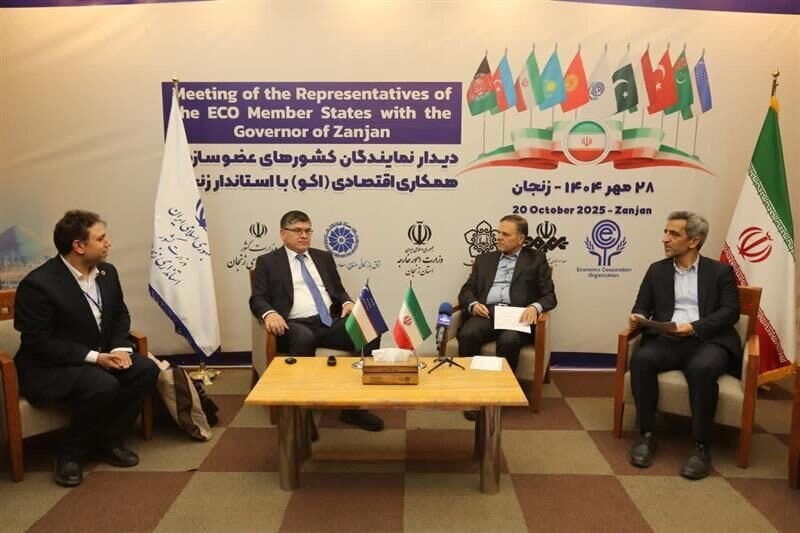
According to a report in the Tehran Times, Mr. Fariddin Nasriev made this remark on Wednesday in a meeting with the Governor of Iran’s Zanjan Province on the sidelines of the ECO Summit, where he expressed his pleasure in coming to the province, described the city of Zanjan (the center of the province) as a beautiful region with great potential for cooperation, thanked the provincial officials for their warm hospitality, and also mentioned the history of Zanjan. Cultural relations between the two countries
He said that three months ago, a trade delegation from Khorasan Razavi province visited Uzbekistan and very good talks were held between businessmen from the two countries, adding: “An official invitation to the Iranian trade delegation to visit Uzbekistan is also being prepared.”
During the meeting, the Governor of Zanjan noted the unique capabilities of Zanjan Oblast in various fields and invited the Ambassador of Uzbekistan to visit Zanjan’s industrial factories and scientific centers.
Senior officials from Iran and Uzbekistan convened in Tehran in mid-May for the 16th Joint Economic Commission between the two countries, aiming to expand bilateral relations and increase trade to $2 billion a year.
Iranian Minister of Industry, Mining and Trade Mohammad Atabak opened the talks by acknowledging that the current trade volume between the two countries is below its true potential.
He called for “fundamental change” and proposed a draft realistic roadmap to reach the $2 billion trade target.
Foreign Minister Atabak pointed out Iran’s strategic location as an important corridor connecting Uzbekistan to the high seas and stressed the need to strengthen transportation and transportation infrastructure.
He also stressed the importance of improving banking relationships, establishing direct flights, lowering customs duties and developing tools to support economic relations.
Beyond trade, the committee also discussed cooperation in tourism, science, culture and medicine.
Noting the deep cultural ties between the two countries, Foreign Minister Atabak expressed Iran’s readiness to play a greater role in the tourism sector and said the meeting would serve as a platform for comprehensive cooperation.
He expressed hope that the operational plan would lead to a “major leap forward” in bilateral relations.
In response, the Minister of Industry of Uzbekistan emphasized favorable conditions for the expansion of trade between Tehran and Tashkent.
He said the two countries had signed a list of preferential trade goods, calling it a “real step” towards boosting commercial exchanges.
He also announced the official opening of the Uzbekistan Trade Center in Tehran, which he said will boost trade. The number of joint ventures between Iran and Uzbekistan has increased 2.5 times over the past five years, reaching 261 companies. These companies operate in sectors such as construction, petrochemicals, food, agriculture, and building materials.
The Foreign Minister of Uzbekistan concluded by reaffirming his country’s commitment to expanding economic and trade cooperation with Iran in multiple areas.
On April 23, Iran’s Minister of Industry, Mining and Trade said that cooperation between the private sectors of Iran and Uzbekistan will continue at an accelerated pace.
Mohammad Atabak made the remarks at the ministry’s location in Tehran during a meeting with a trade delegation of Uzbekistan headed by the Chairman of the Chamber of Commerce and Industry of Uzbekistan (CCI).
During the meeting, the Minister emphasized that the perspectives of the private sector and entrepreneurs from both countries are being considered in the specialized working group.
He added that some goods agreed with Uzbekistan were supplied and shipped from Iran.
The Minister further said that these exchanges and exchanges at the private sector level between the two countries will continue at an accelerated pace. The economic and production capacities of Iran and Uzbekistan are sufficient to raise the current level of trade exchanges between the two countries to a higher level.
Also, during a meeting with Uzbekistan’s Deputy Minister of Industry, Trade, and Investment Shohrukh Gramov at the venue of the Iranian Chamber of Commerce, Mines, and Agriculture (ICCIMA) in Tehran on April 20, ICCIMA Director Samad Hassanzadeh said that the country’s private sector is ready to pursue joint investments in Uzbekistan, and called on Tashkent to implement reciprocal agreements. Visa waivers to facilitate travel and encourage tourism between the two countries.
He said reciprocal visa waivers will make it easier for businessmen and nationals to travel, while also supporting the development of tourism.
Hassanzadeh further said that the upcoming preferential trade agreement between Iran and Uzbekistan, which is expected to be signed at next month’s Joint Economic Committee meeting, could increase the level of bilateral trade cooperation.
He added that the current trade volume (nearly $500 million) does not reflect the true potential of both countries. “The Iranian Chamber of Commerce and Industry, as a representative of the private sector, is ready to take all necessary measures to increase trade volumes,” he said.
He stressed that the Iranian government and the private sector are committed to expanding relations with all countries, especially with neighboring countries. “Historical, religious and cultural ties can pave the way for broader economic, cultural and academic cooperation,” he said.
Hassanzadeh welcomed Uzbekistan’s move to eliminate the $400 toll for trucks, calling it a positive step towards greater cooperation along the International North-South Transport Corridor (INSTC).
The ICCIMA director further reiterated his call for Uzbekistan to lift visa requirements for Iranian nationals, noting that this would particularly support cooperation in medical tourism, medical services, and pharmaceutical production, in which Iran has strong capabilities.
Highlighting interest in investment, he said that Iran’s private sector is particularly keen to invest in Uzbekistan’s textile and garment industry. “As a representative of the private sector, the Iranian Chamber of Commerce and Industry seeks the necessary support for these investments,” he said.
Mr. Hassanzadeh concluded by expressing his hope that the bilateral trade volume would reach $1 billion through close cooperation between the two chambers of commerce.
MNA