
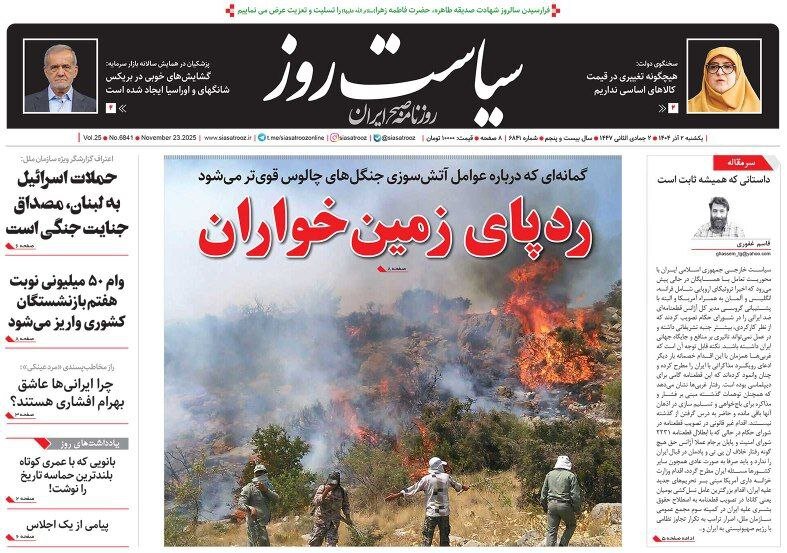
TEHRAN – Regarding the recent anti-Iranian resolution in the IAEA Board of Directors by three European countries: the United Kingdom, France, Germany (known as the E3) and the United States, Siyasat-e-Roos wrote: Despite the European Troika passing an anti-Iranian resolution in the Council with the support of IAEA Director General Grossi in cooperation with the United States, Iran’s foreign policy, centered on engagement with neighboring countries, continues to move forward.
In reality, this resolution has no impact on Iran’s interests or global standing. Notably, in parallel to this hostile move, Western governments reiterated their commitment to negotiations with Iran and presented the resolution as a diplomatic step. Their actions reveal that old fantasies of forcing concessions through a combination of pressure and negotiation still dominate their thinking, and that they are unwilling to learn from the past. But Iran’s paradigm remains consistent. We will never give in to bullying or blackmail, knowing that retreating in the face of Western irrationality will only invite new demands. As stated by Iranian officials such as Foreign Minister Araghchi, the activation of the “snapback” mechanism, and in particular the recent Council resolution, effectively ended the Cairo agreement between Iran and the IAEA. Western countries cannot undermine this paradigm of sovereignty and resilience.
Iran: regional integration is the best option
Iranian Newspaper examined the development of Iran’s neighborhood policy in an interview with Bahadur Zarei, professor of geopolitics at Tehran University. Zarei explained that the geopolitical importance of the region is now more evident than ever, as Iran’s foreign policy under the current government focuses on deepening ties with neighboring countries. If a “neighborhood policy” were to become a binding national strategy, Iran could define most of its national interests within the region. In his view, the main reason Iran lags behind its competitors in regional markets from Iraq to Central Asia is the lack of a comprehensive and durable framework for governing neighborly relations. “Local diplomacy” is a healthy means to complement neighborhood policy. Strengthening this policy must remain Iran’s consistent strategy, even if future avenues for engagement with the West are opened. In this context, the Economic Cooperation Organization (ECO), as one of Iran’s key regional assets, has the potential to serve as a regional trade engine, reduce economic costs, and create common value chains across Iran’s neighboring regions.
Resalat: Europe’s real “Black Friday”
Absolute agreement with anti-Iranian resolutions due to the lack of political independence of European countries is consistent with acceptance of humiliation in the Ukraine peace plan proposed by President Trump. This contradictory behavior occurs during a period known in the West as “Black Friday.” In Western culture, Black Friday symbolizes big sales and deep discounts. But what Europe is selling at the moment is “dignity and political independence.” This situation marks the peak of European political subordination to American interests. On the Iran issue, Europe has abandoned the means of multilateral diplomacy and joined a unilateral pressure bloc. In the Ukraine issue, the European Union accepted the conditions imposed to ensure the maintenance of US military and political support, even though Europe’s strategic interests were at risk. This performance resulted in a complete loss of credibility and dignity for Europeans on the international stage. Europe is no longer perceived as an independent, value-driven entity, but rather as an instrument subordinate to US strategy. This contradictory approach undermines the confidence of international partners and sends a message that European foreign policy lacks stability and fixed principles and is merely an offshoot of temporary US decisions.
Arman Emruz: Decoding President Trump’s Iran policy
In a commentary on President Trump’s policy toward Iran, Arman M. Emrouz writes: Recently, President Trump has repeatedly said, “We destroyed Iran’s nuclear program.” In the view of President Trump and his team, this statement is a political tool designed to simultaneously pursue three main objectives:
First, prepare the American people to accept a new agreement. If the United States is to return to negotiations with Iran, society must feel that such negotiations are not coming from a position of weakness.
Second: Creating a psychological advantage in negotiations. When President Trump publicly asserts that he believes Iran is eager for a deal and says, “I’m fully open to it. We’ll talk to them and start the process,” that statement will resonate in the world’s media and put Iran on the defensive, even if Iran has not made such a request.
Third, Trump continues to carve out his own exit strategy in all scenarios by repeating this claim. If the negotiations were successful, he could say, “Look, we broke the deal and generously agreed.” Simply put, this statement is no longer just a military assertion. It is the golden key that simultaneously opens the door to political, diplomatic, and even electoral victory, regardless of the actual damage done to Iran’s nuclear program.