
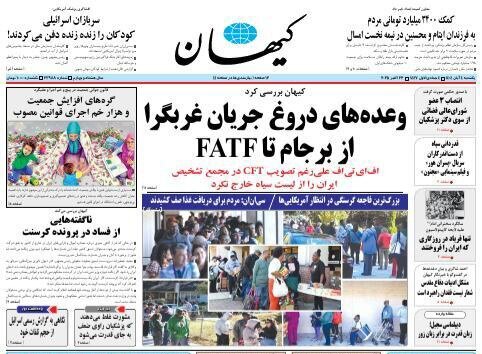
TEHRAN – Kayhan explored Iran’s national power and deterrence strategy in a recent commentary, arguing that diplomacy must go beyond mere dialogue and political exchange.
It described diplomacy as the strategic application of all elements of national power to shape global outcomes. Within the framework of the Islamic revolution, diplomacy has meaning only if it is rooted in independence, self-reliance, and homegrown strength. The commentary emphasized that Iran’s historical experience, including the imposed war (1980-88), decades of sanctions, and persistent threats from hegemonic powers, shows that lofty ideals are fragile without hard power. In this context, missile capability emerges not just as a military asset but as a symbol of national sovereignty and the basis of deterrence. The article argues that Iran’s missile arsenal is not a weapon of aggression, but a language of lasting peace. It conveys the message that the Iranian state will never engage in conflict, but will respond decisively to any act of aggression. In a world dominated by the logic of power, Iran must fight oppressive forces in its own way: through force.
Hamshafri: The war that strengthened Iran’s power
In his article, Hamshahari assessed Iran’s strategic achievements after the 12-day war started by Israel. Contrary to Western analysis and critical tone, the article argued that the war would not degrade Iran’s position. Rather, it served as a catalyst for a new consolidation of power in Tehran. The war, which has been described as a pre-emptive strike by Israel, provided an opportunity to reaffirm the need for Iran’s “external defense doctrine,” especially in the wake of the October 7 operation. The article further noted that the regional environment is prompting a reassessment of Iran’s security, military, and economic framework. In response to Israeli aggression, the government stepped up its engagement, initiated previously ineffective system-wide reforms, and strengthened the nation’s resilience.
Siasate Ruth: The End of the Road
In its latest editorial, Siyasat-e-Ruth highlighted the changing dynamics of Iranian foreign policy with the expiration of UN Security Council Resolution 2231, which confirmed the JCPOA. The termination of Resolution 2231 was officially announced, despite the persistent hostility of Western countries. This revocation was firmly supported by Russia and China. As a result, Iran’s relationship with the International Atomic Energy Agency will now be governed exclusively by the Non-Proliferation Treaty and the Standard Safeguards Protocol. Despite continued Western efforts to maintain a precarious balance of neither war nor peace through media pressure and sanctions aimed at preventing international engagement with Iran, the editorial asserts that Iran’s nuclear file has officially been normalized. According to the newspaper, the IAEA needs to realize that the days of negotiations and conditional engagement with Iran are over. Domestically, the editorial calls for a strategic shift, moving beyond past cycles of negotiations and focusing on self-reliance. The proposal calls on Iranian policymakers to leverage domestic capabilities and work with emerging powers such as BRICS and the Shanghai Cooperation Organization to position Iran in a new international order that is not dependent on Western frameworks.
Eterrat: The Complexity of Power and the Call for Inclusive Diplomacy
In a detailed analysis, Mr. Etteler examined Iran’s geopolitical posture amidst intensifying geoeconomic competition. The paper warned that recent developments regarding Iran, particularly in the Caucasus region, reflect a concerted effort to curb its strategic influence. Through diplomatic and military means, Iran must clearly declare to regional and transregional stakeholders that changing borders and encircling Iran’s geopolitical position in the Caucasus is a red line that cannot be crossed and may face harsh strategic responses. The paper advocated active diplomacy as Western countries seek to rebuild West Asia without Iran’s participation. The Iranian government needs to redefine the regional landscape by proposing a comprehensive indigenous framework for security and economic cooperation. This includes submitting a formal document of partnership to neighboring countries outlining common goals in corridor development and regional stability. Such efforts would not only strengthen Iran’s diplomatic influence, but also reduce the legitimacy of foreign interference and ease the burden of high-stakes geopolitical decisions. By pursuing a win-win regional strategy, Iran can assert its role as a stabilizing force in an increasingly fragmented global environment.
Armand et Meri: Our atomic bomb is the ability to say “no” to great powers.
Armaan Melli news agency reported on remarks by Foreign Minister Abbas Araghchi, who emphasized that Iran’s strength lies in its people. “Iran’s atomic bomb is its ability to say ‘no’ to the great powers, and this has been the case ever since the victory of the revolution,” the paper quoted the minister as saying. He added that the core issue between Iran and the US stems from America’s domineering attitude, but the relationship can still be “managed”.
In an online interview, Aragushi also described the unity of Iranians at home and abroad during the 12-day war with the Zionist regime as a “historic turning point.” Commenting on the importance of maintaining this unity, he said, “A very auspicious phenomenon that occurred was the unity of our people at home and abroad.” “The Iranian people everywhere felt the injustice directed against them. The Zionist regime had no justification for its invasion. We had committed no wrongdoing that could be excused in the slightest. Our nuclear program is completely peaceful and legitimate. We have exercised this right accurately and there have been no deviations in the production of weapons, and no such allegations have ever been reported. All of the questions that have been raised have been answered and resolved.” I recognized this innocence and legitimacy. ” Araghchi concluded: “No matter how deep our differences are in our culture, we are united when it comes to Iran, its soil and its homeland.”