
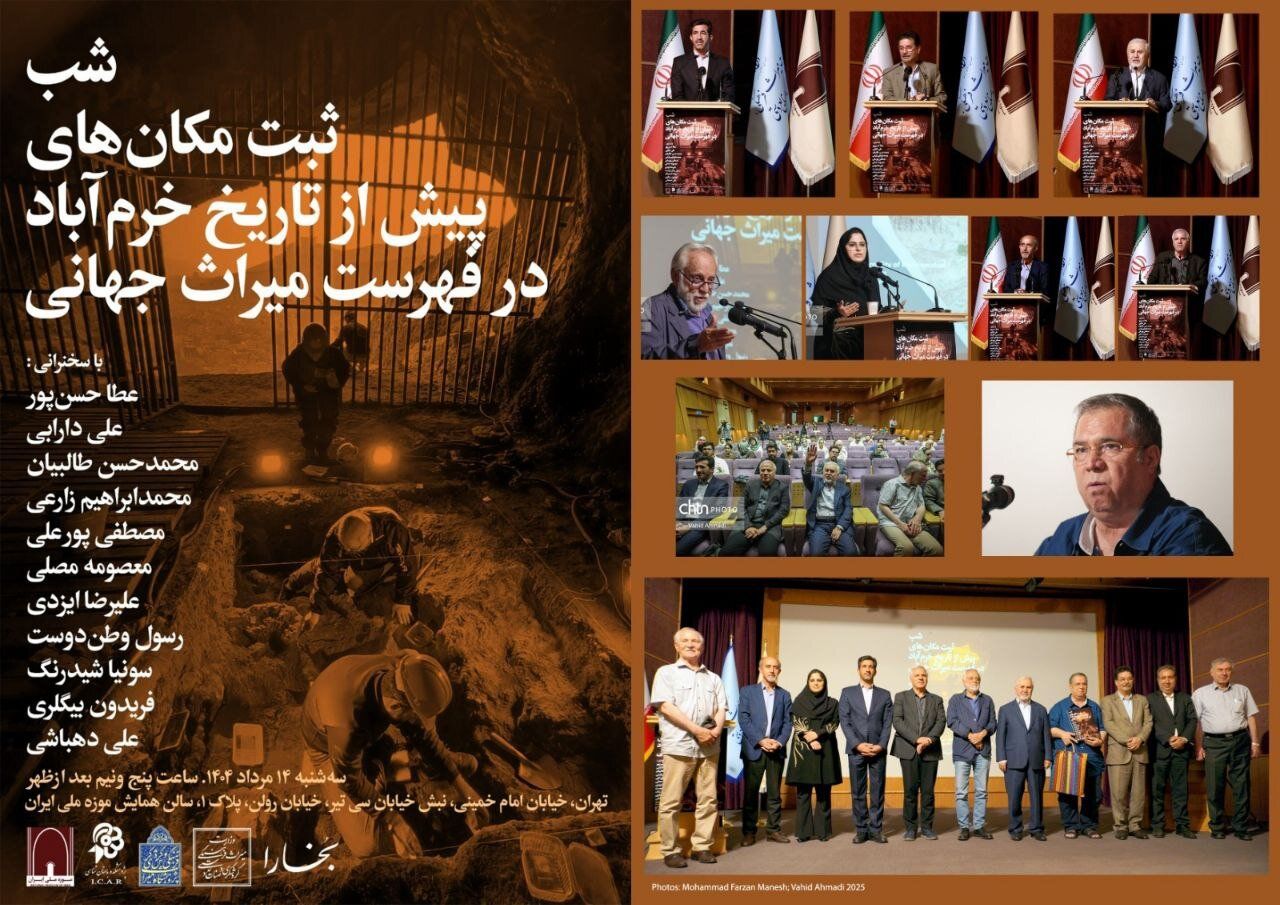
Tehran – A ceremony was held at the Iranian National Museum on Tuesday depicting the UNESCO World Heritage Site of the prehistoric site of Khorramabad Valley.
Organized as the 871st session in the Bukhara Magazine Nights series, the event attracted a large audience, including Professor Jalaleddin Rafifar (anthropologist, University of Tehran), Dr Mansour Ghorbani (President of the Iranian Geological Society), heritage enthusiasts and numerous officials.
Session Director Ali Devasi has launched the lawsuit by congratulating the Iranian people on this major cultural event. He lamented the inadequate public attention given to its importance, and emphasized the important need to explain this important outcome and its impact to the public.
The first speaker, Dr. Ata Hassanpur, was the manager of inscription papers and Director of Cultural Heritage in Laurestan, thanked all contributors. We then explained in detail the enforcement process from November 2023 onwards. Related documents were submitted to UNESCO on January 31, 2024. The “Committee to Resolving Inscription Disorders in World Heritage Sites” addressed the challenges through coordination with the Housing Foundation, Municipalities and public participation. Important actions include: cleaning of graffiti caves and relocating resident herdsmen. Building a dry stone access path. A protective gating will be installed at the entrance to the cave. Adjacent village organizations (asphallization, sewage, cultural programs); clean the walls of Farquarrak Castle of sediment and invasive plants. Established a cutting-edge prehistoric museum. 94 bilingual signs will be installed throughout the site and the citywide. And a new discovery at Ghamari Cave, led by Dr. Biglari. He highlighted the important role of public awareness in the “Khorramabad Valley World Heritage Inscription Channel” managed by Dr. Atusa Ramati and Dr. Mohammad Farzanmanesh. He was engraved on the World Heritage List during the UNESCO 47th session on July 17, 2025, during the UNESCO 47th session, becoming Iran’s oldest engraved World Heritage Site.
Deputy Minister and Vice President of Cultural Heritage Dr Ali Dharabi attributed the inscription to synergistic effects, international involvement and national commitment. “In Iran’s most important archaeological documents, the inscription of the prehistoric location of Khoramabad sends a clear message: Iran is a living, dynamic, dialogue-oriented civilization,” he said. He emphasized the scientific and cultural values of the site, referred to as the result of years of efforts by researchers, archaeologists and national/state administrators, coupled with the intellectual cooperation of related organizations. “This event transcends mere inscription. It symbolizes the prosperity of the country’s cultural capital and is a major advancement in Iran’s cultural diplomacy,” adds Dharabi, recognizing support from past and present ministers of cultural heritage, tourism and handicrafts.
Dr. Mohammad Ebrahim Zarei is the director of the Institute of Cultural Heritage (Richt) and spoke about Iran’s unique and profound historical and cultural realm. “It is a source of pride that the lesser known aspects of the land’s past – the prehistoric world, the Paleolithic age, and the early days of human life on the Iranian plateau, are now recognized worldwide through inscriptions,” he said. He pointed out that international researchers have long acknowledged the importance of such landscapes, but the world now recognizes the unparalleled value of ancient Iranian life and cultural spaces. Zarei pointed out that previous research focused primarily on the glorious historical periods (Elamite, Achaemenid, Sassanian, Seljuk, Safavid, Qajar) and others on Susa, Persepolis, Naqsh-e Jahan Square. “Now there is an opportunity to register and introduce another aspect of the cultural richness of the Iranian Heights. He described the Zagros Mountains as an important prehistoric shelter and a cradle of ancient culture. “Today, I am celebrating this inscription that was gathered at the Iranian National Museum, the most appropriate venue. I am celebrating my colleagues and my heartfelt thanks to all my states and nations who are involved in the efforts of this nation.”
Dr. Mohammad Hassan Talevian, professor and ministerial advisor at the university, discussed the technical and scientific aspects of the papers as follows: He outlined important issues. Extensive construction in cultural landscape buffer zones, herdsmen’s resistance to cave opening, and complex ICOMOS technical requirements. “The turning point was an unprecedented consensus among ministries, state governments, municipalities and the public. From cleaning up the Galar River to the release of the Faq Orua Flak Buffer Zone and the establishment of a prehistoric museum.” Talebian states that the inscription is not the end of responsibility, but the beginning of responsibility. Implementing management plans, publishing excavations, and explaining the site’s prehistoric value to the public is the next next step. “We are not fully utilizing the possibilities of world heritage. The inscription is not an endpoint, but the beginning of a cultural, social, economic and scientific process.”
University professor and ministerial advisor Dr. Rasul Vatando highlighted Iran’s historic and prehistoric sites of over a million people, highlighting its important mission to protect and promote this heritage worldwide. He emphasized that World Heritage inscriptions are not merely rituals, but rather strategic capabilities in three areas: cultural, tourism and, importantly, transforming the site into an international research hub. “This will attract global scientific attention and nurture specialized research centres. Therefore, the future priority is to transform global and national heritage sites into national and internationally effective research poles, beyond traditional conservation and tourism.” He cited the scientific discussion within the ICOMOS International Committee on Lorestan Sites (PARIS Meetings and Online). “The inscriptions in the related documents of Laurestan open a new chapter in Iranian archaeology and reveal a new perspective focusing on the unique features of the country’s ancient hills and sites.
Dr. Sonia Shidrang, a faculty member at Shahid Beheshti University and science author of related documents, states the double importance of outcomes. The UNESCOLIST site of Iran’s first paleostone subject, and the ultimate important stage during the war, has been successful, demonstrating the commitment and capabilities of the parties involved. She noted that the research history of Khorramabad Valley dates back to the late 1940s and has become one of the richest Paleolithic research areas in Southwest Asia. Its unique geological location in the Central Zagros (karst characteristics, rich water) has created a life support oasis that allows for human habitation for over 60,000 years. Dr. Shidrang emphasized that the scientific foundation of the relevant documents of UNESCO standards focuses on the Baladost culture as a distinctive feature of the Valley. The abundant evidence at sites like Yafe Cave, Kaldar and Gar Argene Rock Shelter, which were first identified in Kurdistan, Iraq, made Horamabad the focus. Important discoveries such as decorative pendants (including deer dogs) at Yafteh Cave imply modern human behavior, techniques, and complex beliefs/symbolic behaviors in early modern humans (~40,000 years ago on behalf of the Neanderians). “As the first such evidence in Iranian archaeology, it provided a solid basis for meeting UNESCO standards (III). These artifacts, along with the advanced stone industry, represent unique regional distinctions that represent exceptional testimony that extincted human cultural traditions.”
The final speaker of Dr. Fereidoun Biglari, deputy director of the Iranian National Museum, outlined the history of Iran’s Paleolithic research. He noted that Iranian archaeology, like most of Western Asia, initially focused on historical periods, with prehistoric/Paleolithic archaeology emerging quite a while later, despite more than 99% of the professional history of the plateau belonging to this period. The excavation began in 1949/1950 with western archaeologists from West Zagros (Kelmansha, Koramabad Valley). Pioneering anthropologist Henry Field first identified Paleostemic ruins in the Horamabad Valley and conducted test excavations in the Kunji Cave in 1950 to discover evidence of the late paleostemic period. Despite continuing research until the revolution, Iranian archaeologists paid poor attention. Following the post-revolutionary break, a new generation of Iranian archaeologists revived research from the Paleolithic age since the mid-1980s. “As a result, Iran is now one of two major countries in research in the Paleolithic period in Southwest Asia, a proud milestone.” Biglari praised pioneers like Frank Hall, John Space and Robert Bladewood, along with the efforts of Iranian researchers over the past 40 years. “The concrete results are the inscription of Iran’s first paleolithic-based actor (Khorramabad Valley) on the UNESCO list, and testifies to the scientific capabilities of Iranian archaeology in international research and conservation. This is a truly great victory for Iranian culture, archaeology and history.” He concluded that the province of Laurestan, which has a rich Paleolithic research history that has attracted global attention in Zagros, is also a pioneer in conservation and presentation. “At least six caves/rock shelters within the province (five fully protected) define boundaries, conservation gating, and infrastructure for ongoing research. While cave protection exists elsewhere in Iran, Lorestan holds a national status that stands out in the number of managed sites and the number of quality of conservation measures.”
morning