
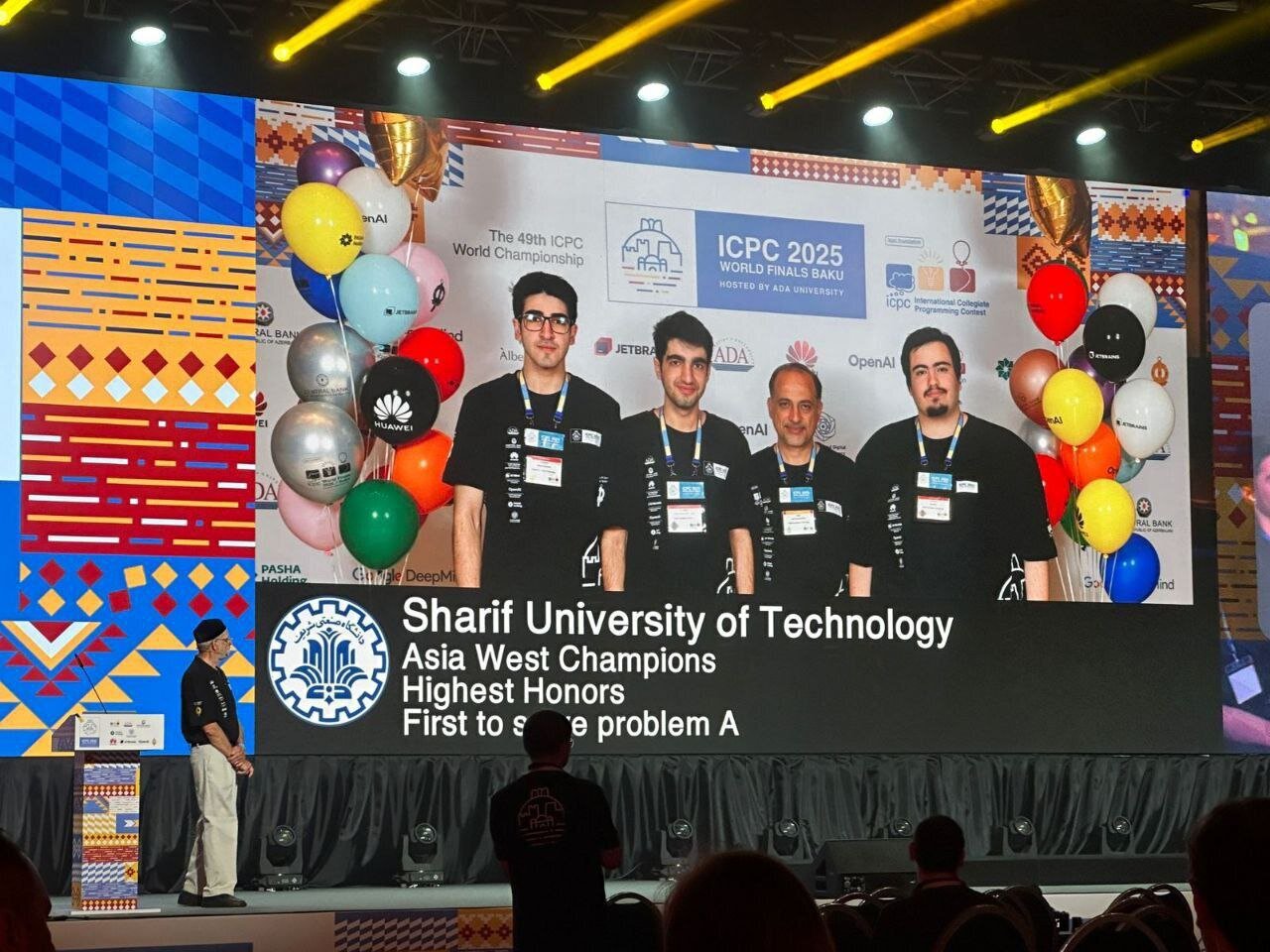
Tehran – Sharif University of Technology students are placed on top of Western Asian countries at the 49th International University Programming Contest (ICPC) 2025.
The international conference hosted by the ADA University in Baku, Azerbaijan, was held from August 31st to September 5th.
The event features 140 teams, including 73,000 students from 103 countries, representing major universities in each country.
The three-person team consists of Ali Safari, Alireza Keshavarz and Amir-Mohammad Shahrezaei. The teams that solve nine of the 12 questions are ranked 16th in the world and are among the top five teams with the highest honor. They were the first to solve one of the most difficult problems, problem A: A-Skew-Ed reasoning, Irib reported.
Sharif Institute of Technology is located ahead of many well-known universities, such as the University of Cambridge (50th), the University of California, Berkeley (33rd), the University of Illinois Urbana-Champaign University (20th), and the University of Chicago.
Due to the considerable gap, the Indian team at Chennai Mathematics Institute was ranked second in West Asia, solving seven questions. The team ranked 60th in the world.
ICPC is a global algorithm programming competition for university students. Three teams work together to solve complex, real-world problems under time constraints and test creativity, teamwork and problem-solving skills. The contest promotes computer science innovation and excellence through fierce, high levels of competition.
It began in 1970 as a local North American initiative. In 1977, they held their first Championship Round and have since evolved into a global multi-tier competition. Today, ICPC spans local and local contests around the world, leading to the annual ICPC World Final under the auspices of the ICPC Foundation.
The contest promotes excellence in algorithmic thinking, programming and teamwork by challenging students to solve real-world problems under pressure. It highlights the next generation of computing professionals through a global competition that promotes academia and industry collaboration and drives innovation and growth.
Recent results
Iranian students managed to win 13 medals (3 gold medals, 4 silver medals and 6 bronze medals) at the Innoverse International Invention & Innovation Expo, which showcases their exceptional talent in science and technology.
The US-sponsored event took place online on August 24th. Accommodation in 2025 represents more than competition. It was a field for collaboration, knowledge exchange and intellectual growth across academic and generations.
It provided inventors, researchers, students and emerging talents around the world with a renowned platform to showcase their ideas, inventions and scientific contributions.
The project includes areas such as advanced technology, artificial intelligence, social development, and environmental sustainability.
This year, a total of 177 teams from 47 countries participated in the competition, including Armenia, Bangladesh, Belgium, China, France, Chile, Iran, Iraq, Saudi Arabia, Japan, the UK, the UK, the US, Vietnam, India and Finland.
Ilia Majidzadeh Heravi, Parsa Karimi Yazdi for inventing ‘CommuniMateSmartApp: Solutions for Deaf Communication Challenges’, Artin Radmatin, Ava Alebouyeh, Baran Bahman, Elyar Ferdosizadeh, MohammadHossein Ezzati, for ‘Evaluation of the effect of using magnetic gear in improving the performance of process systems based on mechanical gear’, and Niki Abtahi, Parsa Ahmadpour Rahiminejad, Baran Derakhshandeh Daryasari, Sarina Nosrati, Ramiya Rahjou, “Improve the design of pneumatic muscles: Simulation and analysis of the dynamic behavior of systems”, bagged gold medal.
Mehran Rajabi and Alireza Jafarnezhad, for the invention of ‘EcoNet Bin: An AI-IoT Powered Smart Waste Segregation System for Efficient Recycling’, Yasin Abbasi, Ali Rahbari, Nikasadat Hosseini, Kiarash Rshidzadeh Gargari, and Eizadyar Jalali Pour, for the invention of ‘Medismart Smart Pharmacy Solutions, Palmida Salamand, Solena Salamand. “Development of nanoextracts containing herbal extracts with resistance to wear and oral bacterial attenuation,” and Matin Hayati and Matin Hayati invented automated analysis and visualization of EEG signals for seizure prediction using frequency band silver media.
Mohammad Thumbnematimoin, and Mahangadimi, “Evaluation of Gamma Aminobutyric Acid Efficiency in CACO2 Colorectal Cancer Cells,” Rodinafodechenas, Baranmoradi, “For the Preparation and Characterization of Antibacterial Biotype Packaging Based on Antibacterial Biotype Nankaididonan Compositegy with Antibacterial Biotype Nankaididonan Compositegy.” ziziphora essential oil for protein based Packaging application’, Sam Rashidi and Radin Abasi, for ‘Design and Implementation of Smart NannyBot: A Humanoid IoT-Based Robot for Remote Child Activity’, Arshia Chehrezad, Taha Tajik, for ‘Fabrication of a Hydrogel Containing Captopril and Investigation of Its Effects on Oral Ulcers in Type 2 Diabetic Rats’, Raman Nafarieh, for ‘Evaluation A novel herbal nanogel preparation of skin cancer cells using the MTT assay, and a safe bronze medal for Moeid Rajabi and Helena Rajabi’s “Protect the Curious Little Little Mind: A Smart Child Safety Solution with IoT and Image Processing.”