
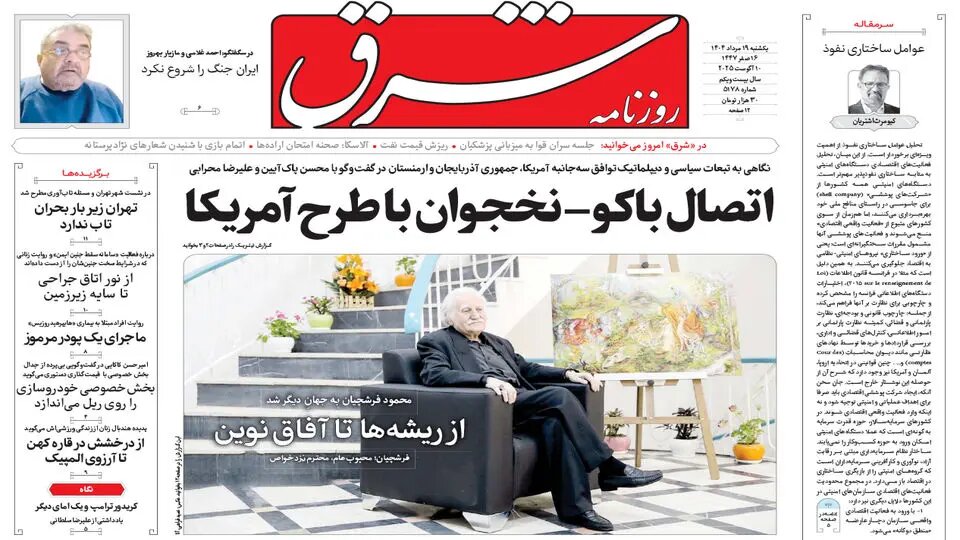
TEHRAN – In a memo, Sharg discussed the Zangezur corridor in a new name on Friday’s agreement between Armenia and the Republic of Azerbaijan.
It writes: From an Iranian perspective, transportation routes that can strengthen north-south connections and create opportunities for trade and transportation are potentially positive. The Armenian Prime Minister also explicitly emphasized the importance of railway relations with Iran, and even mentioned the role of Iranian companies in Armenia’s road and railway projects. This could make Iran one of the main beneficiaries of the project in an optimistic scenario. However, US involvement in the project has prevented Iran from seeing it as an opportunity. For Iran, the agreement represents a complex equation and provides economic opportunities while simultaneously poses security challenges. In this situation, we maintain an analytical approach, strengthen our active diplomatic presence, and utilize regional multilateral forms such as “3+3” (3+3 refers to three southern white countries involving three southern white countries – Armenia, Azerbaijan, Georgia, and three large neighbours were able to prevent the best neighbour, Russia, the Turkish, as Tehran was marginalized by the development of the Caucasus.
Vatan-e-Emrooz: The Nobel of Betrayal
In the analysis, Vatan-E-Emrooz condemned the online remarks by Nobel Peace Prize winner Narges Mohammadi. Narju Mohammadi’s speech at the Nobel Peace Centre’s annual conference is a new example of the functioning of international organizations in US and Western strategies against Iran. Almost two months after the US and Zionist regimes attacked Iran, Narju Mohammadi spoke about the need to put an end to Iran’s peaceful nuclear program. That’s what Trump and three European countries are looking for now. Her speech was exactly what Trump and Netanyahu expected to hear from within Iran, and she acted in line with the plans of the US and Zionist regimes against Iran. Mohammadi’s speech is a clear example of betrayal in his hometown. Furthermore, she actually encourages her enemies to attack Iran again. Iran is currently at war. One of the key requirements of this situation is to clearly stand up to internal betrayal. Dealing with enemy elements and agents seems to be the highest demand and hope of people.
Etemad: Return to negotiations? !
In an interview with the Etemad newspaper, international affairs expert Rahman Ghahremanpour is considering alleged reports by Western media and the US after the 12-day war in June. He said: Based on information received from multiple sources, reports on the possibility of resuming negotiations between Iran and the United States appear to be true, with Iran having decided to go back to the negotiation table to maintain its diplomatic path and prevent the channels of dialogue from being shut down. The decision was probably made to alleviate tensions and create a national security, especially given concerns about the possibility of escalating tensions. However, it remains to be seen whether the US will agree to Iran’s assumptions and proposals. It suggests that negotiations will begin soon, but given the deep differences in Iran’s serious mistrust of Washington after the 12-day war, we cannot be optimistic about the success of the negotiations. The current conditions for reaching an agreement seem far more difficult compared to the 12-day pre-war period.
Khorasan: First Test of the Supreme Defense Council. Caucasus and Lebanon
In the article, Khorasan dealt with a serious test of Iran’s highest defense council on development in Lebanon and the South Caucasus region. It writes: The less-than-note fact is the establishment of Iran’s Supreme Defence Council, an institution expected to play an analytical and guiding role amid the local crisis. The issue of Zangezur in the Caucasus and Hezbollah Disarmament Project has become two serious tests by the Council at the start of its work. Adopting the right strategies in these two cases can change the balance. If Iran can take initiatives from the Americans in both respects, it will not only increase authority in the region, but will manifest in full hands in the face of political and economic pressures from the West. Of course, decisions in these areas certainly come with great strategic risks and the potential for security conflicts. “Analysts believe that if our impact decreases in the Caucasus and Lebanon, the resulting shift could enhance strategic security in Tehran and provide updated leverage that in both regional dynamics and international negotiations.