
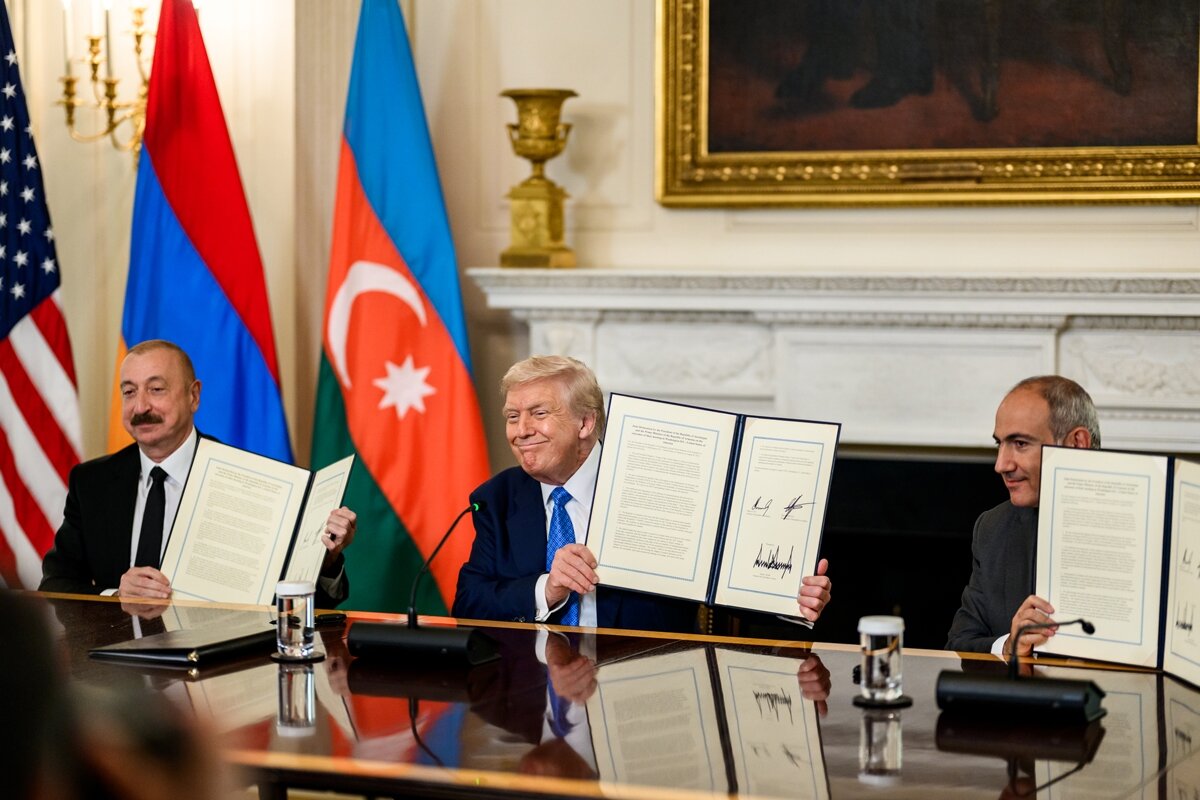
Tehran – The so-called Zanjur Corridor has emerged as an international geopolitical issue with widespread significance following the 2020 Nagorno-Karabakh conflict.
Some observers believe Azerbaijani President Ilham Aliyev is unhappy with his attempts to fully incorporate the region and have tried to advance his agenda by attracting major international players, including the US. Between 2020 and August 2025, Aliyev released two positive claims regarding Armenia’s internationally recognized territory. The first labelled Armenian Sinik province as “Western Azerbaijan”, and secondly, demanded a “return” of around 500,000 people from the Azerbaijani people.
Initially, Aliyev pursued a strategy focused on integrating Syunik into Azerbaijan. However, this approach was eventually removed due to strong opposition from Iran and lack of support from Russia and the US. The inclusion of Article 5 of recent agreements that refer to the 1991 Almaata Declaration and confirm that it respects the territorial integrity of a nation and the inviolability of international boundaries represents a major change. The Almaata Declaration established the basis for recognizing the boundaries of the post-Soviet state based on the former Soviet administrative division.
From an international legal perspective, this reference demonstrates mutual acceptance by Armenia and Azerbaijan of existing border boundaries, effectively ending further territorial claims. On the surface, this appears to be beneficial to Iran. This is because it could prevent border instability along the northwest border and reduce the possibility of conflict in the broader region. However, more detailed legal and strategic analysis reveals potential complications, particularly during the boundary separating stages on the map and subsequent ground boundary stages. Therefore, certain aspects of the contract require a thorough investigation given the risks that could be brought to Iran’s access and security benefits.
The central issues surrounding the issue of Zangezur include Iran’s involvement as a third party in negotiations between Armenia and Azerbaijan, or its potential objections, and legal basis. The core issues are: If both countries are negotiating issues affecting Iran’s “critical interests,” will international law allow Tehran to intervene, express concern, or oppose the outcome? Furthermore, if the current government of Armenia under Prime Minister Pashinyan is granted some of its sovereignty or pressured on treaties transferring territory, does Iran have legal measures to challenge or influence such agreements? And how are these legal tools interpreted in light of changes in the geopolitical landscape of a region?
International law generally recognizes that if a third state’s important interests or established rights may be affected by a bilateral treaty or negotiation, that state has the right to express its views, challenge it, and engage in limited intervention. This right is derived from established legal principles, but certain scope and terminology may vary depending on the details of each case.
Principles of non-binding effects on third states
The basic principle is that an international agreement cannot be imposed on a third state without an explicit agreement. This is described in Article 34 of the 1969 Vienna Convention on the Law of Treaty.
This principle, derived from Roman law, prevents the contract from hindering the binding or interest of parties that are not involved.
Right to objection by third state
When two states negotiate issues that directly affect the territorial integrity, security, or other important interests of a third state, the third state has the right to formally oppose it and assert that the concerns will be addressed in a bilateral agreement. This right comes mainly from diplomatic practices, customary international law and established legal doctrines. Although not expressly defined in treaty law, it is consistently endorsed by international courts and arbitration courts.
Legally, this right flows from the principle that a treaty cannot bind a third state without consent, and generally allows a third party to prevent enforcement of the treaty or its specific provisions against its will. This right is usually exercised during treaty negotiations or the formation of customary international norms. In fact, a third state, such as Iran, allows it to express its opposition through diplomatic channels, formal protests, raise issues in international organizations, or even pursue legal action. If the proposed implementation of the Zangezur corridor threatens Iran’s northern border security, disrupts Iran and the Almunia-Georgia transport corridor, or changes the geopolitical balance of the South Caucasus, Iran can call this right fully.
Essential Party Principles
If a dispute is resolved between two states, then it will inevitably involve determining the rights and interests of a third state, that third state must be included as a party to the suit. Without participation, the award will be deemed invalid. The rise in multilateral disputes and the growth of international courts and courts have strengthened this principle, which is reflected in the International Court of Justice (ICJ) case law.
In particular, the 1995 East Timor Incident reaffirmed the need for the existence of a “essential party.” Under this rule, any dispute that substantially affects the legal interests of a third state requires state involvement in the settlement process. Without that inclusion, we cannot make a valid judgment.
For example, if an agreement on the issue of Zangezur is reached without Iran’s participation and there is a direct security, economic, or legal impact that is detrimental to Iran, Tehran could invoke this principle to challenge the validity of the inclusion of contracts and demands in future negotiations.
Doctrine of conditional rights for intervention
While state interventions in domestic affairs are generally prohibited under international law, diplomatic measures or formal expressions of concern may be justified in order to protect important national interests, particularly when agreements between other states threaten those interests. Although not explicitly codified, this doctrine is recognized in legal scholarships and state practices, allowing the state to assume diplomatic or non-military action when important interests are at stake.
For example, if the establishment of a Zangezur corridor involves military or territorial changes that benefit third parties, the affected state can protect its interests by manipulating borders, issuing warnings, or calling local mechanisms.
Principles of fairness
Under international law, fairness serves as a supplementary and interpretive principle and is designed to ensure fairness in certain circumstances. The ICJ specifically applies this principle when it includes disputes over maritime boundaries, shared resources, and certain tripartite disputes. It is expressly referenced in section 38 of the law of the court.
For Iran, calling the principle of fairness is legally justified – not as a basis for military intervention, but as a legitimate basis for participation in negotiations, exercise of diplomatic and legal objections, and even filing complaints before international organizations. Several factors support this trust:
(a) Length and effectiveness of shared boundaries: Iran shares more than 40km of borders with the Zanjur region, including Southern Armenia and Naktiban. Geopolitical changes in the region directly affect Iran’s national security and the trade and transport corridors.
(b) Principles of Direct Effect: This basic rule determines who is entitled to intervene in issues that affect their destiny. Under fair and established legal precedents, conditions that suffer concrete and direct harm from negotiations between the other two states must be granted the right to comment and participate in the formation of the outcome, particularly if the contract establishes a new legal status for that state. This principle underpins more specific doctrines, such as the right to conditional intervention.
(c) Prohibition of unfair exclusion: Despite the important interests on the Zangezur corridor, all related negotiations violate international fairness, excluding Iran. The removal of actors is most geopolitical exposure to issues from the decision-making process contradicts the core principles of international justice.
Principles of sincerity
The principle of good faith is engraved in Article 2 of the UN Charter and Article 26 of the Vienna Convention Act. This is the fundamental requirement for interpreting the treaty, conduct of negotiations, exercise of legal rights, and even calling for self-defense.
Conversely, conduct that is superficial, deceptive, manipulative, or contrary to the true purpose of a legal provision constitutes maliciousness. Excluding only the states that share a direct border with Sheenik from negotiations with strategic changes to the northern border. It will take office in a violation of its obligation to negotiate in good faith, particularly if the treaty is structured to prevent Iran from monitoring or impacting the process. This is especially bad when treaties are used in a means to achieve geopolitical containment.
Conclusion
The Iranian approach is based on the principle that opening transport routes should not be at the expense of blocking Iran’s own communication and transport corridors, as Baku argues. Baku employs a variety of strategies at different levels to advance their goals. After an attempt to annex Syunik failed, Azerbaijan appears to have eased that approach. The so-called “Trump Road” agreement does not mention “corridors.” This was not a term of office under the Moscow Agreement on November 9th, but some of the latter provisions were subject to misconceptions.
Overall, peace plans that claim to resolve allegations of transport cannot logically result in obstruction of Iran’s communication routes. Such consequences violate the principle of good faith. Therefore, the state of a third party with a vested interest retains the right to objection and intervention, particularly when there is a basis for suspecting that the agreement is being misused for geopolitical containment.
Salar Seyfodini is a PhD expert in the South Caucasus. in geopolitics from Tarbiat Modares University.