
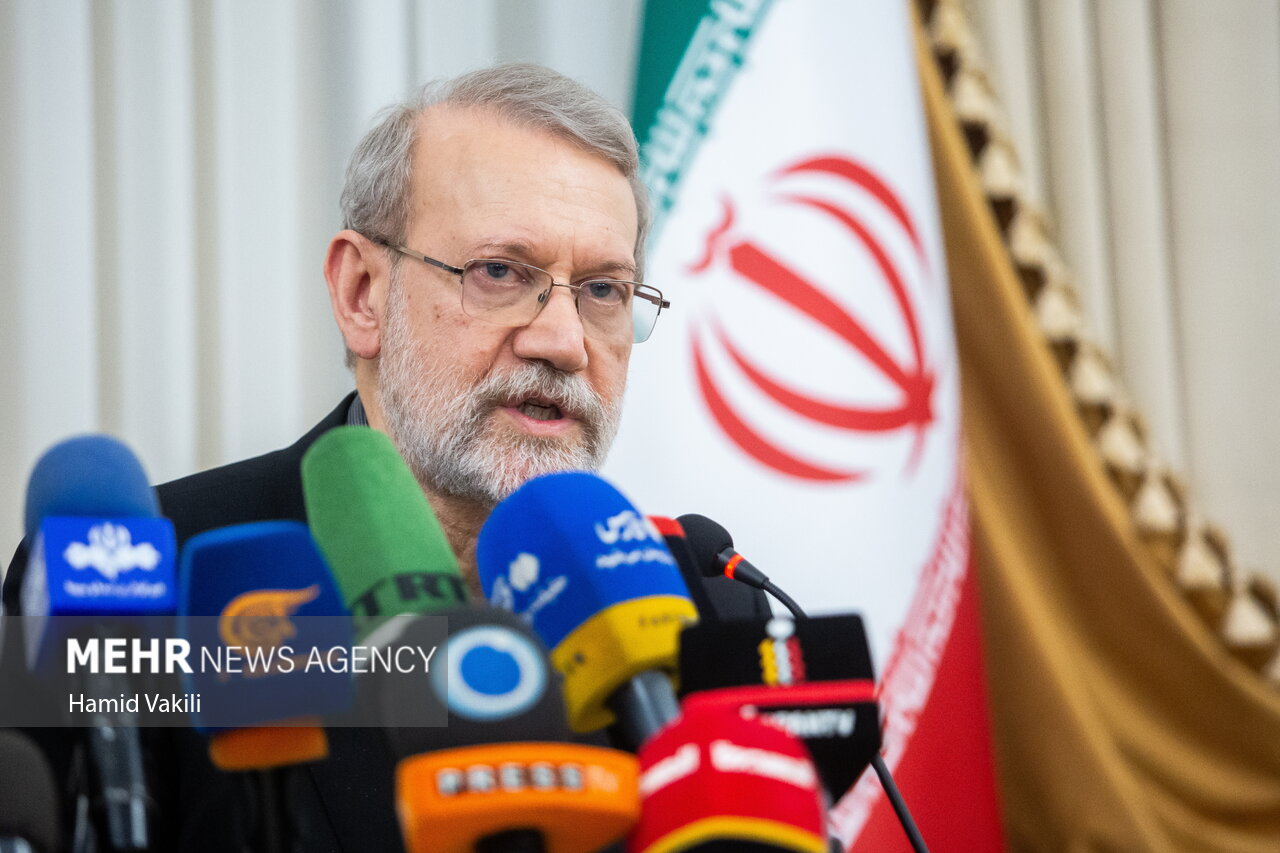
Ali Larijani, Secretary of Iran’s Supreme Council for National Security, speaking at the “We and the West in the Thought of the Supreme Leader” conference, said that to understand Iran’s relationship with the West, it is necessary to consider the West’s approach, which often seeks peace through force. He criticized historical Western actions, stating that the result of Western rationalism was world war and that current developments reflected what he described as a period of instability.
Larijani divided Iran’s relations with the West into five historical periods. In ancient times, Iran was a dominant power, maintaining independence from the West and influencing Greek philosophical thought. During the Safavid era, Iran was able to balance its power against the West by relying on science, religion, and intellectual thought. However, he pointed out that during the Qajar era, Iran became highly dependent on other countries due to the ruler’s desire to maintain authority. This dependence worsened under the Pahlavi dynasty, when Iran lost its independence and Western powers such as the United States and Britain took control of the country’s political, economic, and cultural structures. He cited the 1953 coup d’état (Mordado 28) as an example of Western domination.
President Larijani praised the leaders of the Islamic Revolution, including Imam Khomeini and Seyyed Ali Khamenei, for restoring Iran’s dignity through science and religion. He emphasized that even after the revolution, Iran continues to engage economically with Western countries, but it still prioritizes its national interests over unconditional cooperation from Western countries.
Iranian officials have made it clear that the Iranian leadership is not opposed to economic cooperation with the West, but rejects Western interference with its missile program and nuclear capabilities. He further stressed that Iran opposes cultural aggression and reiterated the leadership’s position of resisting attempts at cultural domination.
Larijani stressed that today it is clear that the nuclear issue was never a real concern, but only a pretext for hostility. “Now they’re discussing missiles and their range and Iran’s regional role, but why should that concern them? This approach shows that America and the West are seeking hegemony.”
He contrasted two approaches in international relations. One seeks power and dominance even with Eastern powers like China, and the other seeks balanced and fair relations. “Iran is not a master, nor is it a country that will succumb to empty threats,” Larijani stressed.
Commenting on the aftermath of the Israeli attack, Larijani said, “The people and the military stood firm against the Israeli regime’s brutal aggression and turned the tide. Never before in history has Israel been so widely despised by the world. Today, global resentment against the United States has increased thousands of times.” He stressed that the only path to victory against such threats is through national unity.
Referring to the US call for negotiations, Larijani questioned: “Wasn’t Iran already involved in the talks? So why did the US president betray Iran and attack during the negotiations? Now President Trump shamelessly admits that he played a key role in the attack.” He stressed that while the first three days of the conflict were particularly critical, the leaders’ strategic guidance, direct communication with field commanders, and attention to people’s needs changed the course of events.
On June 13, Israel launched an unprovoked war against Iran, assassinating numerous senior military commanders, nuclear scientists, and civilians.
More than a week later, the United States also entered the war by bombing three Iranian nuclear facilities, in serious violation of the United Nations Charter, international law, and the Treaty on the Non-Proliferation of Nuclear Weapons (NPT).
On June 24, Iran successfully thwarted an illegal attack through successful retaliatory operations against both the Israeli regime and the United States.
Speaking at the White House on Thursday night, President Trump appeared to take full responsibility for what Washington had previously called Israel’s exclusive actions.
“Israel attacked first. That attack was very powerful. I was in charge of it,” he said.
Since the invasion, President Trump has repeatedly taken credit for the outcome, claiming that the United States had “completely eliminated” Iran’s nuclear program. His comments Thursday went further, suggesting he had been plotting the war all along.
US President Donrad Trump has long campaigned as a “peace” candidate, arguing that he opposes starting new wars.
MNA/ISN1404081911681