
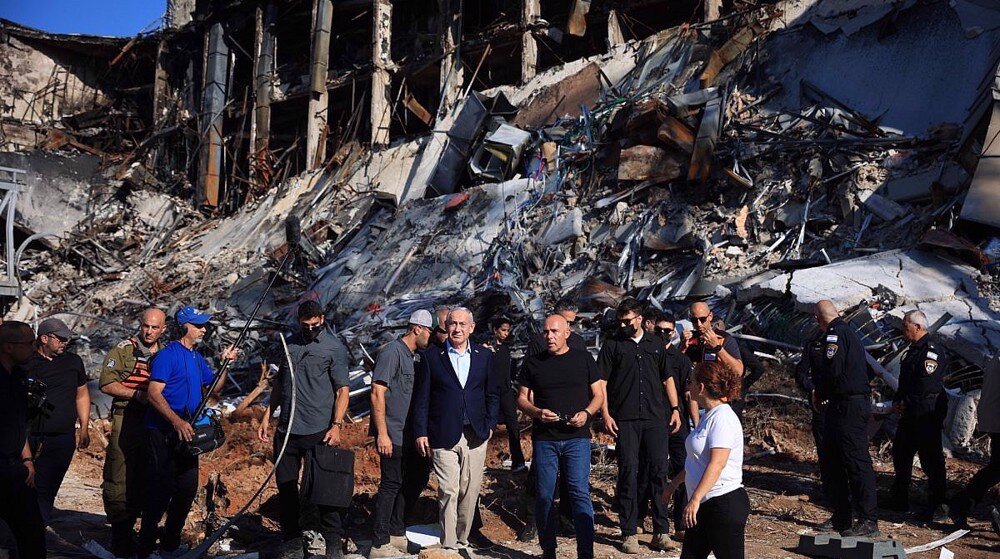
Speaking at a local event in Jiroft, Kerman province, Brigadier General Fatullah Jafari said late last week that “the true scale of the damage inflicted by the Zionist regime has not been announced.”
“The damage was far greater than official accounts indicated, with operational capacity and infrastructure destroyed,” it added.
On June 13, the Israeli regime committed an illegal act of aggression, assassinating senior commanders, nuclear scientists, and civilians. Within 24 hours, Iran counterattacked with a barrage of missiles and drones, then escalated its operations under an operation known as “True Promise III.”
The United States intervened on June 22, attacking three Iranian nuclear facilities in a blatant violation of international law. In self-defense, Iran targeted Qatar’s al-Udeid Air Base, the largest US military installation in West Asia. On June 24, the Israeli government was forced to unilaterally accept a cease-fire agreement.
“The enemy believed that after years of secret planning, they could catch Iran by surprise, but the presence of the people, the leadership of the Islamic Revolution, the spirit of volunteerism, and the country’s defense preparedness overrode all calculations of Israel and the United States,” Jafari added.
He noted that the U.S. and Israeli regimes had conducted a decade of intelligence operations to prepare their populations to take to the streets in the wake of the invasion, but that their presence was “the exact opposite of what the enemy had imagined.”
The adviser also reminded that the “betrayal” invasion by the United States and Israel occurred while Tehran was engaged in indirect negotiations with the United States over its peaceful nuclear program.
After the assassination of a senior Iranian commander, the Israeli regime did not expect Iran to be able to manage a retaliatory operation, he said, but noted that relying on a younger generation of troops and the country’s missile force resulted in a strong response.
The remarks came amid Israel’s military censorship law, which limits the release of sensitive security information, especially during active conflict.
However, data examined by Oregon State University researchers in early July showed that Iranian missiles hit five Israeli military sites during the war.
The Telegraph reported that six missiles hit targets in the northern, central and southern occupied territories. It also contained an intelligence center and a logistics base.
Radar images revealed damage from an explosion consistent with a missile attack. However, these attacks were never disclosed by the Israeli military.
At the same time, Israeli officials acknowledged that Iran’s response had cost the regime huge economic losses. In late August, Ynet quoted tax authorities as saying the damage had “reached record levels.” More than 53,599 claims were filed in just 12 days.
The Weizmann Institute of Science, which is associated with Mossad, was heavily damaged. Companies will be closed for a long period of time. Officials warned that indirect losses would be much higher.
“Direct damages are currently estimated at more than NIS 4 billion ($1.1 billion), and indirect damages have not yet been calculated, but are likely to be in the billions more,” said Shay Aharonovitch, head of the tax authority.
MNA/Press TV