
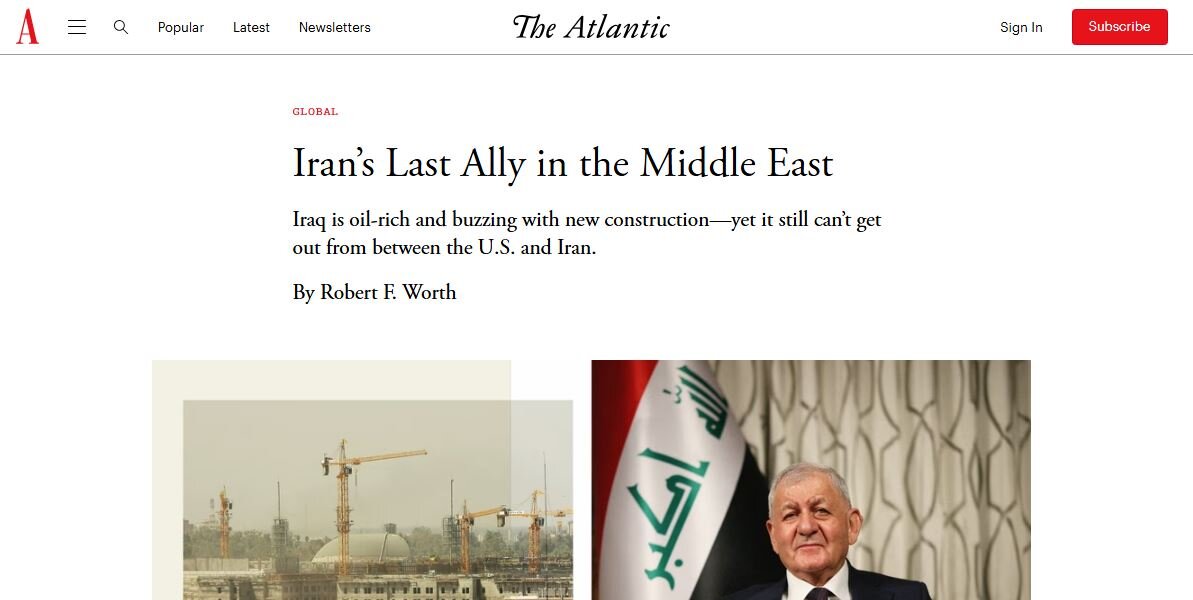
Western analyzes of Iraq are often based on the assumption that Iranian influence will inevitably erode national sovereignty and contribute to destabilization.
Recent commentaries, including from Robert F. Wirth in The Atlantic, continue to portray Iraq’s current stability as fragile and Iran’s involvement as inherently harmful. However, such interpretations rely on inaccurate assumptions about Iran policy and overlook the changing dynamics of the post-2014 regional order.
Evidence suggests that Iran’s involvement contributed in several ways to Iraq’s stabilization, reconstruction, and prevention of state collapse during the conflict with ISIS.
Rather than viewing Baghdad as a subordinate actor within Tehran’s sphere of influence, it may be more accurate to conceptualize the “axis of resistance” as a regional security framework that has emerged in response to decades of foreign intervention, sanctions, and regime change policies. In this context, Iraq’s Popular Mobilization Forces (PMF), often described as an “Iranian-backed militia,” constitute a legally recognized component of Iraq’s security architecture.
The PMF was established under parliamentary authority and has played an important role in maintaining internal security. The simplistic portrayal of the PMF as an instrument of foreign control obscures the institutional integration of the PMF and the broader process of post-conflict national integration in Iraq.
Understanding Iran’s policy in Iraq requires attention to the historical and strategic factors that shape the regional outlook. The Iran-Iraq war, the US invasion of Iraq in 2003, and the rise of ISIS in 2014 reinforced Iran’s perception that instability in its neighbors poses a direct threat to its security. Iran’s involvement in Iraq could therefore be interpreted as an extension of the “forward defense” doctrine, which emphasizes the interdependence of Iranian and Iraqi stability.
During the 2014 ISIS attack, Iran quickly deployed military advisors and coordinated with Iraq to complement, and in some cases precede, United Nations efforts. Iranian assistance helped defend Baghdad and other major urban centers and prevented the possible collapse of the Iraqi state. Created during this period of crisis, the PMF has since evolved into a formal component of Iraq’s security system, with a regularized pay structure, parliamentary oversight, and increased political participation by the leadership. Continuing to portray the PMF as a foreign agent often fails to recognize these developments.
Characterizing Iraq as a client state of Iran overlooks the complexities of sovereignty in a multipolar regional environment. Iraq pursues a policy of balancing its relations with Washington and Iran, positioning itself as an intermediary rather than an extension of either power. Baghdad’s promotion of Saudi-Iranian talks, cooperation with Turkey on border issues, and engagement with both Russia and the United States in counterterrorism operations demonstrate this pragmatic approach.
On the economic front, deepening ties between Iraq and Iran, particularly in the energy, trade, and infrastructure sectors, have contributed to securing domestic supplies and fostering regional interdependence. These developments have been shaped not only by shared geography but also by the constraints of international sanctions. U.S. restrictions on dollar transactions and financial transfers have complicated Iraq’s ability to import Iranian gas and electricity, forcing both countries to adopt alternative mechanisms such as barter and local currency transactions. These arrangements should be understood not as indicators of dependence or corruption, but as adaptation strategies within a constrained global financial environment.
Although the Axis of Resistance is often portrayed as an expansionist network, it can also be seen as a defensive coalition aimed at deterring outside intervention and preventing a resurgence of extremist threats. Coordination between Iranian and Iraqi actors has reduced cross-border insurgent activity and limited the reach of terrorist organizations. Although Western analysts often frame this cooperation as “Iranian expansionism,” it can alternatively be conceptualized as a regional security mechanism based on deterrence and interdependence.
Although US sanctions are often justified as a measure of accountability, they have had a significant economic impact on Iraq. Restrictions on dollar access and imports from Iran have disrupted some of Iraq’s financial stability and contributed to inflationary pressures.
Reevaluating Iran’s role in Iraq therefore requires moving beyond the binary of control versus autonomy. The relationship between the two countries reflects a pragmatic calculation based on geography, common security interests, and economic necessity. A stable and sovereign Iraq serves Iran’s strategic interests as well as Iran’s own. Iran’s involvement should therefore be analyzed within the broader context of regional restructuring and the gradual emergence of indigenous security regimes. Rather than viewing Iran’s involvement as inherently eroding sovereignty, it may be more productive to view it as part of an evolving regional order in which West Asian states increasingly control their own security and development.
The Iran-Iraq partnership, although not without tensions, exemplifies the shift towards regional autonomy and collective resilience in post-U.S.-centrism in West Asia.