
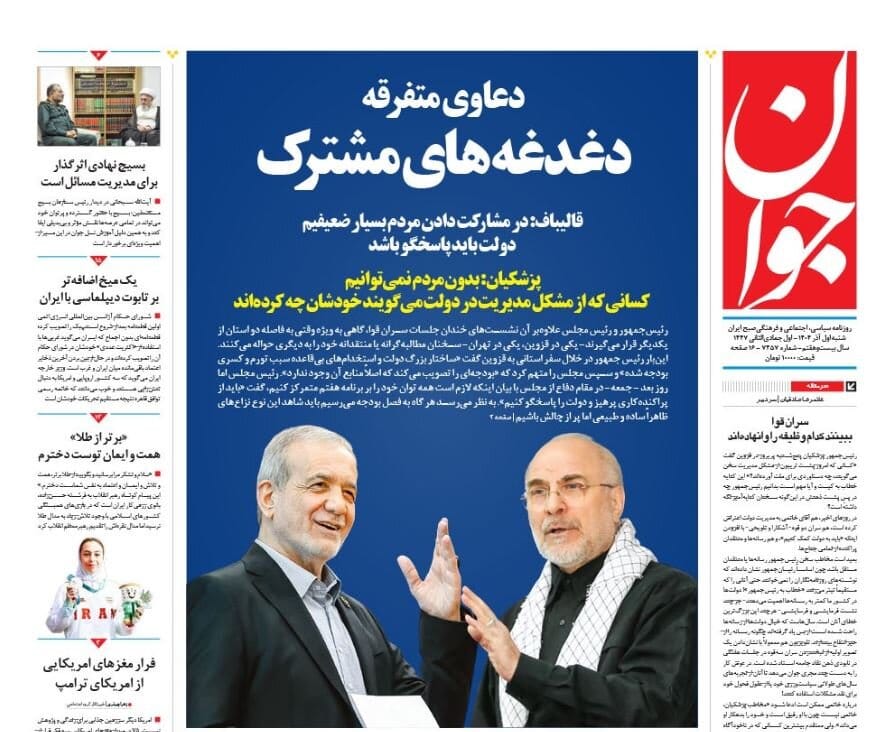
TEHRAN – Iraq’s parliamentary elections held under extremely delicate circumstances were described by the Javanese newspaper as a strategic defeat for the United States and Israel.
Although the elections took place amid threats from the Israeli regime and intense pressure from Washington, the results revealed a decisive shift in Iraq’s political situation. According to the paper, plans aimed at containing Iranian influence in Iraq have completely collapsed. Prime Minister Benjamin Netanyahu’s vision for a “new Middle East” and the United States’ attempts to reassert its dominance in the region now face formidable obstacles. Israel has openly declared Iraq to be its “next front” after Gaza and Lebanon, and Prime Minister Benjamin Netanyahu has repeatedly insisted that “Iran’s influence in Iraq must be cut off.” Instead, Iraq now confronts the reality that resistance groups are gaining legal, parliamentary, and popular legitimacy. A widespread propaganda campaign against Iran’s role in Iraq backfired, with parties aligned with Tehran gaining significant public support. When Israeli leaders consistently repeated that “after Gaza and Lebanon, Iraq is next,” Iraqis understood that their fate was intertwined with that of Gaza, Beirut, Sanaa, and Tehran. This collective consciousness weakened pro-Western and pro-American currents and steered votes toward resistance-oriented groups.
Kayhan: 22 years of talks and clear results for Iran
In his memo, Kayhan reflected on Iran’s approach to negotiations with the United States. The paper argued that for the Islamic Republic, the decision to engage in dialogue with Washington was neither emotional nor temporary, but rather the product of a long and turbulent experience spanning more than two decades. Over the past 22 years, Iran has endured extensive pressure from the United States, including unprecedented sanctions, the assassination of its nuclear scientists, repeated sabotage of its nuclear facilities, military attacks, and even a 12-day war. The article claimed that US President Trump tried to spread the false narrative that “Iran wants a deal” to cover up his own failures. Indeed, Iran today occupies a position of strength, stability, and deterrence without the need for negotiations that undermine its sovereignty. Kayhan stressed that while it was the United States that abandoned talks and resorted to invasion, Iran stood firm with resilience and integrity. This firmness has become clear to the international community, which recognizes that Iran is not a party seeking concessions, but rather a party defending its independence from external pressure.
Hamshafri: “There is no reason for Iran to abide by the Cairo deal”
Hamshahari investigated violations of the Cairo Agreement related to inspections of Iranian nuclear facilities by Western powers and the International Atomic Energy Agency (IAEA). Following attacks on Iranian territory, the Iranian government signed the Cairo Agreement with the IAEA, restarting the path to dialogue. However, the European troika, the United States, and the IAEA have demonstrated that they approach international affairs with political motives rather than legal principles. The paper argued that the IAEA functions as the enforcement arm of Western countries and that political agendas overshadow international law. From this perspective, once the deal loses its legal basis and becomes politicized, there is no reason for Iran to continue complying with it. Prime Minister Hamshahari concluded that the credibility of the Cairo accord had been undermined and that Iran could not be expected to abide by its terms if other countries abandoned the legal and technical framework in favor of political maneuvering.
Ham Mihan: “War is ruled out for now”
Ham Mihan assessed the possibility of a war between Iran and Israel with the support of the United States. The paper quoted international relations scholar Ali Bigdeli as saying that under the current circumstances, the possibility of a recurrence of the conflict is low. The United States is embroiled in the fallout from wars in Gaza and Ukraine and tensions with Venezuela, and has little remaining ability to confront Iran militarily. Furthermore, Washington views instability in the Middle East as contrary to its economic interests. Some political and media circles have expressed concerns about war, but these are in line with specific objectives. The upcoming UN Security Council meeting will be critical for Iran, as new punitive resolutions could bring further threats and restrictions. Foreign Minister Ham Mihan stressed that Iran needs to seek common ground with Europe to avoid undesirable outcomes. Observations show that Iran does not like continued conflict with the United States and insists that its rights should be recognized. This increased flexibility indicates that Iran and the United States are holding a secret dialogue, as all parties know that the current situation will not continue indefinitely. Meanwhile, Iran is facing a serious economic crisis. On the other hand, the United States views instability in the Middle East as inconsistent with its strategic objectives. Both sides will therefore be forced to find ways to negotiate, even informally. The paper concluded that while war is not imminent, neither Iran nor the United States can withstand prolonged escalation under current circumstances, and careful diplomacy is needed to preserve the fragile balance.