
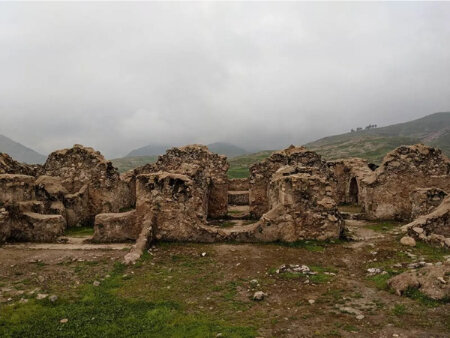
TEHRAN — Iran’s Iron Age is more than just a historical era. It is a story of life, migration and art spanning thousands of years, preserved in cemeteries and ancient ruins from Zagros to the north of the country, and revived today through scientific exploration.
Announcing this, prehistoric archeology expert Habibollah Mahmoudian told ISNA that archaeologists have named the period from 1500 BC to 500 BC the Iron Age, and Iron Age I covers the period from 1450 BC to 1100 BC.
Based on archaeological discoveries, many ruins, cemeteries and ancient ruins in Iran were settled during this period, he added.
He noted that Western archaeologist Eric Schmidt led a delegation from the American-Iranian Institute of Archeology and Art to explore and excavate the Rumeshkan and Seymale valleys in 1934-1935 and 1938. “He intended to obtain detailed information about the cemeteries of Lorestan, and this delegation succeeded in discovering a tomb containing bronze attributed to Lorestan Bronze in Hatunban, Lorestan. He also made important discoveries in the Soruk Dom area of Lorestan.”
Mahmoudian explained that archaeologist Oral Stein was able to discover the Hasanlu and Dinka Tepe settlements between 1931 and 1935. Zioi Tepe was also investigated by archaeologist Burton Brown, and artifacts belonging to the Iron Age I and II were discovered at this ancient site, he added.
“During the excavations of Ganj Tappe in 1950, they managed to discover an Iron Age settlement in this area. This site was also excavated in 1954 by Belgian archaeologist Louis Vanden Berghe, and the Belgian delegation successfully excavated and investigated 14 tombs this season. The archaeological discoveries of this delegation indicate that there was a primary Iron Age culture at this ancient site.”
“Archaeologist Theodore Cuyler Young studied information obtained from archaeological work, particularly Iranian pottery from the Iron Age between 1500 and 500 BC, and identified several pottery strata. A very important point of his research was that Iranians migrated from northeastern Iran to the western Zagros region from the last quarter of the second millennium BC.”
Kyler Young discovered Iron Age artifacts at Godin Tepe, and archaeologist David Stronach excavated at Nosyjan Tepe from 1967 to 1977 and successfully discovered Iron Age III culture, he added.
“The Horeiran Valley was excavated between 1924 and 1963 by a Danish archaeological team led by Jørgen Meldgaard and Henry Barton. During this period, Iron Age layers were discovered at Goran Tepe. Babajan Tepe in the Delfan Valley was also investigated by a British archaeological team between 1963 and 1968. The site has three settlement phases, the oldest of which is associated with the Iron Age. ”
The archaeologist explained that the Iranian Antiquities Authority conducted extensive research in 1961 to complete the archaeological map of Iran. The northern region of the country was also one of the study areas. Iranian archaeologist Ezatollah Neghaban has managed to obtain the most important archaeological discovery.
“The Negaban managed to discover the Mallik cemetery and obtained many artifacts in the area. The Negaban believe that these works date from the late 2nd millennium BC to the early 1st millennium BC.”
“Iron Age to Bronze Age cemetery areas in western Iran are also of great importance,” Mahmoudian said. “Manjar cemetery is located in the mountainous region of Manjar around Char and belongs to the Bronze Age. Dozens of graves have been excavated in this large cemetery, and the natural features of the area include water sources, forests, fertile land, and a temperate climate. Near the cemetery is the Manjar coal mine, which was developed in the past.”
KD