
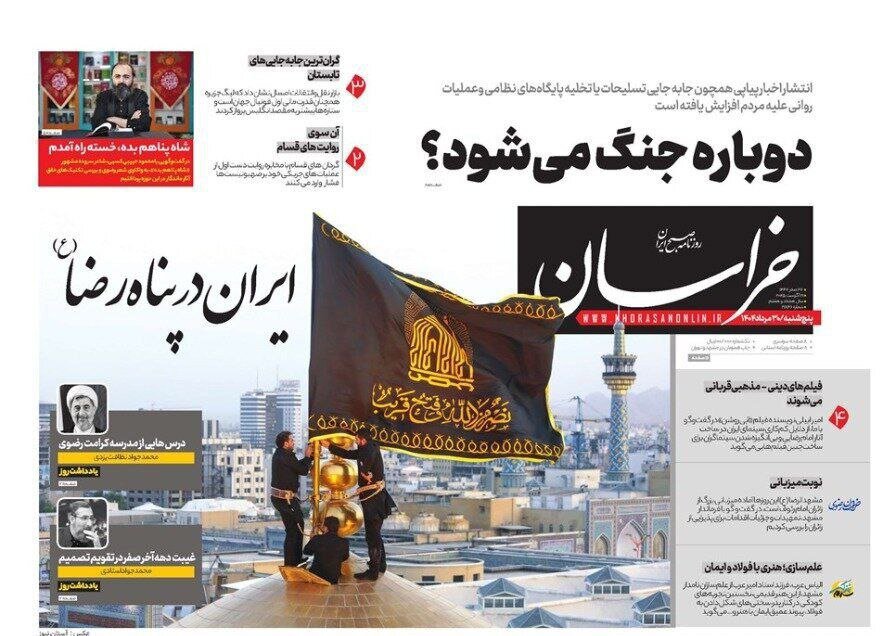
Khorasan raised the question whether the war between Iran and Israel would resume after a lull. It said: There are scattered reports of the end of a temporary ceasefire and the imminent resumption of war between Iran and the Zionist regime, but we must first distinguish between possibilities and probability.
The possibility of returning to a direct war between Iran and Israel is always on the table, but it is not very likely to occur in the short term. A new balance of deterrence was formed after the 12-day war, forcing both sides to reassess the costs and benefits of each action. In this balance, an immediate return to full-scale war replaced a more likely scenario. This was a continuation of conflict in the form of “shadow wars,” limited strikes and fields of competition, making it even more multi-layered. Many imagine a ceasefire as a product of one-sided incompetence or complete defeat, but reality is more complicated. The end of the war was the result of careful calculations by both sides. Both sides found they were at a point where the marginal costs of further attacks were far greater than their potential benefits. This is the logic of mutual deterrence that is still held today. As long as this calculation holds, the threshold from Shadow War to Direct War will remain high.
Sharg: Tehran’s distrust of the IAEA
Writing about the main causes of Iran’s conflict with the International Atomic Energy Agency, Sharg said: One of the main causes of the dispute with Iranian institutions is that the institutions are not neutral. The agency’s silence faces an attack by us and Israeli on our nuclear facilities. Iran’s nuclear facilities were under strict supervision, not only seriously destroying Tehran’s trust, but also paved the way for Iran to rethink the level of cooperation. Iranian officials have repeatedly emphasized that this biased trend could even limit or suspend technical cooperation with the agency. Tehran recently began negotiations with the institution to define a new framework for cooperation. And unless the country’s security and rights are guaranteed, it is not the same as before. From an Iranian perspective, the main problem lies in the political and biased behavior of the institution. Visits by agency staff to Washington are not considered merely technical measures. The trip takes place in an environment where mutual trust between Tehran and the IAEA is at the lowest level, and the obvious convergence of the IAEA with the US could exacerbate this mistrust and negatively affect ongoing negotiations.
Etemad: Difficult conditions after snapback
Etemad discussed the possible activation of the snapback mechanism and the results with Dr. Gholamreza Karimi, professor of international relations. He said: If a snapback mechanism is triggered, the level of mistrust between parties increases sharply. Iran will likely respond to this action by withdrawing from the NPT or at least reducing the International Atomic Energy Agency’s inspections. This will increase Western countries’ distrust of Iran, and will increase the opportunity to build an international consensus on Iran, particularly by issuing resolutions by the IAEA Committee and referring to the Security Council. While the split within the Security Council is unlikely to allow new resolutions to be adopted against Iran, the recovery of previous resolutions under Chapter VII of the UN Charter and sanctions from the potential placement of Iran would exacerbate the situation significantly. This situation, given the current multiple internal crises, can make the Iranian incident very complicated and lead to escalation of tensions between the two sides.
Siasat-e-Rooz: Powerful Iran
Siasat-e-Rooz discussed Iran’s military approach in a memo, saying: Located in a geopolitical sensitive region, it faces multiple aspects of Iran’s security and terrorist threats. The US and Zionist regimes, together with several European countries, rely on terrorism and regional factors, as well as tools of military attacks, to trigger civil wars and ultimately collapse Iran. The truth is that today’s world no longer values diplomacy, and negotiations without tools for power represent surrender. The 12-day experience of war imposed showed that diplomacy and negotiations were not going well as the enemy was preparing for war, genocide and Iran under the guise of diplomacy. Certainly, if it weren’t for the military’s missile and drone capabilities, the US and Zionist regimes would not have agreed to a ceasefire. Today, it is only the military capabilities of its indigenous people that decide to deter Iran against invasions, and must be taken with the authority to realize it.