
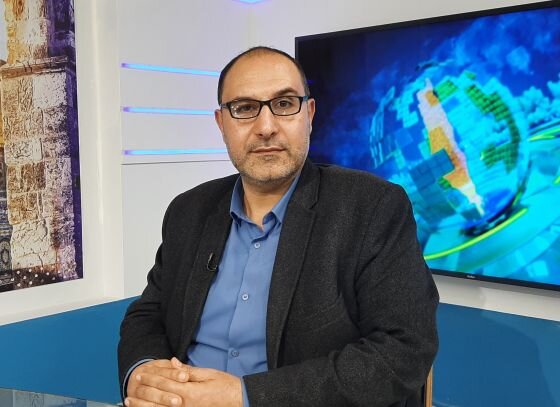
In the wake of renewed Israeli attacks following the Tehran-Gaza ceasefire, Palestinian author and analyst Hassan Rafi examines the underlying political and strategic motivations driving Tel Aviv’s escalation.
In an exclusive interview with the Tehran Times, Rafi argued that Israel’s military operations reflect deep internal tensions within the Netanyahu government and its growing isolation on the international stage. He explains how Israel’s right-wing forces see the ceasefire as a setback and are using new attacks to regain domestic legitimacy and reshape the ceasefire in their own favor.
Rafi also assesses the US position, suggesting that the US remains a tacit partner in Israel’s military plans, even as the US seeks broader regional stability. He warned that Israel’s recent attack on Lebanon could signal a broader attempt to destabilize the region in the name of “freedom of military action.”
The text of the interview is below.
After the ceasefire in Gaza was announced, Israel launched a new series of attacks against civilians. In your view, what motivates Tel Aviv to resume its attacks despite its declared efforts to calm it down?
Israel reluctantly agreed to a ceasefire. The prevailing view within the government was to continue occupying Gaza and displacing its population, but US pressure and increasing international isolation forced the prime minister to accept the agreement.
Many Israelis therefore view the deal as failing to meet the demands of far-right groups. By resuming bombing, they aim to change the terms of the agreement in their favor by creating a reality in which they can claim so-called military freedom of action against Gaza, what Israeli media call the “Lebanon model.”
At the same time, it sends an internal message to a wide swath of Israeli voters who believe the deal will not bring Netanyahu the decisive victory he has sought throughout two years of war.
To what extent do these attacks convey a domestic political message related to Prime Minister Netanyahu’s weakness and domestic crisis?
There is a connection between these attacks and Israel’s domestic situation. This link appears in two ways:
First, the far-right forces (the core electoral force of the Religious Zionist right-wing bloc) wanted to occupy Gaza and settle there after evacuating the majority of Palestinians. They see the deal as U.S. oversight of the government and a sign of Prime Minister Netanyahu’s weakness in political will.
The attack would soften right-wing opposition and send a message that Netanyahu is effectively managing the situation and can change the terms of the deal to suit Israel’s interests.
Second, the families of Israeli prisoners of war. The recovery of POW bodies and the repatriation of POWs are central and popular issues. Mediators acknowledge there are logistical and security hurdles, but Netanyahu is also trying to ease pressure from his large constituency, which has opposed him during the war for not securing his release sooner.
In this way, the POW bodies strike gains domestic legitimacy and appeals to a segment of the population that has criticized Netanyahu and called for an end to the war, especially given that Israel is widely expected to enter an election year.
Although the United States has always been a partner in Israel’s killing and war against the Palestinian people, the balance of power sometimes forces the Palestinians to deal with the United States as a mediator.
How should the Palestinian resistance respond to this kind of “fragile ceasefire” that Israel breaks at any time?
Gaza’s resistance groups see the ceasefire as a major success because it protects Palestinian lives and thwarts Israeli evacuation plans. They must treat these bombings as Israeli violations, expose them, and use them to hold accountable the mediators and the international community that welcomed and supported the ceasefire.
At the same time, continuing to expose the crimes of the occupation (regime) serves to maintain international pressure to isolate Israel as a rogue state unwilling to stabilize the region.
On the military front, the Resistance has shown great patience and strategic endurance in confronting these Israeli invasions. We are trying to build a deterrence equation, not necessarily starting only in Gaza, to prevent Israeli escalation against Palestinian lives.
Do you think Israel will use the cease-fire as cover to redeploy and prepare for new battles?
Israel wants to continue the war in new ways. After the release of living Israeli prisoners and a shift from all-out war to limited and targeted operations, this time accompanied by American legitimacy and international silence.
However, a return to full-scale war faces opposition from the international community and the United States, which is currently reluctant to accept that option.
How do you assess the US position on these attacks? Is the US government still able to really put pressure on Israel, or is it a tacit partner in escalation?
Although the United States has always been a partner in Israel’s killing and war against the Palestinian people, the balance of power sometimes forces the Palestinians to deal with the United States as a mediator.
That said, the Trump administration has become convinced that the war must stop altogether, not for the sake of the Palestinian people, but to protect America’s greater interests globally and regionally, and to protect Israel from itself.
At the same time, the Trump administration would not oppose allowing Israel free military hand in the Gaza Strip, as long as the comprehensive cease-fire agreement remains intact and it remains under U.S. control.
We witnessed a new attack on Lebanon by Israel on October 30th. How would you explain this escalation at this particular moment?
Lebanon will be at the forefront of events in the coming months, especially since Israel’s bet on Lebanese domestic forces (whether party or state) to disarm Hezbollah has failed.
Therefore, if Israel continues to apply the principle of freedom of military action in Lebanon even after the ceasefire, ground military operations will increase and may escalate to large-scale military operations short of full-scale war, especially south of the Litani River.
Here we need to pay attention to the electoral calculations in Israel.
Is Israel seeking to widen the circle of conflict in order to disrupt the situation and impose a new equation on the region?
Reordering the region is beyond Israel’s reach unless approved by the United States, and is consistent with Washington’s central vision of reshaping the Middle East. As the US president has stated many times, the Gaza agreement is aimed at reordering the Middle East.
Therefore, Israel does not have the freedom to act throughout the region without American approval. This is evident in the American intervention on the Syrian front and in connection with Turkish interests, and will also be evident on the Iranian and Lebanese fronts. Without an American military plan in which Israel plays a clear role, Israel will not be able to act on its own to reshuffle the regional cards.
What message does Tel Aviv want to send by attacking Lebanon after the Gaza ceasefire?
Israel wants to send several messages. The most important strategic message is that it seeks to emphasize the goal of disarming Hezbollah as a strategic objective, or at least preventing Hezbollah from rearming in Lebanon.
This is also an internal message tied to Israel’s electoral calculations that favor the ruling coalition. And some messages try to persuade the Americans to forcefully intervene in the Lebanese file as an alternative to all-out war by Israel against Lebanon.
However, in my view, the regional and international (and even Israeli) environment does not allow for the right conditions for Israel to launch an all-out war against Hezbollah in Lebanon.
That said, Israel will likely seek to increase the pace of limited military operations against Lebanon and Hezbollah.