
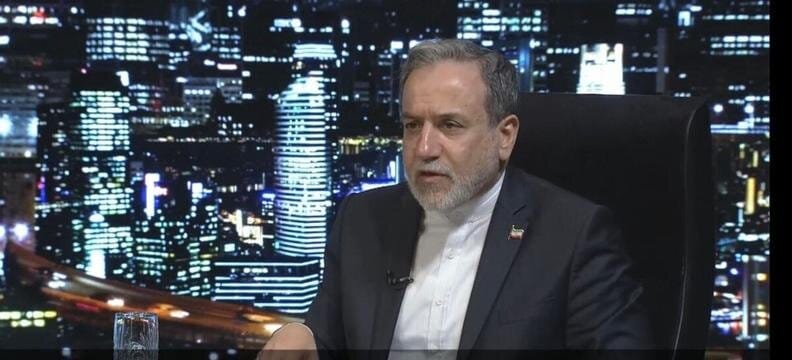
TEHRAN – Iranian Foreign Minister Abbas Aragci said Thursday that the Israeli regime has “out of despair” the 12-day war of attacks on Iran and has been forced to end the prerequisites following a wave of waves that have caused severe damage to all the territories where they have been hired.
During the nationally aired interview, Aragut worked on a wide range of developments surrounding recent conflicts, including the role of the US and Europe, the status of nuclear negotiations, the Iranian decision to halt cooperation with the UN nuclear watchdog, and his diplomatic engagement in Geneva and Istanbul.
Araghchi made it clear that it was the Zionist regime who first reached out to demand a halt of Iran’s operations in exchange for stopping its own attack. However, Iran rejected any form of negotiated ceasefires or mutual arrangements.
“Iran never concluded any consultations on a ceasefire,” he revealed. “A ceasefire means mutual agreement and negotiation. What happened was a one-sided halt of enemy attacks after realising the costs of continuing the war.”
He warned that future violations by the Zionist regime will be met with a decisive response. “Our military command is fully prepared to retaliate,” he said.
Aragut reiterated that Iran was not involved in any form of negotiations with Israel and its allies to end the war, calling Israeli invasion “completely provocative and illegal.”
“I don’t accept the concept of a ceasefire when it means negotiation or compromise,” he said. “There were no negotiations. The attackers were forced to stop after our response changed the balance.”
He added that Iran has serious doubts about Israel’s willingness to comply with an offensively declared suspension, citing past actions of the regime in Gaza and Lebanon, where ceasefires were routinely violated.
“But Iran is not Lebanon,” he warned. “The current violation of calm will be met with immediate and powerful responses.”
“Discussions under review for our status”
Turning to Iran’s nuclear negotiations with the US, Aragut said progress remains uncertain. The sixth round of indirect talks scheduled to take place in Muscat was disrupted when Israel attacked Iran on June 13th.
“It depends solely on national interests to see whether we return to consultations or not,” he said. “Even before the war, Americans were increasing pressure on Iran based on false claims about nuclear weapons. There are no continued negotiations at this point, and the statements of the US President are not being taken seriously.”
“Iran’s strike against a US base in Qatar: a message to Washington, not to the Persian Gulf countries.”
Addressing Iran’s missile strikes at US military bases in Qatar – Araguchi, compensated for in retaliation for US airstrikes at three Iranian nuclear sites, revealed that the strike is directed exclusively to the US.
“I told my Arab neighbors up front that if the US attacks us, we have no choice but to respond and that it might target US military infrastructure based on your country,” he said. He emphasized that Iran has no intention of targeting the Arab state and that the message was directly passed on to all six PGCC foreign ministers.
“Our policy remains one of peaceful neighbourhood relations with all countries, including the Persian Gulf and Iraq,” he emphasized.
“Iran has shown resistance to a global coalition of power.”
Araguchi described the 12-day war as a historic moment in Iran’s revolutionary struggle, marking “resistance against a global coalition of power.”
“Iran has been attacked by two nuclear armed states, the US and Israel, under the political and logistical support of the European government,” he said. “Their aim was to break Iran’s resolve and force them to surrender after decades of resistance. They failed.”
“Iran is currently reassessing its commitment to the NPT.”
Legally, Aragut has condemned the attacks that Israeli and the US attacks undermined the very foundations of the Nuclear Non-Proliferation Treaty (NPT), which Iran has long adhered to.
“Nuclearly armed states were unable to fulfill their disarmament obligations and instead expanded their arsenals,” he said. “On the other hand, non-nuclear states like Iran, which adhere to the rules, are punished and restricted.”
He added that Iran’s continued commitment to the NPT is under review based solely on national interests. “There is nothing sacred about foreign policy,” he said. “Only the rights and interests of the people of Iran determine our course of action.”
“We warned Europe against snapback mechanisms.”
Araghchi issued a harsh warning to European signatories of the JCPOA (France, Germany, UK) who threatened to invoke a “snapback” mechanism of dealing to revive UN sanctions.
“The trigger on a snapback is Europe’s biggest historic mistake,” he said. “It would permanently remove Europe from Iran’s nuclear equation. Just as the US launched an attack undermined the prospect of consultations, Europe would hamper its role through such actions.”
“IAEA Chief Grossi was forbidden from entering Iran.”
Iran also banned Rafael Grossi, director of the International Atomic Energy Agency (IAEA). This entered the country in response to a recent resolution from an agency that accused Tehran of condemning non-compliance.
The Iranian parliament has since passed a bill suspending cooperation with the IAEA. This was later approved by the Constitutional Council.
“The resolution provided political coverage for the Israeli attack,” Araguchi said. “The IAEA has lost credibility and Grossi is not welcome in Iran for now.”
Finally, Aragut said Iran is moving forward with legal and diplomatic efforts to ensure Israel and the United States are responsible for the war.
The International Bureau of the Ministry of Foreign Affairs, together with the Legal Department of the President’s Office, has begun compiling evidence of human and material loss to present to the United Nations. The goal is to formally designate the attacker and demand compensation.
“The process is complicated and time-consuming, but it’s already underway,” Araguchi said. He said the initiative was particularly recognized by leaders of the Islamic Revolution.
Iran’s Deputy Minister Saeed Katibzadeh also confirmed that the reparation lawsuit is being actively pursued.