
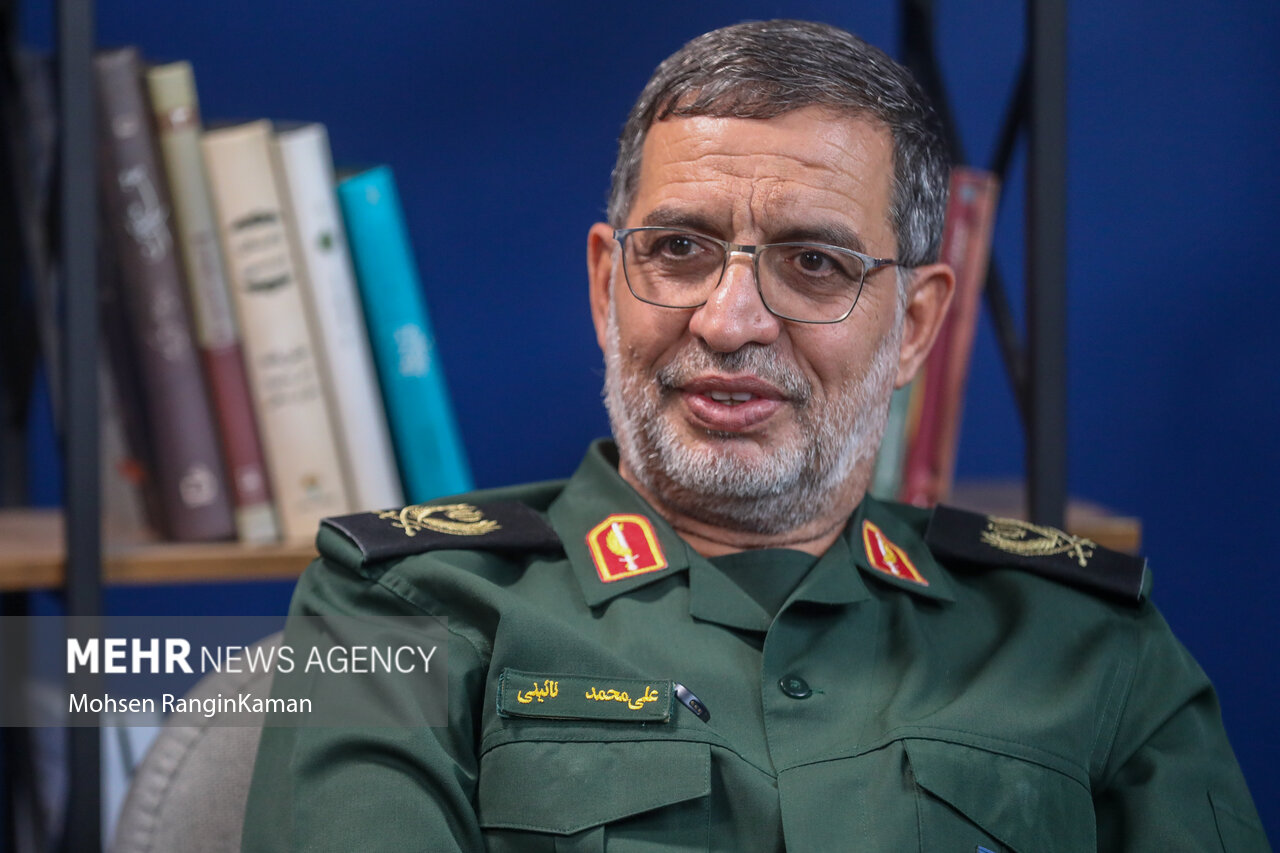
At one of the country’s most sensitive and historic security moments, we met Brigadier General Ali-Mohammad Naini, Spokesman and Deputy Public Affairs Officer of the Islamic Revolutionary Guards Corps (IRGC), to hear firsthand about the 12-day war with the Israeli regime, one of the shortest but most significant battles in modern Iranian history.
This conflict was much more than a traditional military conflict. It was a strategic test in which every element of Iran’s national power, from its military deterrence to the resilience of its infrastructure, came under intense pressure.
In this in-depth interview, General Naini recalled the shocking early moments of the conflict and the martyrdom of some of Iran’s most prominent military commanders. Still, he emphasizes how the chain of command was quickly restored and how Iran responded as violently as possible to the aggressor.
He said this remarkable level of preparedness was the result of years of systematic planning, continuous military training, and the foresight of commanders who believed war was “inevitable” months before events unfolded.

Below is the full text of the interview, which reveals untold details about one of the most decisive battles in the history of Islamic revolutions.
What exactly was the Twelve Day War? How was it fundamentally different from previous conflicts?
“The Twelve Day War was a full-fledged technological war, a missile-based air war.”
The nature of this war was quite different from the eight-year Iran-Iraq war. The war imposed was a typical ground war aimed at seizing territory and occupying Khuzestan. But the Twelve Day War was truly a hybrid war, full-scale technological, missile-driven, and airborne confrontation.
This was a hybrid war operation in which cyber operations (both offensive and defensive), media warfare, and cognitive warfare were extremely serious and decisive elements. These are characteristics of modern asymmetrical conflicts.
In previous wars, physical destruction and human casualties were the main indicators. In the Twelve Days’ War, victory was not defined by capturing territory, but by imposing one’s will and re-establishing the balance of power on the battlefield. But we were completely successful and forced the enemy into a desperate situation.
How was Iran able to react so quickly and decisively after the first Israeli attack?
Since February last year, we thought war was “inevitable.” All military exercises and careful planning were aimed at deterrence and preparation for the day. Senior commanders, including martyrs Bagheri, Rasheed, and Salami, constantly assessed and oversaw combat readiness in all aspects, from weapons and equipment to tactics and technology.
Immediately after the enemy surprise attack that resulted in the martyrs of several commanders at the base of operations and headquarters, the command cycle was quickly restored and our forces were mobilized to respond within an hour. For example, the Aerospace Operations Command was fully prepared and carried out a historic missile operation despite a 12-hour delay due to new appointments. This level of preparedness was the result of years of struggle and force-building by these commanders.
How do you compare the 12-day war to the Iran-Iraq 8-year war?
Key similarities: Both conflicts were part of an “American project” aimed at overthrowing and weakening Iranian national sovereignty. In both cases, the invaders sought to divide the country and target Iran’s key power structures.
Fundamental difference: The Eight Years’ War was primarily a ground war, relying on strategic surprise attacks against Iran because Saddam’s threat was not taken seriously at the time.
But the Twelve Days War was an air and missile war fought with complete preparation and a clear understanding of the threat. We recognized the inevitability of war a year ago. The most important lesson we learned from the Iran-Iraq war was accurate threat assessment. We understood that future threats would be primarily extra-regional from the United States and the Israeli regime.
Regarding the regional situation, how likely is it that the situation will escalate, and what is the military’s preparedness?
I’m not worried about threats. The military continues to strengthen and innovate. We don’t focus on anything other than being ready. Each branch of the armed forces is striving to achieve a completely innovative response in tactics, technology, and methods, surpassing even those exhibited during the Twelve Days War.
I don’t think the enemy will have the ability to wage war anytime soon. The main obstacle for them is precisely the increase in the capabilities and strength of our armed forces, which prevents them from taking new decisions. What is being said about the new war is more psychological warfare than actual battlefield scenarios.
But if the enemy commits another act of folly, he will be faced with a far more decisive and contrite response. We are also preparing for more complex wars.
MNA/6653172