
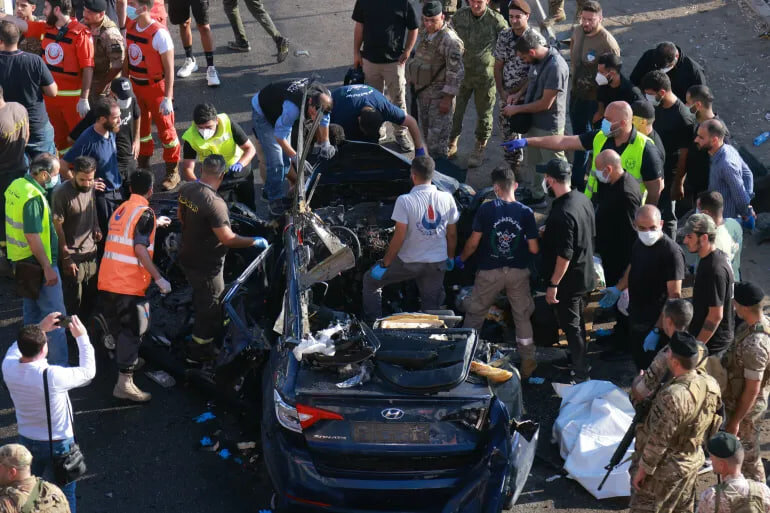
BEIRUT – The Israeli regime has expanded the scope of the strike on the eve of Thomas Barrack’s visit to Beirut to receive Lebanon’s official response to his proposal.
Lebanon’s health ministry has announced that Israel’s attacks on the southern part of Israel have caused injuries to 10 citizens, including a child who had to be hospitalized in intensive care. The village of Barbeck was also targeted.
Furthermore, Israeli military forces have also infiltrated the town of Kfal Kira (about 400 meters deep). Another unit infiltrated the outskirts of Aita al-Shaaaa.
For the sake of discussion, even if we assume Hezbollah agrees to hand over that weapon, who will protect Hezbollah’s executives and communities? What about sanctions following that finance, services, society and educational institutions? Who will guarantee the halt of Israeli invasion in border villages? Who guarantees reconstruction?
Lebanon’s anti-resistance team intentionally ignores these important questions. Not only should we maintain weapons in resistance, but we should not give justification to silence those who demand national defense strategies that hinder external threats.
The team doesn’t care about Israel’s ongoing crimes (over 4,000 people) or breach of its commitment to the UN agreement or international law. Rather, it pushes hard to strip Hezbollah of its strength and strength.
They rely on all means to counter Hezbollah.
Clearly, Hezbollah’s options are extremely important and costly. Director General Sheikh Naim Qassem confirmed in a recent speech that the option of conflict is easier than the option of humiliation and freedom surrender.
Hezbollah is caught between abandoning and holding weapons. Hezbollah is preparing to review its policies and make the most dangerous decisions of its history, but is fully aware that other alternatives could come with unexpected surprises.
Since the date of the ceasefire, November 27, 2024, Hezbollah has demonstrated incredible flexibility, as proven by Republic President Joseph Aung, Prime Minister Nawaf Salam, and Chairman of Parliament Nabi Beli.
However, Hezbollah’s prudence was not appreciated by the embarrassingly lined people who portray the weapons of resistance as Lebanon’s only dilemma, and who claim that Lebanon would turn into a reality like Singapore if Hezbollah abandons it.
Therefore, the situation in Lebanon is becoming increasingly complicated and the remaining options facing resistance are increasingly limited.
Hezbollah is fully aware that the strategic factors facing regionally and internationally remain unchanged and there is a consensus to eliminate Hezbollah despite the deep division within Israeli society.
Hezbollah also recognizes that the local environment is undesirable. It notes that if the war with Lebanon resumes under the pretext of Hezbollah providing an excuse, it affirms a reconciliation between Arab Americans and Israel.
Furthermore, Hezbollah read how Damascus’ collapse to pro-Israel camps threatened Lebanon, and after Sunni leaders abandoned Takfili Salafism (Mahtiderian’s recent visit to Damascus), he received Saudi Arabia’s orders, he was the prime minister of the Prime Minister’s Office of Judicial Sunnis Academia (Prime Minister).
Not only Sunni leaders who succumbed to Arab Americans and Israeli desires, but also Christian leaders blinded by their intense hostility towards Hezbollah, have turned their eyes to the terror bombing of St. Elias Church and the annihilation of the Syrian coast.
Unfortunately, the scenario for the resumption of war approaches the horizon under the pretext of “we advised Hezbollah, but we didn’t pay attention to our advice.” It is, according to rhetoric of resistance, “You forced humiliation, but you resisted.” In any case, Hezbollah and its inner circle are prepared for all sorts of unforeseen circumstances.