
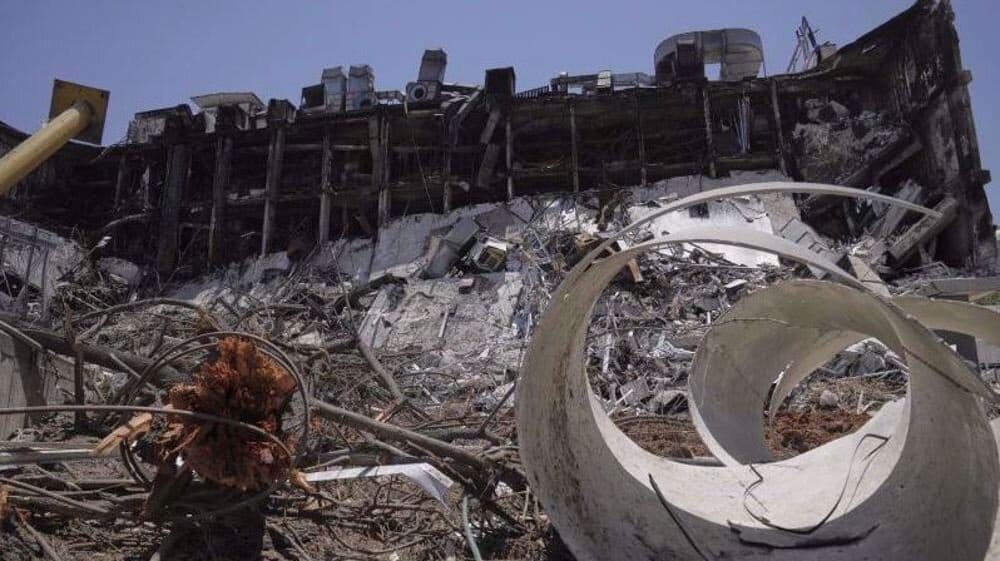
TEHRAN – A senior commander of the Islamic Revolution Guards Corps (IRGC) Aerospace Forces, whose name and face were not disclosed, said in an IRIB television interview that Iran targeted Israeli air defense centers during Operation True Promise III and succeeded in disrupting the operation.
The operation included at least 21 waves of missile and drone strikes against occupied territory in 12 days after the regime launched an all-out war against Iran on June 13.
The commander stressed that Israel’s air defenses were unable to prevent Iranian attacks even after being rebuilt. He noted that despite widespread media censorship, Iran was able to attack and cripple the regime’s air defense centers.
Although Israel was updating and upgrading its air defense capabilities between True Promise II and True Promise III, its capabilities were once again overwhelming in subsequent operations. True Promise II targeted Israel in October 2024.
True Promise III, the largest in Iranian history, involved extensive use of ballistic missiles and drones. According to the US-based CTP-ISW consortium, a joint initiative of the Neocon Institute for the Study of War and the Critical Threats Project, Iran launched 543 ballistic missiles and more than 1,000 drones. The Revolutionary Guards themselves said a total of more than 3,000 projectiles were used, including drones and cruise missiles.
Israeli military officials have confirmed that between 500 and 550 ballistic missiles were fired, broadly consistent with Iranian reports. Post-conflict data confirmed that Israel’s missile defenses were overwhelmed, even though Israeli and U.S. officials claimed near-total success.
Fox News verified a direct Iranian missile attack on the Kirya military headquarters in Tel Aviv, the central command headquarters. Satellite radar analysis by Oregon State University, shared with the Telegraph, revealed six successful missile strikes on five undisclosed military installations, including intelligence facilities, airfields and logistics hubs.
Haaretz journalists Avi Schaaf and Bar Peleg identified 10 previously unreported attacks, far more than the 36 officially acknowledged by Israel. Analysts noted that many civilians were injured by falling debris from the interceptor as Israel tried to intercept the wave of missiles.
Initially, Israel claimed an interception rate of 90-95%, but by the seventh day the Telegraph reported that at least 16% of Iranian missiles had evaded defenses, an estimate that experts view as conservative. Postwar analysis revealed that many high-value targets were left unprotected and exposed critical weaknesses in Israeli and American missile shields.
During the 12-day conflict, the United States fired more than 100 THAAD interceptor missiles (possibly up to 150) from two systems deployed in Israel. This rapid spending consumed nearly a quarter of the U.S.’s premium stockpile and raised concerns among U.S. defense officials about the world’s missile defense posture and ability to quickly replenish supplies, especially at a time when public support for Israel’s defense was at historically low levels.
Analysts are now warning that despite Israel’s claims of readiness, Tehran’s ability to penetrate air defenses shows that significant gaps remain in the Israeli and US missile networks.
There is still no reliable information on the exact damage caused in the occupied territories in June. The regime imposed strict censorship during the war and also detained many journalists who tried to report on the reality on the ground after the June 24 ceasefire. It was Israel who proposed a ceasefire.
“If war breaks out again, we will do the same thing to Israel as before, but this time it will be much worse,” the Revolutionary Guards commander told IRIB in an interview. “We now have more experience and confidence, and all units are fully ready.”