
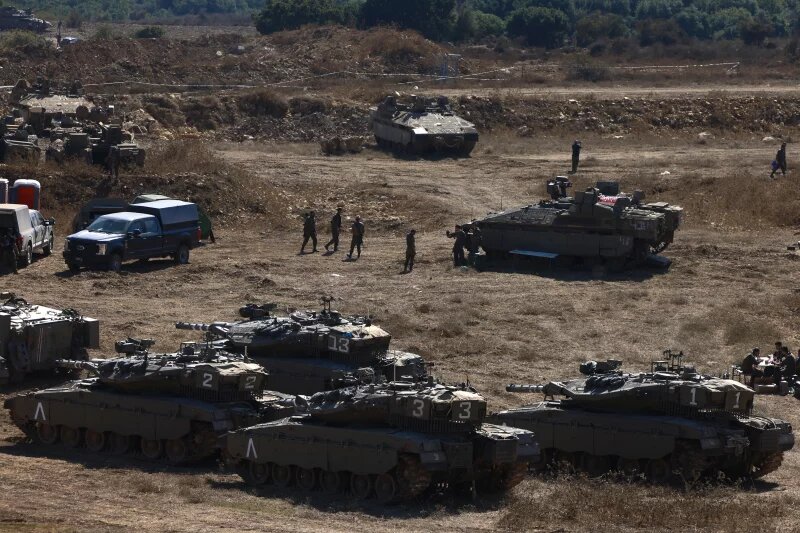
BEIRUT—Lebanon is going through a complex period, facing continued Israeli shelling, deep political divisions, and increasing economic and diplomatic pressure.
Israel continues to target villages and towns from Bunafur to Ansar and Shamstar. It terrorizes civilians and discourages them from working in the fields.
Amid these Israeli actions, residents of border villages insist on returning to their lands to harvest crops.
The daily war on this border is not just a military one. It is also a war over land, memory, and identity. Enemies, in complicity with international silence and the failure of the Lebanese state to protect its people and their rights, seek to impose a new reality that makes the south a de facto buffer zone.
Since October 2023, Israeli aggression has not been limited to daily shelling of southern towns, but has taken a systematic form targeting symbols of both land and identity: olive groves.
As part of a deliberate policy to clear border areas and create buffer zones, Israel uses phosphorous bombs to burn down olive groves and destroy the soil between Lebanon and occupied Palestine.
In addition, occupation forces uprooted ancient trees and transported them to the Palestinian territories in order to erase the agricultural and human memories of the south.
This is not only a military war, but also an environmental war and a cultural war. It aims to uproot people.
In parallel, the struggle for electoral law reform has reopened traditional factional lines of communication, and intra-party struggles have manifested themselves on the political and electoral front.
Parliament Speaker Navi Berri has closed the door to any amendments, but the Lebanese Armed Forces party is resorting to what it calls “Plan B” and trying to get the government to pass new legislation.
Behind this controversy lies a delicate calculation that goes beyond the letter of the law. This is a battle for influence and representation, especially regarding the votes of expatriates, who will be a valuable asset in the next parliamentary elections.
As the conflict between Foreign Minister Youssef Raji and Prime Minister Nawaf Salam of the Lebanese Armed Forces party intensifies, it becomes clearer that the government is unable to make a unified decision. This comes amid growing legislative and oversight paralysis in a country that has lost its constitutional and economic compass.
Externally, Lebanon has returned to the forefront of international attention following France’s message of support and the promise of two conferences to support the military and reconstruction.
However, parallel to the Saudi side’s apparent reluctance to participate in any initiative, this support is subject to a delicate balance.
This reflects the deep cooling between Riyadh and Beirut due to the lack of serious reforms and the growing influence of Hezbollah-aligned forces.
Between French optimism and Saudi hesitation, the US position remains cautious and observational, linking any support to Lebanon’s involvement in a regional solution, including indirect negotiations over the border with Israel.
But neither Paris nor Washington seems able to break the impasse unless there is a unified Lebanese will, which has been lacking so far.
Adding to this situation are important political and security implications. It is an Israeli escalation targeting Chairman Berri’s areas of influence. A bombing campaign was carried out in parallel to the refusal to negotiate with Beri before withdrawing from the occupied villages. Enthusiastic election activities at home and abroad. and administrative and financial scandals that reflect institutions’ inability to achieve accountability and reform.
Even issues of life, from the contamination of a tannoline drinking water company (linked to the Lebanese military) to the collapse of the accounting system, reveal the fragility of the state in the face of intertwined interests and the continued collusion of power and wealth.
The water crisis turned from a health issue to a bitter sectarian conflict after the Ministry of Health decided to stop bottling the product due to bacterial contamination.
Instead of a scientific discussion on water safety, the Lebanese army launched a demagoguery campaign describing the decision as political and sectarian, targeting “Christian companies” simply because the health minister has ties to Hezbollah.
In this way, scientific facts were suppressed and replaced with language of hatred and division in an attempt to exploit the health crisis to incite sectarian hatred and achieve political gains at the expense of public safety.
Amid this turmoil, Lebanon appears to be a public forum for conflicting messages. Israel is forcing reality into the ground with fire, domestic forces are scrambling for what remains of power, foreign powers are threatening conditional aid, and society is groaning under the weight of high prices and division.
Despite this, the South remains a symbol of dignity and resistance. Bombarded and facing displacement, starvation and conquest, farmers are harvesting olives, a symbol of Lebanese survival.
What Lebanon is experiencing today is not just a security, political and economic crisis. Rather, they are experiencing an existential struggle in a region where their alliances are testing their ability to withstand a rapidly changing world.
Lebanon’s choice is clear. Will we achieve the unity needed to rebuild our nation based on justice and sovereignty, or will we remain mired in internal contradictions, with each Israeli attack and election dispute posing new challenges for a country that has not yet secured its own survival?