
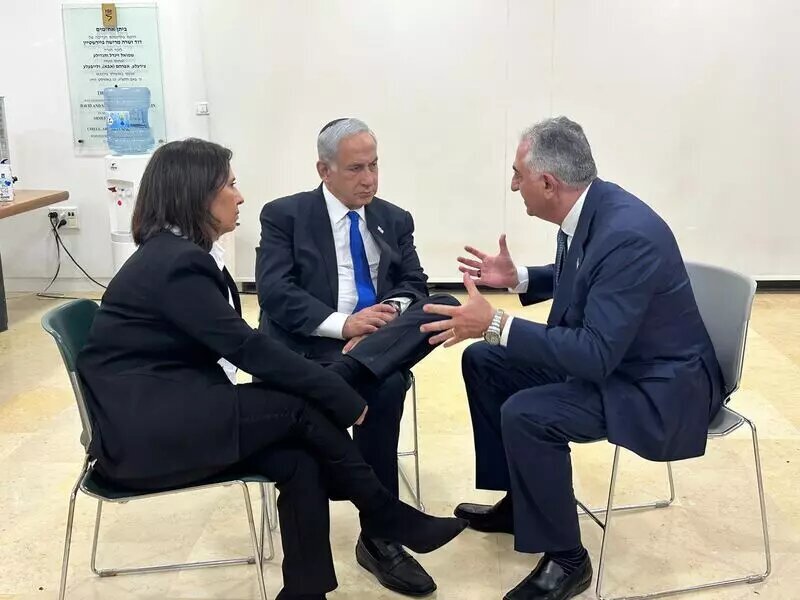
Tehran-Harletz articles report on Israel’s broad and influential influence targeting Iran, aiming to promote the return of the fallen Pahlavi monarchy.
According to reports by Haaretz, Themarker and the University of Toronto’s Civic Research Institute, Israel operates an online Persian business designed to amplify the image of Reza Pahlavi, the son of abdicated Shah, and encourage anti-government sentiment within Iran.
The revelation shed light on the widespread use of artificial intelligence, fake social media accounts and disinformation to destabilize the Islamic Republic during the recent military attacks on Iran on Israel.
Researchers from the Civic Lab discovered that when they fired the Ebin Prison in Tehran, Israel on June 23, a network of fraudulent accounts began to circulate between produced videos and false reports even before Iranian media confirmed the attack. Some of them are designed to appear to come from ordinary Iranians near the site, though they were produced. The campaign was called “Prison Destruction” and aimed to raise anxiety by encouraging people to rush to prison.
The researchers concluded that the speed and accuracy of disinformation strongly suggested prior knowledge of Israeli strikes, and concluded that it is very unlikely that an independent third party would carry out the operation.
The same study also revealed another Israel-supported digital operation that promotes Reza Pallavi as a political alternative to Iran’s current leadership. The campaign relies on “Avatars” (Fark Online Identity, disguised as Iranian citizens) to flood social media platforms such as X (formerly Twitter) and Instagram.
Sources familiar with the project confirmed that native Persian speakers were employed to create content and artificial intelligence tools were employed to generate videos and stories that favor the former Crown Prince. In some cases, networks have been amplified from Israeli allies, Minister of Innovation and Science and Technology, Giragamuriel, who publicly hosted him during his first official visit to Israel in 2023.
In a 7th August article by Haaretz, less than a week after the war with Iran, Gila Gamliel posted an AI-generated video related to Iran to X, quickly gaining over 600,000 views. Researchers have identified hundreds of suspicious X-accounts that artificially enhanced Gamriel’s Iran-related content. Unlike her posts on domestic issues that attracted only thousands of viewers, her Pahlavi-themed posts have consistently reached hundreds of thousands of users.
Research revealed that the Pro-Pahlavi network is not operating on its own. Citizen Lab documented another set of AI-generated videos, fake BBC Persian reports, and Israeli-related accounts spreading deepfakes among Iranians.
Researchers found dozens of telegram groups linked to the campaign were simultaneously encouraging protests in Iran, recycling fraudulent material. Some accounts have also been raised as Iranian women to seduce real users to share personal stories.
Experts note that the Israeli government is openly accepting Reza Pallavi in the hopes of legalizing the campaign for a change of regime in Iran. However, analysts warn that Israel’s open support for Shah’s son only strengthens the long-standing debate by Iranian officials that hostile forces in Washington and Tel Aviv are trying to restore the monarchy of Tehran’s clients.
“In the end, Israeli Pahlavi’s sponsorship is a propaganda tool,” an Israeli analyst admitted. “It’s more useful for public relations than realistic political alternatives.”
The revelation shows that Israel is not only engaged in a military strike against Iran, but also in a parallel digital war designed to manipulate Iranian public opinion, spread chaos and undermine the legitimacy of the Islamic Republic.
The revelations of these operations highlight the extent to which Iranian enemies rely on fake narratives and online deceptions to advance political and military purposes.