
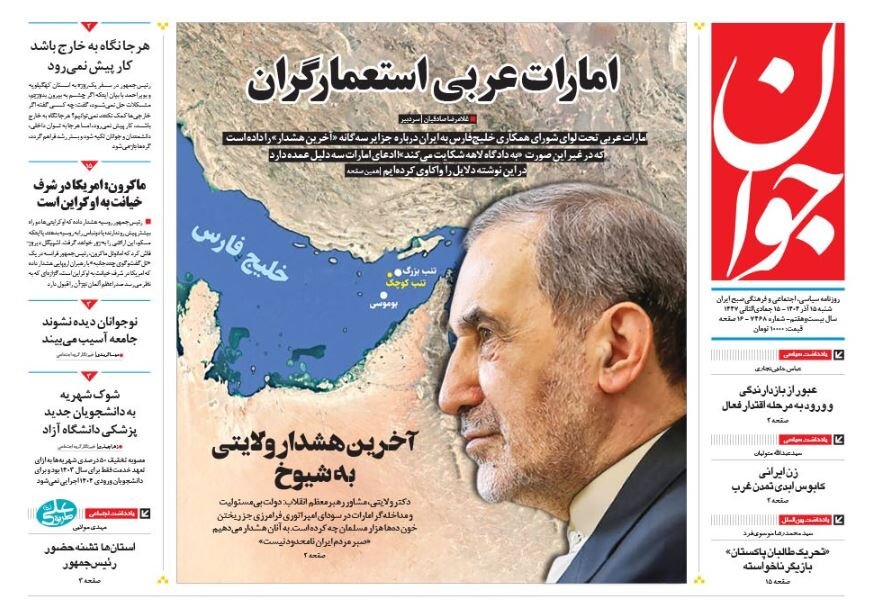
In his analysis, Mr. Tehran-Jawan referred to the UAE’s ownership claims to the three Iranian islands and wrote: The (United Arab Emirates), under the banner of the (Persian) Gulf Cooperation Council, issued a final warning to Iran regarding the three Iranian islands and threatened to take the matter to the International Court of Justice if ignored.
The UAE’s argument is based on three main reasons. External pressure: This demand is essentially a demand from the Arabs in the United States and Europe, and is not an independent decision of the sheikhs. Their motivation is to increase their bargaining power on other issues. These islands are undoubtedly intended to be offered to President Trump and turned into US military bases. Territorial concerns: Sheikhs appear to be concerned about Iran’s territorial rights. The sheikhs could back down from their current position if Iran begins to publicly or unofficially pressure Bahrain to return to Iranian sovereignty. Reorientation Strategy: The intent is to reduce focus on Iran’s foreign policy priorities and divert it from core issues in the Islamic world. The rulers of the southern Gulf have indeed done their utmost to serve the United States and Europe by spending oil revenues to distance the Islamic world from its core concerns.
Mr. Hamshafri: Shahed Drone, a global military model
Hamshahari examined the US imitation of Iran’s drone industry in an interview with defense analyst Mehdi Bakhtiari. “Iran’s military capabilities and technology forced the US military to reverse engineer Iranian drones,” the expert said. The Shahed drone is now recognized as an important model for the global military industry, inspiring imitations from Russia and the United States to Egypt. The drone sector forms a key part of Iran’s defense doctrine, along with its missile force, and has proven highly influential. Iran’s ability to produce low-cost drones is considered an important achievement in the military industry, with a positive impact on both exports and domestic costs. During more than 40 years of sanctions, Iran was forced to develop its own military tools and strengthen its defense and security. The fact that Iran has managed to achieve such advanced technology under the harshest sanctions is the most important message being sent to the world today. Countries prioritize their own security, and Iran seeks to ensure this security through self-sufficiency.
Ham Mihan: “To confront Israel, Iran must pursue friendlier global relations”
Ham Mihan reflected on the nature of Iran’s relations with the world in an interview with Middle East analyst Mehdi Borhani. The analyst argued that after the 12-day war, Israel has effectively left Iran in a state of “neither war nor peace” and could erupt into open conflict at any time. This situation is putting enormous pressure on Iran’s political, economic, and military systems. One of the goals of Israel and the United States is to maintain these pressures and eventually force Iran to succumb to nuclear, missile, and regional challenges. At the same time, Israeli leaders are trying to reassure the public by broadcasting news of the military buildup, insisting that Israel has resolved its regime’s security problems and will not be hit as hard as the 12-day war. If the Islamic Republic weakens domestically, Israel will seize the opportunity to attack. Therefore, to confront the Zionist regime, Iran needs to have friendlier relations with the world. A policy of maximum friendship with other countries is essential. If Iran is demonized and isolated, a nuclear attack on Iran may even be considered. On the other hand, if Iran could play an active role in the region and the world and build friendly relations with other countries, there would be no basis for attacking Iran.
Etelert: “Armed negotiations are like the beginning of a war.”
Ettelert quoted senior international affairs expert Rahman Ghalemanpour, referring to the ongoing impasse in negotiations between Iran and the United States. He pointed out that key parts of the Iranian government’s official position indicate that the policy of “armed negotiations” remains the dominant policy of the Ministry of Foreign Affairs. This policy means that Iran has no intention of starting negotiations at this time. The Islamic Republic’s strategy at this stage is focused on maintaining its position and stabilizing the status quo. Under these circumstances, the United States appears to be adopting a similar approach, showing little interest in starting a new process. At this time, neither side is willing to accept the risk of war, and the United States and Israel in particular currently believe that the costs and risks of conflict are too high. However, this situation will not last forever. Over time, sensitivity to the current situation in Iran may wane, while the United States may become completely disillusioned with diplomacy. In such a scenario, the possibility of new conflicts would increase and this issue would become one of the main challenges.