
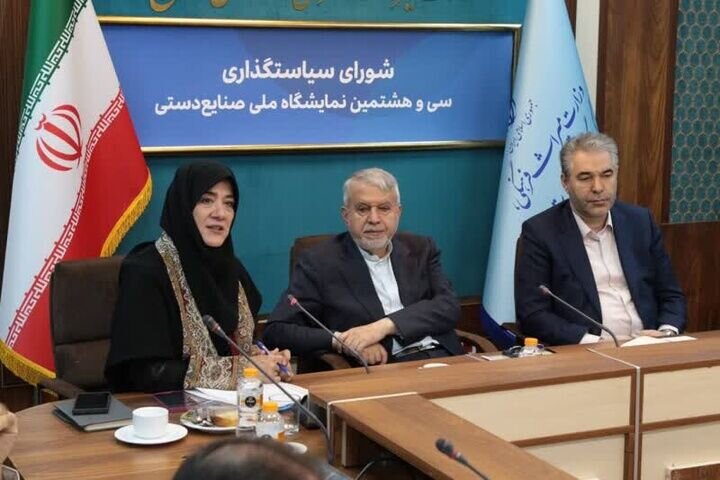
Tehran – Minister of Hand Engineering Mariam Jalali de Deckordi announced the sale of 1 trillion rials ($1.1 million) worth of handicrafts at the 37th National Handicraft Exhibition held at Tehran Permanent Fairgrounds from November 13th to 16th, 2024.
He gave a lecture at the Policy Decision Council of the 38th National Handicraft Exhibition. This said that the presence of Minister of Cultural Heritage Reza Salehi Amiri, the general manager of the ministry, representatives of the organization, representatives of the private activists, and more than 1,000 activists at Handicraft Field, 80,000 visitors will be holding history and reaching conclusions in an international contract. The IRNA reported it.
She noted that last year’s exhibition and ministerial wisdom and synergy with all the elements, resulting in structural and content transformations, and became a model for the future of this national event. “We witnessed a real change in this exhibition, not just in the sales sector, but also the exhibition that has become a platform for introducing Iran’s cultural power.”
Explaining statistical details of last year’s event, she added: “The exhibition took place from November 13th to 16th, and during this period, we were able to receive a 50% discount on the cost of the pavilion through effective consultation and interaction.
She continued that, based on the artist’s self-declaration, the total sales made at the exhibition reached an astonishing trillion rial. Additionally, a contract worth 150 billion rial ($166,666) with government agencies and a $50 million understanding of trade delegations from the regional countries, has been registered, indicating the large capacity of handicrafts in the country’s economic and cultural diplomacy.
Finally, Jalali-Dehkordi expressed his gratitude for all the trustees’ tireless efforts and used the successful experiences of last year to express his hope that by focusing on the 38th exhibition, he will become a platform for a new leap for the arts economy, the prosperity of the domestic market and the development of the country’s culture.
Iranian handicrafts are a vibrant expression of the country’s rich cultural heritage, showing off art and craftsmanship for centuries. From intricate Persian carpets to exquisite designs and vibrant colors, celebrated with exquisite miniature paintings and calligraphy, Iranian artisans create works that blend tradition with unparalleled skills.
Ceramics and ceramics, often decorated with geometric or floral patterns, reflect a historical connection to the Silk Road. Metalworking, including carved copper and brass, highlights the accuracy of Iranian artisans, while turquoise inlays, or Fireozeh-kubi transforms jewelry and ornaments into cultural treasures.
Woodworking traditions such as Khatamkari, a form of Marquetry, combine delicate inlay pieces to create a fascinating design. Hand-woven textiles such as Pateh Embroidery and Gabbeh Rugs represent local identity and local stories.
Experts say each Iranian handicraft is more than just a product. It is a story of history, artistry and cultural pride, passed down through generations of dedicated craftsmen.
Currently, the selection of 13 cities and three villages in Iran is registered as “World City of the World” by the World Crafts Association.
KD