
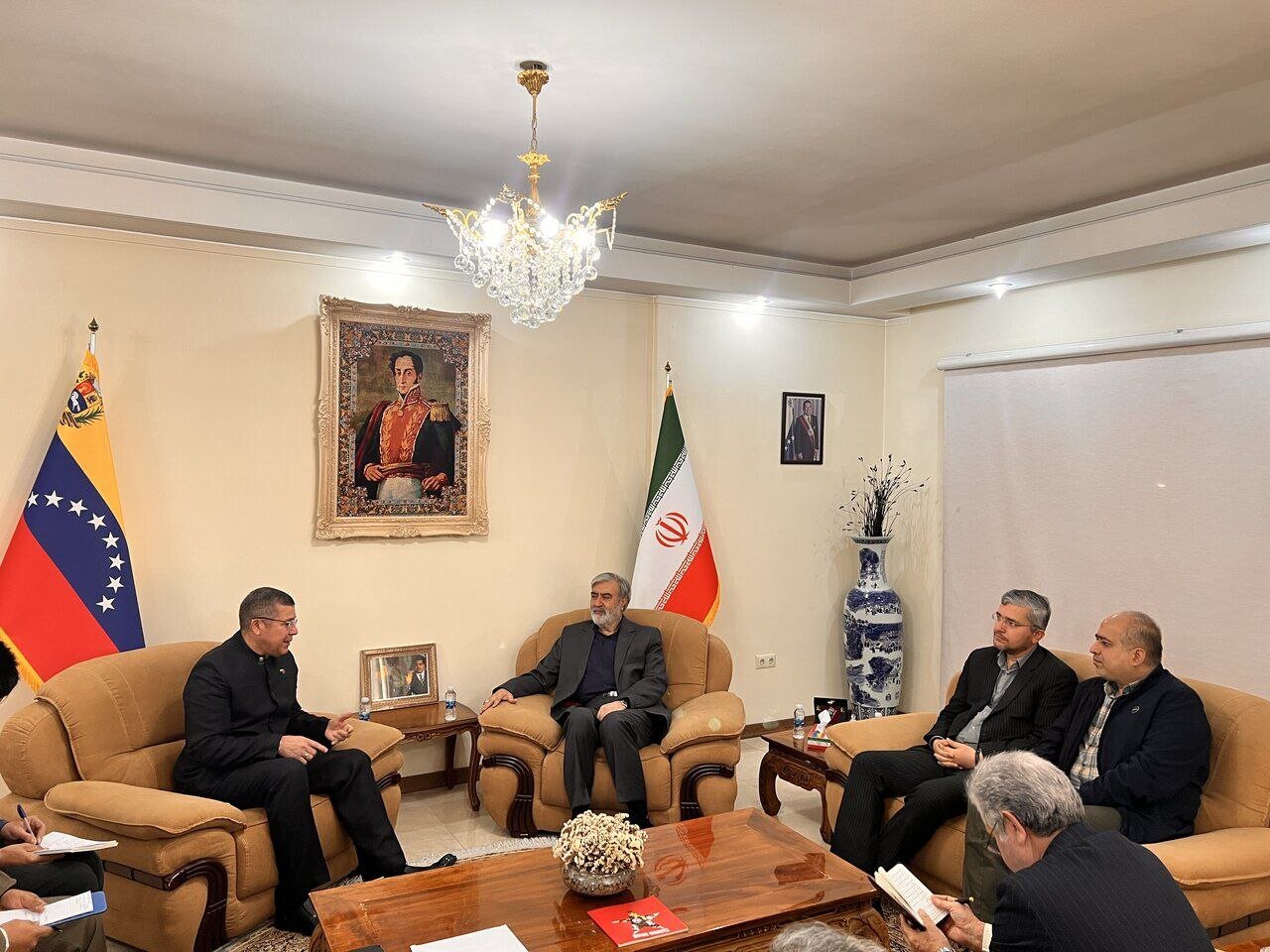
TEHRAN – A group of Iranian parliamentarians has condemned the growing US threat to Venezuela.
Ebrahim Azizi, Chairman of the National Security and Foreign Policy Committee of the Iranian Parliament, said in a meeting with Venezuelan Ambassador to Iran Jose Rafael Silva Aponte, who was also present with several other members, that “the United States’ nature is terroristic and organized smuggling, but it attacks other countries under the same pretext.”
His remarks followed a significant build-up of U.S. forces in the Caribbean, justified as a counter-drug operation. Beginning in late August, the expansion included warships, surveillance aircraft, and special forces, culminating in the deployment of the aircraft carrier USS Gerald R.
The US military also carried out multiple attacks on vessels it said were smuggling drugs, killing more than 85 people. The killings, which legal experts have condemned as illegal and extrajudicial, have so far been carried out without official evidence.
President Donald Trump has said he could further escalate tensions by launching a direct invasion of Venezuela. He reportedly told President Nicolás Maduro that he would resign if the Venezuelan leader resigned, left the country and allowed someone backed by the United States to take his place.
Analysts cite Washington’s historical tendency to control South American governments and its desire to access Venezuela’s unparalleled oil reserves as possible motivations for the current situation.
“The fact is that the United States has always supported terrorism. American intelligence and security services are basically the founders of state terrorism,” Azizi added in a meeting with the Venezuelan envoy on Saturday.
He has emphasized Washington’s supplies, emphasized its use of weapons of mass destruction and chemical weapons, and has never sought to fight terrorists or support human rights, and will never do so.
“The United States has a bad and ugly track record in the Caribbean region. This action by Washington is just an excuse to defy the will of the Venezuelan state. They (Washington) are not trying to fight drug trafficking, but are instead on a path against freedom-seeking and militant states,” the lawmaker said.
In response, the Venezuelan ambassador cited the United States’ double standards in various situations and situations, calling it a blatant lie to attack small vessels under the pretext of building up American forces in the Caribbean and fighting drug trafficking.
He dismissed the United States as Iran and Venezuela’s “common enemy” and expressed his country’s solidarity with Iran and all countries that have risen up against tyranny.
Iran has repeatedly condemned US threats against Venezuela.
Recently, Iranian Foreign Minister Abbas Araghchi personally condemned the US military buildup in the Caribbean.
In a telephone conversation with Venezuelan diplomat Ivan Gil Pinto, Iran’s top diplomat touched on the growing danger that America’s “belligerent unilateralism” poses to global peace and stability.
Araghchi also denounced the U.S.’s baseless accusations against the Venezuelan government and Washington’s threat to use force against the country, reiterating the unity between Iran and Venezuela.
During the telephone conversation, the Venezuelan Foreign Minister reported on recent developments. He highly appreciated Iran’s solidarity and support for Venezuela, stressing that the Venezuelan government and people are determined to protect national sovereignty and independence from threats from the United States.
A few days ago, Venezuelan Defense Minister Vladimir Padrino López said that the civil-military alliance would resist pressure on the country by the United States.
He pointed to the determination of the Venezuelan people to defend the independence and territorial integrity of the left-wing Latin American nation.
The move comes as most Americans oppose the possibility of a military invasion of Venezuela as part of the fight against so-called drug cartels, according to a CBS News poll of about 2,500 Americans.
Seventy percent of respondents opposed military action, and 76% said President Donald Trump’s administration has not clearly explained its position to voters.
Meanwhile, 53% of respondents supported U.S. military attacks on vessels suspected of drug trafficking, but 72% said the U.S. government should provide evidence that drugs were being transported.