
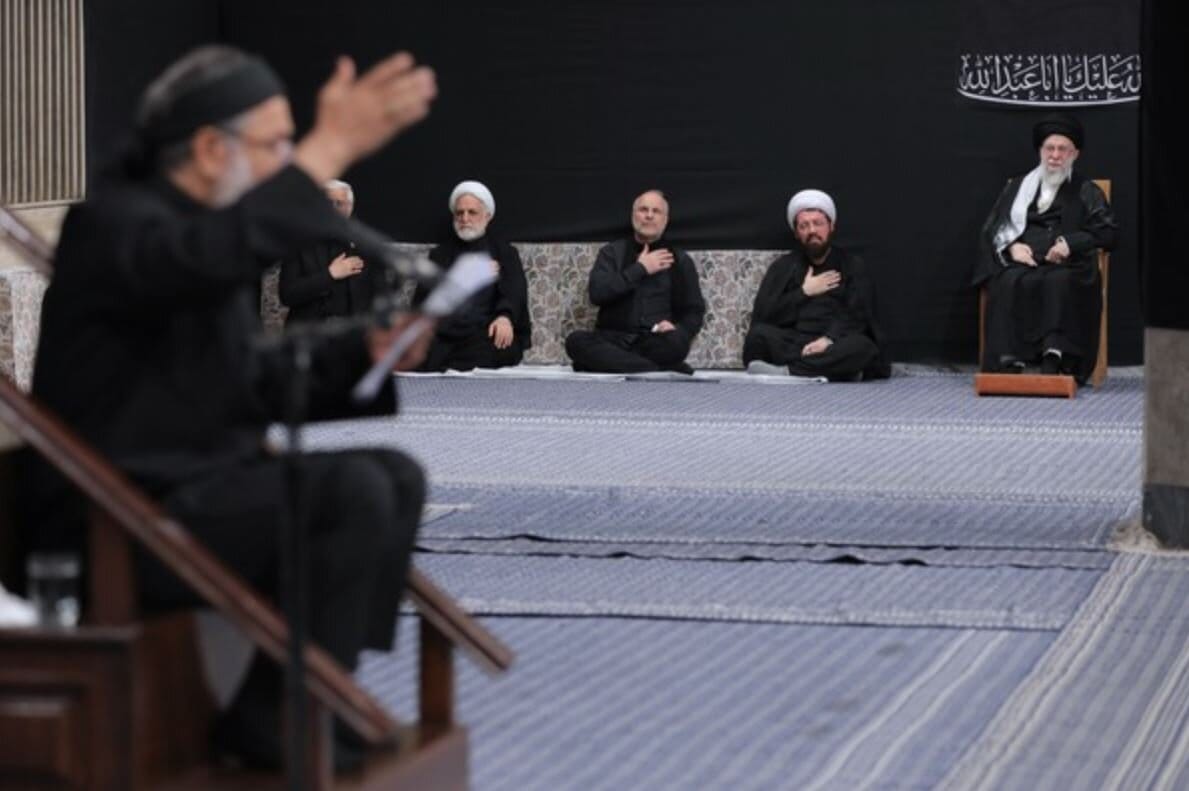
Tehran – One video is attracting particular public attention in Iran following the global circulation of footage showing Ayatollah, the leader of the Islamic Revolution, at a mourning ceremony the night before Ashura. In it, leaders are seen requesting one of the praisers to carry out the patriotic national anthem “Ai Iran” during the ritual gathering.
The story begins with the fact that “Ai Iran,” sung by famous Iranian vocalist Mohammad Nouli, has ranked among the top five most beloved musical works with patriotic content for the Iranian people since its release in 1981.
Meanwhile, in religious rituals commemorating Ashura, performers known as “Noha Sara” (pro-religious) usually sing elegant poems that mourn Imam Hussein and his 72 fellow martial artists, relying solely on percussive things like drums and cymbals, usually without melodic instruments.
Therefore, it is traditionally assumed by small fringes at each end of the secular or religious spectrum – not only are these two different musical styles, but also represent two diverse worldviews. One is a nationalist, another religion.
From this point on, the surprising nature of recent videos is beginning to take shape. Ayatollah Khamenei, as a religious authority of Shiites, appears to have called for the performance of nationalist songs in religious rituals. However, the story does not end here, as such dichotomy and contradictions did not exist in his worldview.
Old videos from the frontlines of the Iran-Iraq war in 1980 show him responding to soldiers asking if they should fight for Iran or for Islam. With a tone that reflects the spontaneity of his thinking, he clearly asserts that Iran and Islam are a unified reality as they are today. “We cannot protect Iran without fighting for Islam. We cannot protect Iran’s borders without raising the Iranian flag.”
Therefore, this integrated approach to the concept of Iran and Islam was present in the idea of Ayatollah Khamenei for at least 45 years. All we see today is an extension to concrete forms, such as music.
Mahmoud Karimi, now one of Iran’s most prominent religious pro-proponents, offers a new expression of this conceptual unity between Iran and Islam using the exact same melody (as it preserves the original nationalist undertone) that has only slight and deliberate modifications to the lyrics.
This performance, which was generally received warmly even before the Ashura ceremony, became a new symbol of unity in alignment with the leader’s longstanding attitude towards the dichotomy between religion and national character. It reflects the convergence between people and humans, both Shia’s religious authority and Iran’s most powerful guardians.