
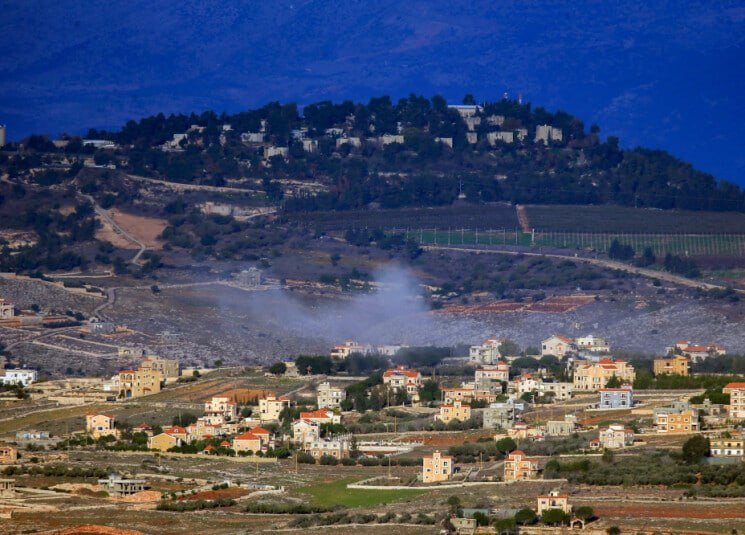
BEIRUT — In the past few months, Lebanon has witnessed repeated Israeli air strikes targeting economic infrastructure in the south and Bekaa, including bulldozers and excavators.
This reflects a strategy aimed at preventing the reconstruction and return to life of border villages unless Lebanon accedes to political and security demands.
Lebanon’s involvement in the ceasefire agreement did not help. Its exclusion from the Sharm el-Sheikh summit confirmed its marginalization of regional role and exclusion from so-called “greater peace” projects.
US President Donald Trump, meanwhile, was keen to show support for Israel’s position in Congress, calling for the disarmament of Hezbollah and the “imposition” of peace on neighboring countries.
This approach has heightened Lebanese concerns that the country could be vulnerable to a similar experience to Gaza, especially with the recent escalation after the Gaza deal and the accompanying U.S. move to force Lebanon into direct negotiations with Israel and win concessions.
On the military front, Lebanon appears concerned about the next steps, with sources speaking of the possibility of the area south of the Litani River being converted into a buffer zone and the possibility of sanctions being imposed on politicians to increase pressure on the government to disarm Hezbollah.
In this context, it was noted that European states seek to ensure the continuation of the UNIFIL mission in the south after the official end of its mission, in order to alleviate a security vacuum that Israel could exploit to exert greater influence on its borders.
In parallel, judicial negotiations between Lebanon and Syria are also attracting attention.
Syria’s Minister of Justice Mazar Alwais’ visit to Beirut marks an important step towards finalizing a draft judicial agreement that includes the extradition of Syrian detainees and wanted persons and the exchange of information on sensitive cases, including political assassinations.
The meeting of the Syrian-Lebanese judicial delegation demonstrated a shared desire for cooperation to strengthen legal and judicial procedures between the two countries and reduce tensions on the border, despite continued differences over the issue of political detainees.
What characterizes the current stage is that Lebanon faces two parallel problems. One is direct external pressure from Israel and the United States to reshape the security and political equations, and the other is pressure in favor of the Syrian regime.
These pressures reflect the depth of the challenges facing Lebanon, as every action at the military or judicial level has a direct impact on Lebanon’s economic and political stability.
Lebanon is at a crossroads. It is necessary to protect the sovereignty and independence of political decision-making processes, while at the same time seeking to ensure mechanisms that can resist Israeli pressure.
The next steps will be decisive in determining Lebanon’s ability to withstand security and political pressures and strengthen its role as a local and regional actor capable of defending its borders and national interests.