
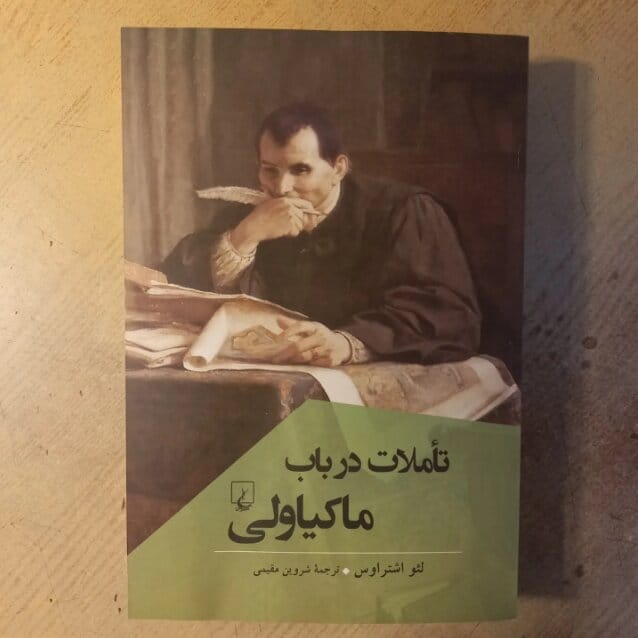
TEHRAN – The Persian translation of Leo Strauss’s The Philosophy of Machiavelli has been released in bookstores across Iran.
ILNA reported that the book was translated by Shervin Moghimi and published by Qoqnoos Publishing House in 520 pages.
In this book, first published in 1995, Leo Strauss argued that the most visible fact about Machiavelli’s doctrine is also the most useful: Machiavelli appears to be an evil teacher. Strauss tried to incorporate this idea into his interpretation without allowing it to overwhelm or exhaust the exegesis of The Prince and Livy’s Sermons on the First Ten Books.
“We sympathize with a simple opinion about Machiavelli (namely, the wickedness of his teachings), not only because it is sound, but above all because unless we take it seriously, we cannot appreciate what is truly admirable about Machiavelli: the boldness of his thought, the grandeur of his vision, the graceful delicacy of his speech,” he writes. This critique of the founder of modern political philosophy by this distinguished 20th century scholar is essential reading for students of both authors.
Leo Strauss (1899-1973) joined the University of Chicago in 1949 as professor of political philosophy and was later appointed Robert Maynard Hutchins Professor Emeritus of Political Science.
Niccolo Machiavelli (1469-1527) was a Florentine diplomat, writer, philosopher, and historian who lived during the Italian Renaissance. He is best known for his political treatise, The Prince, written around 1513, but not published until 1532, five years after his death. He has often been called the father of modern political philosophy and political science.
For many years, he served as a high-ranking official in the Republic of Florence, responsible for diplomatic and military affairs. He wrote comedies, carnival songs, and poetry. His personal correspondence is also important to historians and researchers of Italian letters.
After Machiavelli’s death, his name began to evoke the kind of unscrupulous behavior he most famously advised in his book The Prince. He was interested in how rulers succeeded in politics, and believed that those who prospered engaged in deceit, betrayal, and violence. He advised rulers to turn to evil when political necessity required it, and at one time said that founders and reformers of successful governments should be allowed to kill other leaders who opposed them. Machiavelli’s The Prince has been embroiled in controversy since its publication. Some think this is a frank account of political reality. Many see The Prince as a manual that teaches would-be tyrants how to seize and maintain power.
His work was a major influence on Enlightenment writers such as Jean-Jacques Rousseau and James Harrington, who revived interest in classical republicanism. Machiavelli’s philosophical contributions have influenced generations of scholars and politicians, many of whom debate the nature of his thought.
SS/SAB