
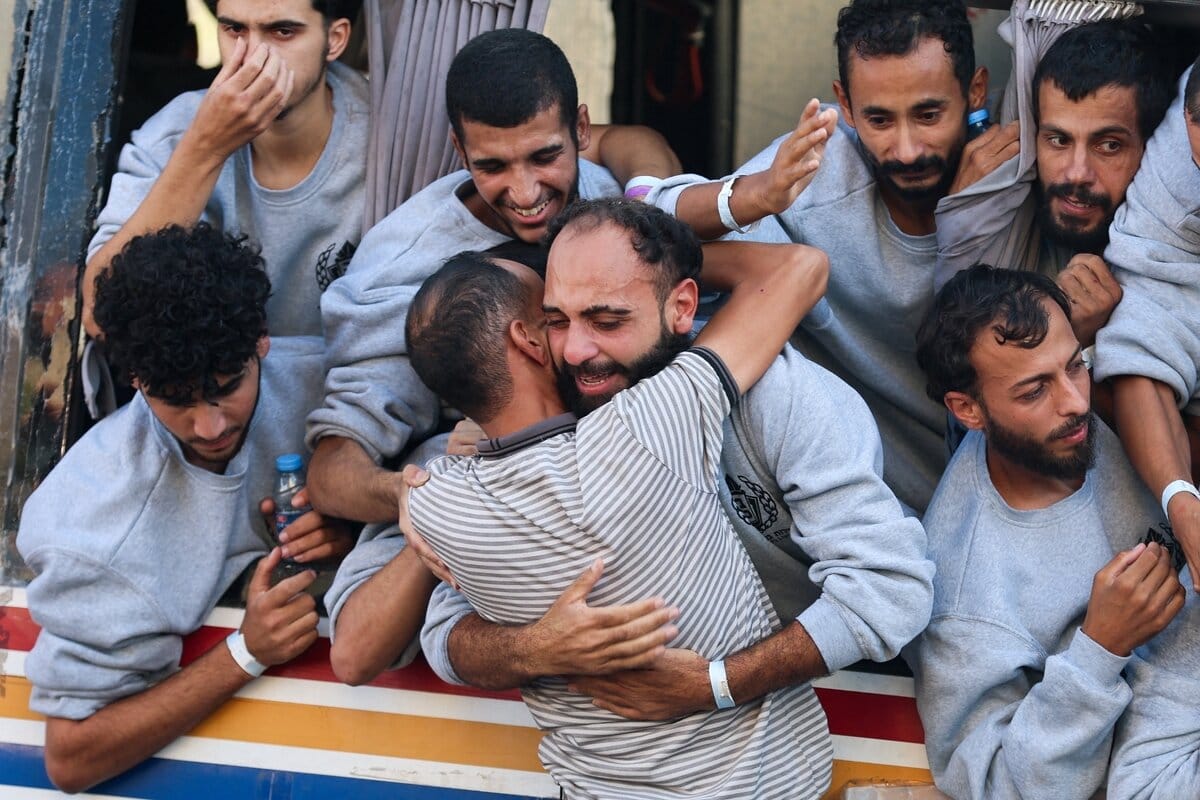
TEHRAN – They emerge from buses under pale, indifferent skies, their bodies shadows of the men they once were. Approximately 2,000 Palestinians released in the first phase of the October prisoner exchange have returned as ghosts.
There was a silence that seemed like a verdict as family members stretched out their arms and stepped back, then medical workers interrupted the embrace and sent dozens of people straight to the emergency room.
“I rejoiced with them,” whispered one released man, who learned that his family had been murdered while incarcerated.
Their names emerge like a ledger of violence. After spending 100 days in an underground cell, Nassim al-Radi endured weight loss and damage to his eyesight from repeated beatings and a final “farewell” kick, leaving him emaciated and weak.
Former university student Mohamed Al Asariya described a “disco” with a constant stream of deafening music that spoke of a regime of sensory torture. He said he was forced to lie face down on his knees for hours, threatened with wild dogs, blindfolded, sprayed with chemicals and subjected to relentless noise until his sleep and senses were ruined.
Photojournalist Shadi Abu Sid said guards stripped her naked, forced her to kneel to eat, broke her camera and threatened her family, before she fainted the moment they were reunited.
After nearly two decades of near-total isolation, Nedal Abu Akl emerged as if remembering the light for the first time.
Akram al-Bashouni, 45, from northern Gaza, was detained for nearly two years at Sde Teyman military base and other locations. He described a regime of systematic torture and killing and recalled how his fellow prisoners were beaten until they collapsed. When detainees asked guards for help, the response was chillingly uniform: “Let me die.”
Dozens more – including Samer Abu Dayak, Ayman Zahad, Ahmad Abdel-Al, Hassam Rayan, Mahmoud Issa, Abd al-Jawad, Mohammad Shamasneh and Mahmoud al-Dah – arrived with infections, broken bones, amputations, scars from electrocutions and blank stares of hunger. Hospital staff in Gaza admitted many people needed emergency surgery.
Taken together, these descriptions do not amount to random cruelty. These reveal Israel’s systematic structure of humiliation, including prolonged shackling, oppressive positions, forced nudity, sleep deprivation, withheld medicine, unclean food, and daily psychological torture.
Survivors have testified that they were beaten so severely that their ribs were broken. One returnee claimed that he had a burning liquid poured on his skin.
Several people reported being told that their children had died. For a devastated handful, the psychological torment inflicted by Israeli guards was devastating. The release provided confirmation that their loved ones were indeed killed in the Israeli military’s genocidal attack on Gaza.
Human rights groups and hospitals say physical evidence seen at the intersection is consistent with these accounts.
There is visual and documentary support. In mid-2024, widely circulated surveillance footage from the Sudeh Teyman detention facility showed sexual assaults and severe beatings of Palestinian detainees.
The video sparked outrage and a formal investigation. Several soldiers were arrested and questioned. But, predictably, justice was not served, investigations stalled, political leaders defended the defendants, and the case was resolved without meaningful accountability.
Human rights groups, from Israeli monitors to United Nations offices, have for years documented administrative detention without charge, denial of care and harsh interrogation methods. The record frames these new accounts as part of a longer-term pattern rather than isolated excesses.
The target is not limited to Palestinians. Dozens of international activists from the Global Sumud flotilla have reported being blindfolded, tied with zip ties, denied medical care and subjected to degrading treatment after being intercepted at sea.
Among them was Greta Thunberg, who spoke about her five days in Israeli detention, which were marked by beatings, humiliation and psychological abuse while in captivity. She said guards kicked her every time an Israeli flag brushed her face, taunted her with obscene slurs such as “Greta the prostitute,” denied her food and clean water and threatened to gas her captors while filming them for propaganda purposes.
The cross-national similarity of methods strengthens the argument that the practices are institutional rather than accidental.
Language is not neutral in this crisis. Western headlines focus on the “hostages” of captured Israeli soldiers. Palestinians returning from long-term administrative detention are commonly referred to as “prisoners” or “detainees.”
That choice narrows who is seen as a victim and who is treated as a problem to be managed. The recent exchange resulted in the partial release of approximately 2,000 Palestinians. According to reliable counts, nearly 9,000 Palestinians remain in Israeli custody, many of them without charge.
For those who step off the bus, survival will be measured by surgery and the slow labor of recovering memories stolen from years within the walls.
For the rest of the world, the obligation is clear. It is about naming what bodies and voices reveal without euphemisms, pursuing independent and transparent investigations, and being mindful of testimonies corroborated by hospitals and human rights documents.
Those who have returned are no longer silent witnesses. Their wounds are visible, named, and numerous, but they demand answers.