
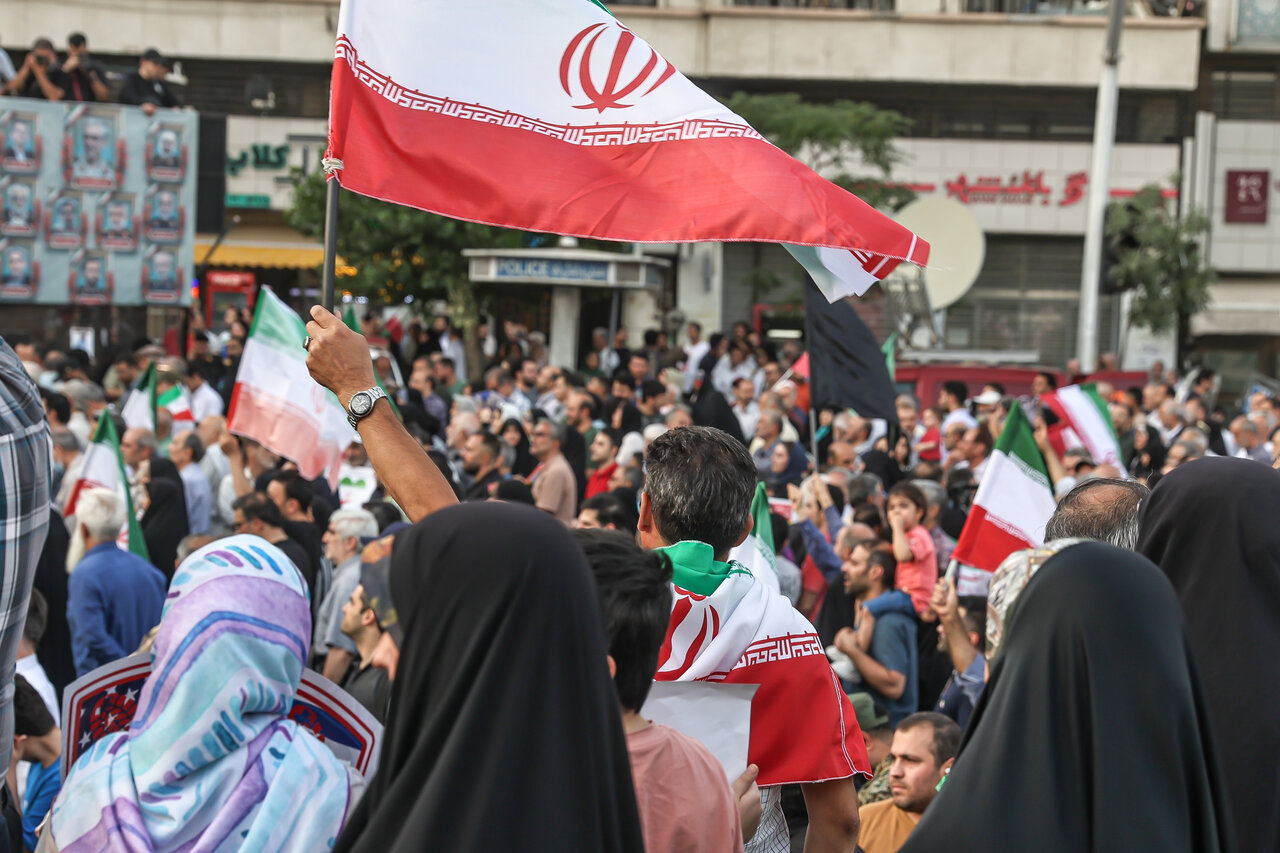
The Tehran-nation concept is still unfamiliar and is lost in the book than it is discovered. I go outside to find it on the street. I have never seen Tehran in this calm and humble manner, and rests quietly under the quiet embrace of Mount Damavand. In my small car, I head from the west towards the center of Tehran.
On the highways and alleys, all over the place, I see some people standing and chatting. The young man goes outside in his underwear, standing in the shadows of a large mural of martian Mustafa Chamran, as if summoned by a phone call from an old man across from him. It’s a beautiful scene. Quiet behind the security. I’m thinking about taking a photo, but my hands gently pull my phone down, seemingly suppressing my journalistic curiosity.
I remember some cafes announced earlier. They remember recently providing music, films, conversations and holding gatherings. I will change my route to “Cafe Tarik” (historical cafe). The place owned by famous figures in Iranian media and politics, due to his passion for documenting oral history, he transformed his cafe into a museum of modern history. As you walk you can wait for Hossein Debashi to pass and see him. As always, I stare at photos on the wall and newspaper clippings. It feels like it’s the first time each time. There is no more space on the wall. He has once predicted how much of modern history will remain, and will he leave some space for today’s headlines and photos? For Netanyahu, who attacked Tehran in several terrorist operations in the middle of negotiations? For Grossi, who will blindly look to his duties at the International Atomic Energy Agency every day? For the smile of that wounded girl staring at the camera in the arms of a nurse in the hospital?
We notice a table where a family of five, with two daughters and a son, sits. The cafe is very crowded! It seems that it gets even more busy as we approach the time to screen Woodyann’s “Midnight in Paris” on the roof of the cafe.
Dehbashi appears. Along with several other men, he draws out apricots, cherry and red plums from the car and brings them inside. Then Dehbashi invites me and we sit at one of the tables next to the young man. A young woman with a melodyka joins us and she adjusts her instruments when we greet each other. I ask, “Is this always crowded here?” She says, “These nights are even more busy! People love music and gatherings. I brought all the instruments here,” she says, pointing to the Saintour behind us.
Without further introductions, Dehbashi explains the fresh fruits on the table. “These were purchased by drivers from the orchard and presented to guests at the cafe.” “It feels like a religious gathering!” Dehbashi understands why this atmosphere is unfamiliar to the cafe as a Western context. He nods in agreement with the smile, “For our generation, there is no difference between cafes, religious gatherings, trenches. They are all trenches.” At least for a Western audience, it is difficult to understand the context of religious gatherings and their meanings transfer to modern Western platforms, or to recognize and respect its importance for Iranians.
“Does your cafe, especially those who help with younger people who look different, have the same view?” the young man asks, adjusting the glass up and down. “It is often argued that younger generations do not have ideals to agree or oppose any route or goal. But I have examples of how to resolve things. You don’t always see stars, but you don’t believe them, so naturally, people don’t want to see the night because they’re scary. Generations can be difficult and perceived, and now we have difficult times, so we should expect stars,” replies Debashi.
The change in cafe decoration and the repositioning of chairs to accommodate more people deflect me until the buzzword of “politics” pulls back the conversation. Dehbashi continues. “The political disagreements still exist, but people feel their presence, regardless of their perspective, in a meaningful connection to the existence of this house, and not because of the revelation of the evil nature of the Israelites in this situation, but because this issue was already revealed during the events of Gaza.
“But perhaps Iranian identity is a higher concept than the nation-state dichotomy, and now reveals itself. It is not something that anyone can control. The government should not hinder its manifestation. “Is there a moral standard for being Iran?”
“We have historical examples. General Oveyssi, who committed the massacres on June 15th and September 17th, did not kill or suppress people. A few years after the revolution, he immediately began gathering troops, imposing traces of them. And when Saddam attacked Iran, he did not frown to working with him. But others read so much that they only use their instrumental reasons to weigh their actions and consequences,” Dehbashi elaborates.
“However, reducing the moral standards for patriotism is just as ineffective as reducing humanity in nationalism when analyzing the behavior of people, especially our people,” Debashi adds to clarify to young people. emotional or psychological support in Iranian society.
Calligraphy on the wall reminds us of a poem from the Quran: “We influenced the soul with its evilness and its piety.” There is no philosophical complexity in moral judgment. Logically, there is no need for academic education. Moral reasons differ from philosophical reasons, taking an immediate and clear position. Debasi said, “Complicated people start reasoning at difficult times. But those who just bought fruit from orchards for the cafe are not that complicated. He may have a hard time keeping up with the conversation.
The retired old man retracted 10 million Toman from his account when he learned that he didn’t request tea here, despite it being a lot of money for him, but it’s not complicated. He is very generous. It’s like the story of Hatham Tai asking someone if they’ve ever seen someone more generous than him. The man replied, “The man who sacrificed a sheep for me!” Hatham asked, “What do you think? I sacrificed more!” he replied, “That man only had one sheep!” The billionaire who gives half a million Toman is not generous enough that retired employees give a cafe half their monthly salary during the war. “The newspaper clippings on the wall since the 1960s have shocked my heart. A state of fear.
“If Zionists weren’t using the terrorist methods and fought face-to-face, would Israel really have destroyed our commanders and scientists?” he asks. The young man smiles and takes off his glasses and says, “Iran’s commitment to avoiding terrorism is like a commitment not to produce nuclear weapons!” Dehbashi kept his gaze away from him, saying, “Our spiritual composition in Iran emphasizes courage and ethics in the fight. We were raised on the story of Hani Ibn Urwah and the refusal to kill Obaidura in Muslim homes. Machiavelian thinks of such an action fundamentally, and it says it openly, because such action is defensible in terms of moral reasons.”
“Do you think it’s a normal experience for people to bring fruit from their pockets into cafes during the war? Can the West understand that?” I ask.
I don’t know how it’s over there, but I think there’s a need for psychological and emotional shelter. The war is over, and people are killed or wounded. The wounds heal, but the damaged spirit remains. We have to live after all, and I would rather want people who are psychologically hurt. After all, that’s what we did. Happiness is important to society. If the polarization is enhanced, they say they don’t recognize that the polarization is legal.
What are the most common keywords you hear these days?
Question: “What will happen?”
So, what really happens?
For me, it’s clear that we will become more fellow people. We will become more Iran. Weber has a concept of what makes people a nation. It points to races, a common language and geography, but they all have challenges. People who share their experiences seem to feel like compatriots. I didn’t know what would come at the end of the eight-year war with Iraq. In some respects, perhaps, the outcome was not great, but we became like fellows. Going to the farthest corner of the country’s villages and towns, the most respected part of the local cemetery is where the Iranian flag was not placed by the government. That shared experience brought these two places together. So, after this, we will definitely be more countries, whether there is nuclear energy or if the invaders have lost it, that we will definitely become more countries. ”