
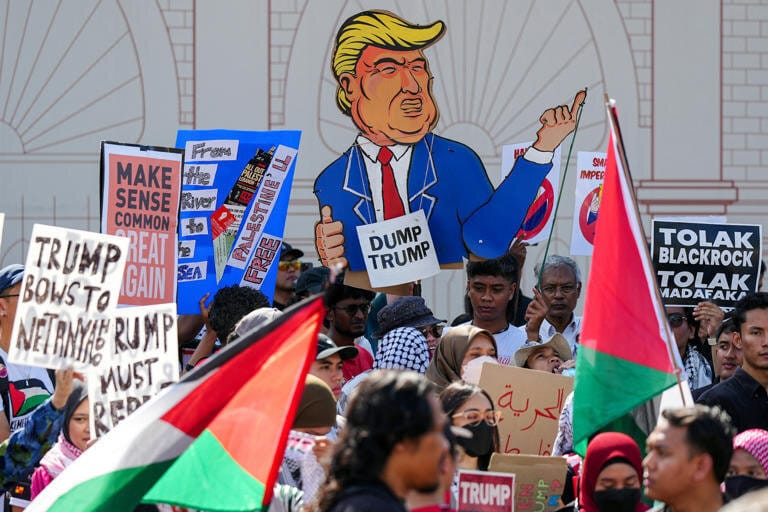
Thousands of pro-Palestinian demonstrators gathered in Kuala Lumpur on Sunday to protest US President Donald Trump’s visit for the 47th ASEAN Summit, expressing strong opposition to his administration’s unwavering support for Israel’s war on Gaza.
The protests, organized by various non-governmental organizations, began in the morning at Dataran Merdeka (Independence Square), with participants waving Palestinian flags and shouting slogans such as “Free, Free Palestine”.
Many wore keffiyehs and held placards condemning the massacre in Gaza.
Asma Hanim Mahfoud, who traveled 300 kilometers from Kelantan to attend the rally, told Al Jazeera: “Everyone with a conscience knows that Trump is a genocide. Without him, Israel cannot kill all the children and people of Gaza. It’s not rocket science.”
Later that day, about 200 protesters reconvened at Ampang Park, near the Kuala Lumpur Convention Center where the summit was being held. The demonstrations continued largely peacefully under heavy police security.
Some demonstrators threw shoes at portraits of President Trump and Israeli Prime Minister Benjamin Netanyahu, symbolizing their disdain for U.S. policies seen as enabling Israeli aggression.
The protests reflect dissatisfaction in Muslim-majority Malaysia with the US government’s support for Israel’s war in Gaza, which has killed more than 68,000 Palestinians and injured more than 170,000, mostly women and children.
Against the backdrop of these demonstrations, President Trump attended the ASEAN Summit and oversaw the signing of the Kuala Lumpur Peace Agreement between Cambodia and Thailand.
The deal aims to ease tensions along the shared border, including measures such as removing heavy weapons and establishing an ASEAN observer mission to monitor the ceasefire.
Additionally, President Trump announced trade deals with Malaysia, Thailand, Cambodia, and Vietnam, focusing on areas such as critical minerals and rare earths.
Despite these diplomatic engagements, the protests highlight regional misgivings about U.S. foreign policy, particularly its stance on Gaza.