
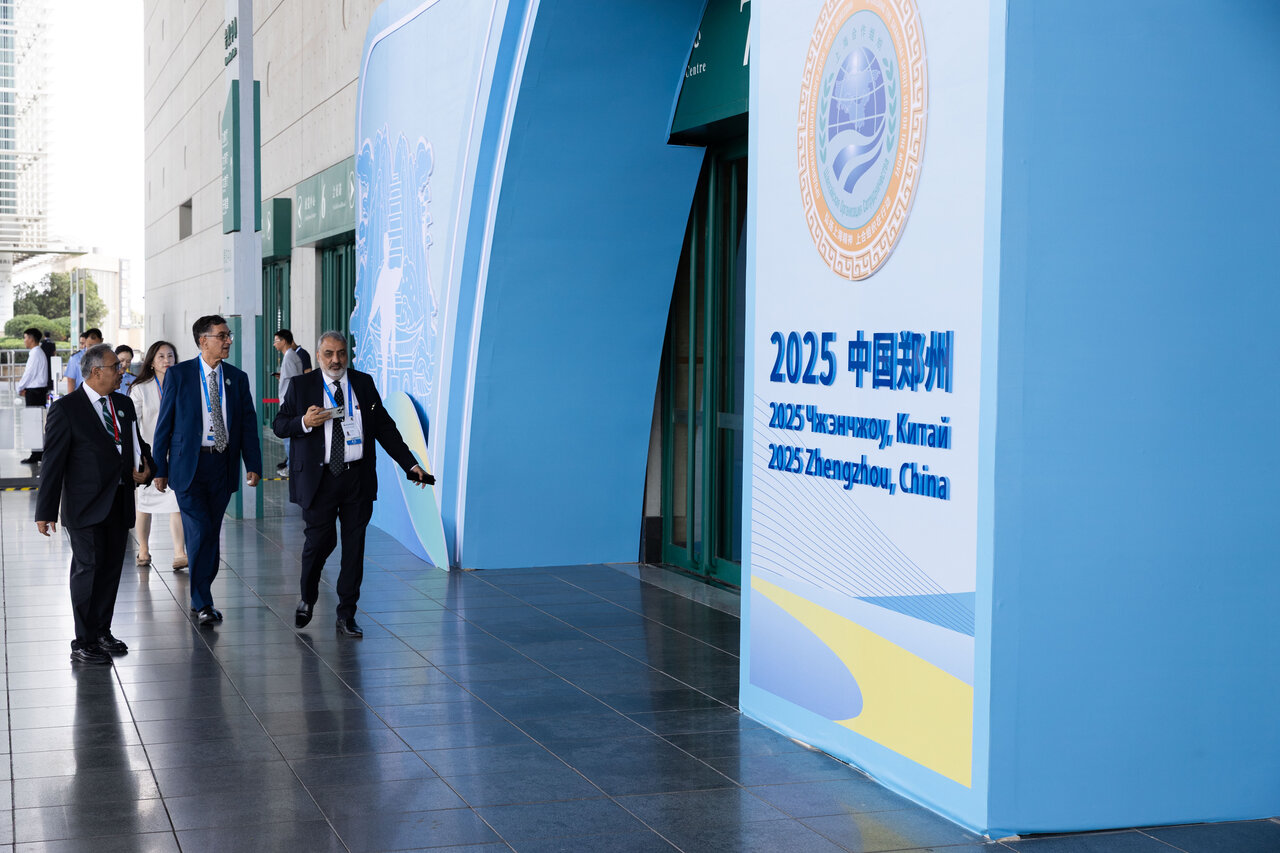
Zhengzhou – Speaking at the Shanghai Cooperation Agency (SCO) Media and Think Tank Forum, Dr Mohammad-Mehdi Rahmati, CEO of Mehr Media Group, emphasized the need to build an institutional framework for media cooperation to form a fair and equitable international order.
Rahmati highlighted the strategic and fundamental role of media in promoting equity and balance of global issues by addressing more than 400 participants, including media experts, think tank experts, government officials from SCO member states and dialogue partners.
The forum will be held in Zhengzhou, the capital of China’s Henan Province from July 23rd to 27th, 2025, and is supported by major institutions including China’s Xinhua Communications Agency, the Chinese Academy of Social Sciences and the Henan Government.
The event will be headed towards the 25th SCO Head of the state summit, scheduled to be held in China this September.
The full speech of Dr. Ramati is as follows:
“Dear and renowned guest attending the Shanghai Cooperative Organization Media Summit,
Respected media executives and representatives of SCO member states;
A good day.
It is a great honor and joy for me to be here with you and speak at this important gathering. I would like to express my sincere gratitude to my dear friend Hu and his dedicated colleagues at the respected Xinhua News Agency for hosting this event.
In recent years, Xinhua has shown an important role in promoting media coordination and cooperation regionally and internationally. Its performance reflects the “Shanghai Spirit,” which was established on the pursuit of mutual trust, mutual benefit, equality, consultation, respect for cultural diversity, and shared development.
When we talk about a fair and just order, it is natural to recognize the importance of historical and regional identities in shaping such new orders. In my country, for example, Iran, Abu Nasr Mohammad al-Farabhi (a 10th century philosopher known in the West) is considered the founder of Islamic philosophy and a prominent thinker of musical theory.
He was born in what is now Kazakhstan Farab and died in Damascus, Syria, and wrote most of his works in Arabic. But throughout the region, including Iran, we consider him our own. Beyond competition for ownership of cultural heritage, this reflects the deeply interrelated roots of shared identities in Central and Western Asia. An international order that ignores such a shared cultural foundation is truly fair and not fair.
The “East” built by the West has been critically investigated by scholars like Edward’s saying (Christian Arabs), Homi Baba and Gayatri Spibach (both Indian thinkers). These may be one of the earliest intellectual attempts to emphasize the need for a more balanced and fair order. Whether or not you join colonial theory, the right to define a fair and independent national and international system must be preserved for all of us.
One fundamental approach to building a fair and just order is to embrace the idea of the international community rooted in the diversity of civilization. As the Chinese philosopher Mencius said in the fourth century BC, “things are essentially different.” Therefore, futures seeking to strengthen alternative mechanisms like SCO must commit to civilized and cultural diversity in the face of unilateral uniformity and forced homogenization.
Shanghai is non-western, but not anti-western. The SCO provides a balanced framework of institutional cooperation, both in managing relationships between member states and in engaging with other international stakeholders. It provides an alternative vision for the international order.
Through meaningful joint action, such organizations can play an ethical and effective role in shaping new world order based on equity and justice.
However, the important question to address this media gathering of SCO members is how culture and media can promote justice and order through the Shanghai cooperative organization.
The first step is to build mutual trust within the organization and establish a clear and smooth framework for media cooperation. The designated secretariat may be liable for this. In line with the spirit of Shanghai, we must understand each other better. And media is our main tool to achieve that. Diversity and differences are natural. The key is to build collaboration on the myriad shared topics we have. The Secretariat should regularly monitor and report on the level of participation by members and assist in the distribution of valuable news and analysis.
The second step is to support the spirit of Shanghai by increasing media dialogue. It is essential to provide equal opportunities for discussion and seek mutual understanding. The outcome of this media engagement will result in less internal conflict within the organization and increased solidarity and cooperation to achieve that goal. Media collaboration in such dialogues will allow for true interactions towards a more fair and fair order, allowing for a more accurate and fairer order.
The third step is for SCO media to actively pursue implementation of decisions made both nationally and internationally during various organisational meetings. Deep institutionalization is key to becoming a major and influential entity that can maintain its position against existing structures. Media can play a central role in this process. For example, in the economic sector, if the proposed SCO Development Bank were to be realized, it would deepen the organization’s institutional framework significantly.
The fourth step is to believe in the importance of mutual commitment to Asian security as a requirement to establish a fair and just order. Media must help clarify and expand this concept, allowing a broader understanding of its meaning, dimensions, and needs. This is because ideas like this would not become reality without public support and participation.
As a fifth step and a concrete joint initiative, I propose media engagement to support the Belt and Road Initiative (BRI). SCO members contribute to BRI at various levels, but it stems from shared cultural and historical experiences. The Ancient Silk Road once enabled cultural exchange, economic cooperation and local solidarity that benefited all participants. China, as a major initiator, plays a strategic role in shaping the BRI, but has always welcomed the expansion of dialogue and cooperation, especially among SCO members. Through constructive engagement, these countries can help make BRI a successful model of international development. Media can also clarify misconceptions about initiatives through open dialogue with their own society, and become an important factor in their progress.
They say that people are never the same after the war. Less than a month later, I was another person. Only those who have experienced the pain of war really understand it. As journalists, I don’t know if we were approaching war or if the war was quietly drawn to us. The loss of 227 journalists in Gaza is not a minor issue. Just 40 days ago, one of my friends, Nima Rajabpur, had martyrism during the war between Iran and the Israeli regime.
They grew up together in Tehran’s Narmak district, once known for their pomegranate trees. He was four years older than me and became a journalist a few years before I did it. We went to school, mosques and gyms together. In recent years, our daughters have become friends and have been taking part in music and ceramic classes side by side.
Unlike me, who was attracted to media management, Nima believed that journalism and news editors were sacred callings. On the day Israeli fighter planes launched 11 missiles at the central building of Iran’s National Broadcasting Agency, he was killed by flying through the sky of hot metal and glass. He passed away with the same calm and kind smile he always had – now stained with blood.
I hope that the war did not take away the kind people from us. I wish it hadn’t transformed my life into mere memories. We used to think that war would make people more distant and loving, but Nima’s memories have strengthened us. I am sure that a real person cannot be destroyed by war.
Thank you for your attention. “