
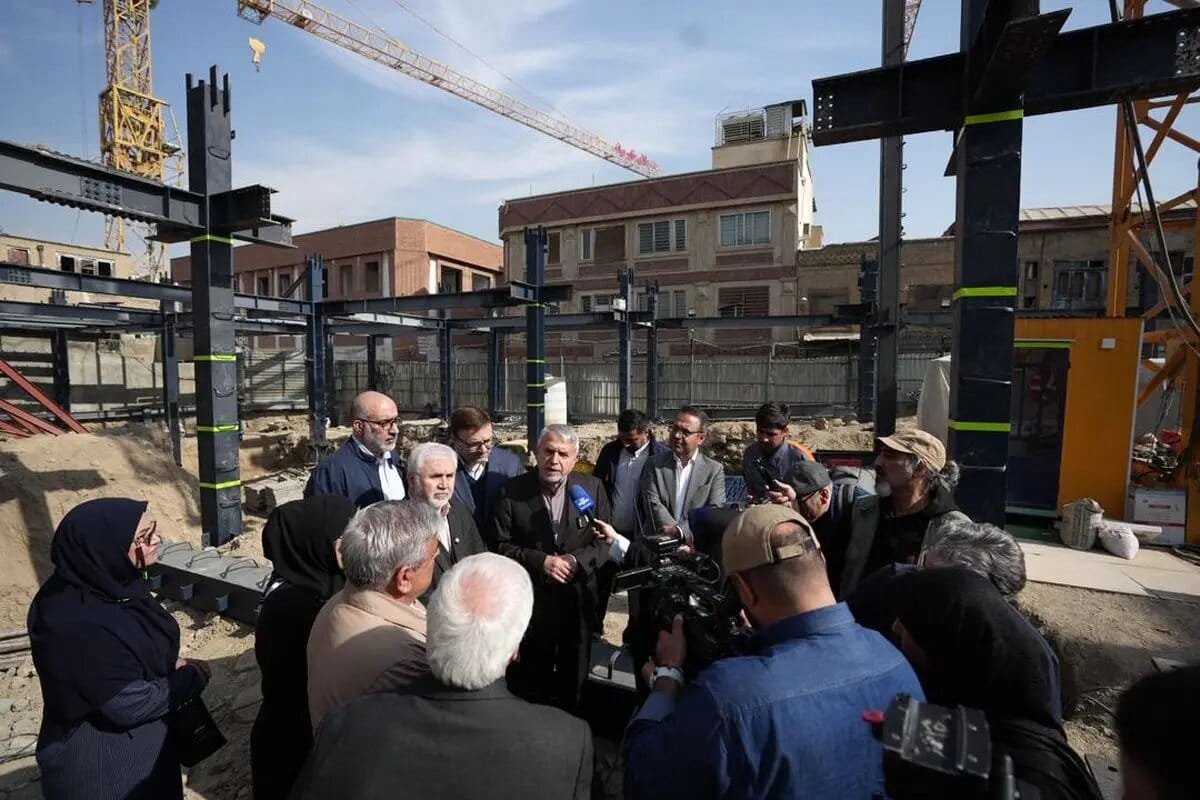
TEHRAN – Iran’s Minister of Cultural Heritage said on Friday that violations of heritage protection rules will not be tolerated and called for an immediate halt to suspicious construction near Golestan Palace in central Tehran.
Following public concerns about new buildings being built in the area, Seyed Reza Salehi Amiri visited the palace complex and surrounding construction sites on Friday. The palace is a UNESCO World Heritage Site and one of Iran’s most important Qajar period monuments.
“All regulations regarding protected areas and buffer zones are mandatory,” Salehi Amiri said during the visit. “No one has the right to violate heritage boundaries,” the minister stressed.
Recent reports suggest that although an eight-metre height limit has been approved for the project, the building’s foundation may be designed for an even taller structure.
“These monuments are entrusted to the authorities, but they belong to the people,” Salehi Amiri said. “No public authority or responsible authority will allow even the visual boundaries of the premises to be distorted.”
Salehi Amiri said the ministry is coordinating with the city of Tehran to halt construction, and judicial authorities are expected to follow up on the enforcement situation.
The task force will consider the technical details and report its findings to the public. The group is chaired by Deputy Minister Ali Darabi and includes heritage experts Seyyed Mohammad Beheshti, Mohammad-Hassan Talebian, Saeed Tarai and Reza Khaldouni.

Salehi Amiri said all decisions must follow legal procedures and be considered by the relevant heritage council. He called on local authorities to work with Tehran’s district leaders to ensure compliance with national preservation regulations.
“The Ministry of Culture and Heritage will not allow profiteers to achieve their goals,” he said. “We will support public opinion against any violations.”
He also called on Tehran’s mayor to strengthen supervision over construction near historical buildings, while pointing out that the city generally cooperates with the ministry.
Inscribed on UNESCO’s World Heritage List in 2013, Golestan Palace served as a royal palace and government center during the Qajar Dynasty. Known for its fusion of Persian and European architectural elements, it played a central role in the development of contemporary Iranian art.
Salehi Amiri said Tehran’s historical buildings are valuable national assets and called for increased public awareness of the capital’s cultural heritage. “Many people in Tehran and other regions do not know about this historic region,” he said. “It has the potential to become a major destination for domestic and international tourists.”
morning