
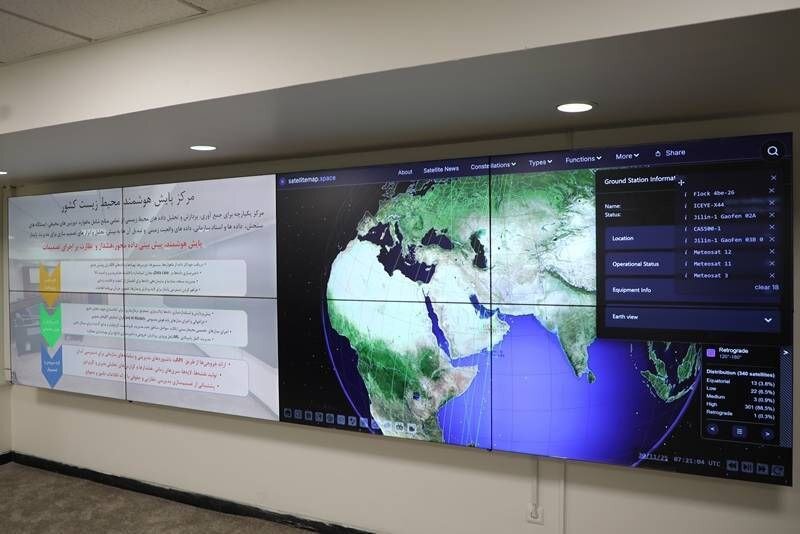
TEHRAN – The Department of Environment (DOE) launched a smart monitoring center on Sunday to provide real-time data on various environmental parameters, thereby improving management efficiency and reducing disaster risks.
The center collects online data from environmental sensors and processes and analyzes the results. IRIB reported that such modern centers replace traditional, time-consuming field monitoring with smart sensors and artificial intelligence to instantly identify changes in ecosystems and manage natural resources more efficiently.
Physical monitoring involves collecting data using traditional tools and methods, such as manual sampling of water and air, field visits to soil and plant species, and measurement of ambient temperature with basic equipment. This type of monitoring typically requires human presence on-site, and data is collected at specific time intervals. Physical tracking, which directly indicates the actual state of the environment, is very important for sustainable development. It is also essential for validating other data. However, it can be inefficient, costly, and prone to human error.
However, smart monitoring leverages modern technologies such as the Internet of Things (IoT), AI, and big data analytics. It enables continuous collection and analysis of data, providing accurate and rapid insights into changes in the ecosystem. Wise management of the environment contributes to effective monitoring and protection of natural resources. Helps manage and control the spread of pollution. Also, decisions are made based on real-time data, making them much more efficient.
conservation of natural resources
On March 9, the Ministry of Energy held a national conference on conservation of natural resources in Tehran.
“Regarding the fact that this country is affected by climate change, we need to develop adaptation measures and take steps to promote resilience. This will require close cooperation between different organizations,” IRNA quoted DOE Secretary Shina Ansari as saying.
“Over the past century, the world has lost one-third of its natural resources. In our country, we are experiencing quantitative and qualitative depletion of natural resources for a variety of reasons,” Ansari said at the conference.
When talking about the value of forests, economic benefits are usually considered, but non-market services such as water regulation, soil conservation and carbon sequestration are ignored, as well as habitat for plant and animal species.
The official went on to say that DOE estimates the value of 64 percent of sensitive ecosystems so that their true economic value can be assessed. We contribute to exploring the true value of natural capital, which is not eternal.
“Furthermore, it helps make the right decisions between development goals and the benefits of a healthy ecosystem,” she added.
Ansari said forests are home to 80% of terrestrial biodiversity and forest degradation causes severe habitat destruction and leads to species decline.
The official also emphasized the importance of promoting environmental culture, educating local communities, restoring damaged areas, developing sustainable forest management plans, utilizing modern technology, and judicious monitoring of areas as key elements to conserve natural resources.
According to the executive director of the National Policy Planning Headquarters for Dust Storm Control, 2.5 million hectares of dust storm hotspots in the country have stabilized over the past six years.
This action was taken in cooperation with other organizations, in particular the Natural Resources and Watershed Management Organization.
SDS hotspots in 23 states cover approximately 35 million hectares. ISNA quoted DOE official Ali Mohammad Tahmasubi as saying that they are responsible for generating dust across the country.
Tahmasubi cited the stabilization of the 120,000 hectare SDS hotspot in the southeastern part of the state as one of the key measures of the national headquarters, saying it is an example of successful cooperation and synergy between the government and other agencies.
He further emphasized the importance of adopting measures based not only on scientific principles but also on local specific conditions, such as soil type, climate and available water resources, to achieve the desired results.
MT/MG