
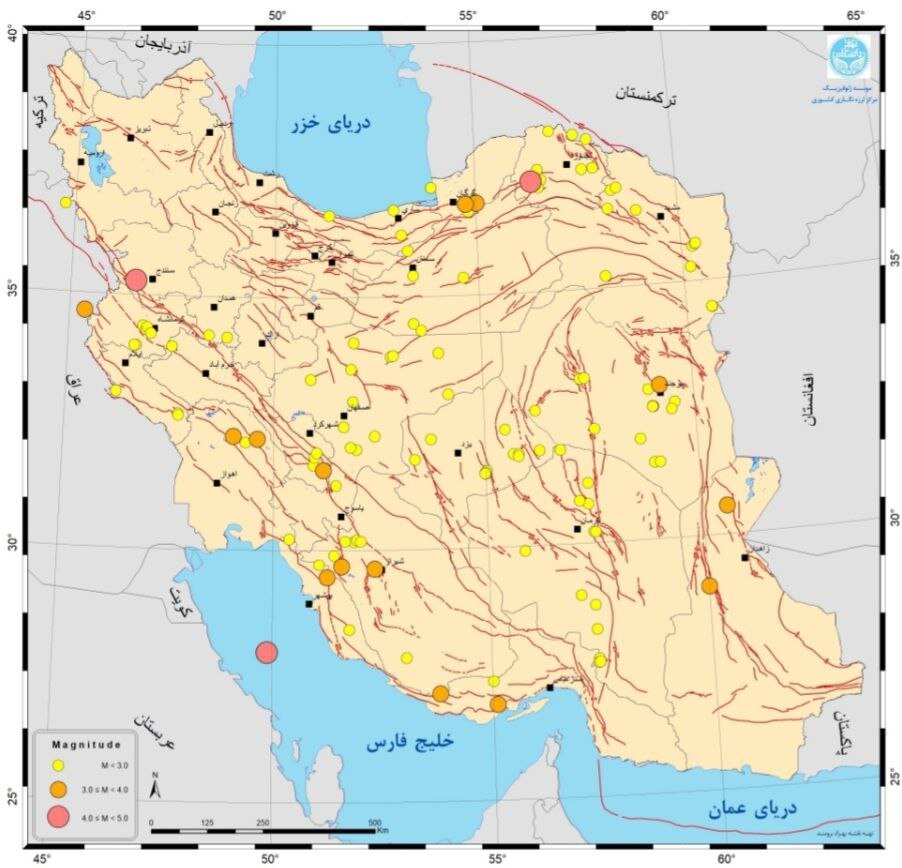
TEHRAN – A total of 132 earthquakes were recorded across the country in the week from November 15 to 21, according to the Earthquake Network of the University of Tehran Institute of Geophysics.
Statistically, there were 115 earthquakes with a magnitude of less than 3. There were 14 earthquakes between magnitude 3 and 4. According to a report by IRNA, there have been three earthquakes between magnitude 4 and 5 in the country, but no earthquakes greater than magnitude 5.
Among the provinces in the country, Isfahan had the most earthquakes with 16, followed by South Khorasan with 15, followed by North Khorasan, Kerman, and Yazd with 12 each.
Of the total earthquakes, one with a magnitude of 4.3 on the Richter scale occurred in the Persian Gulf on November 18th.
During the same period, no earthquakes were recorded in Tehran, East Azarbaijan, West Azarbaijan, Ardabil, Alborz, Zanjan, Qom, Qazvin, Kogilye Boyehmad, Gilan, Mazandaran, Lorestan, and Markazi governorates.
According to the Seismology Network of the Geophysical Institute of Tehran University, a total of 6,272 earthquakes were recorded across the country in the past calendar year (March 2024-March 2025).
Of the registered earthquakes, 150 were of Richter scale 4 or higher. The country experiences at least five earthquakes of magnitude 4.5 or higher each month.
The Iranian Plateau is located in a highly seismically active region of the world and is known not only for large and devastating earthquakes, but also for natural disasters, especially earthquake-related disasters.
Approximately 2 percent of the world’s earthquakes occur in Iran, but over 6 percent of the world’s earthquake casualties in the 20th century were reported to be due to Iranian earthquakes.
MT/MG