
TEHRAN – The Motamed Cancer Institute, which was recently upgraded to the National Cancer Institute of Iran, continues to take important steps towards improving public health and social welfare.
Dr. Ramin Salami-Forshani, Director of the Motamed Cancer Research Institute, affiliated with the Academic Center for Educational, Cultural and Research Research (ACECR), announced that the center has been promoted to the National Cancer Institute of Iran, highlighting this as a milestone in the improvement of public health.
He noted that ACECR continues to make great strides toward improving the health and well-being of society, fulfilling its mission to address national challenges and harness scientific and technological capabilities.
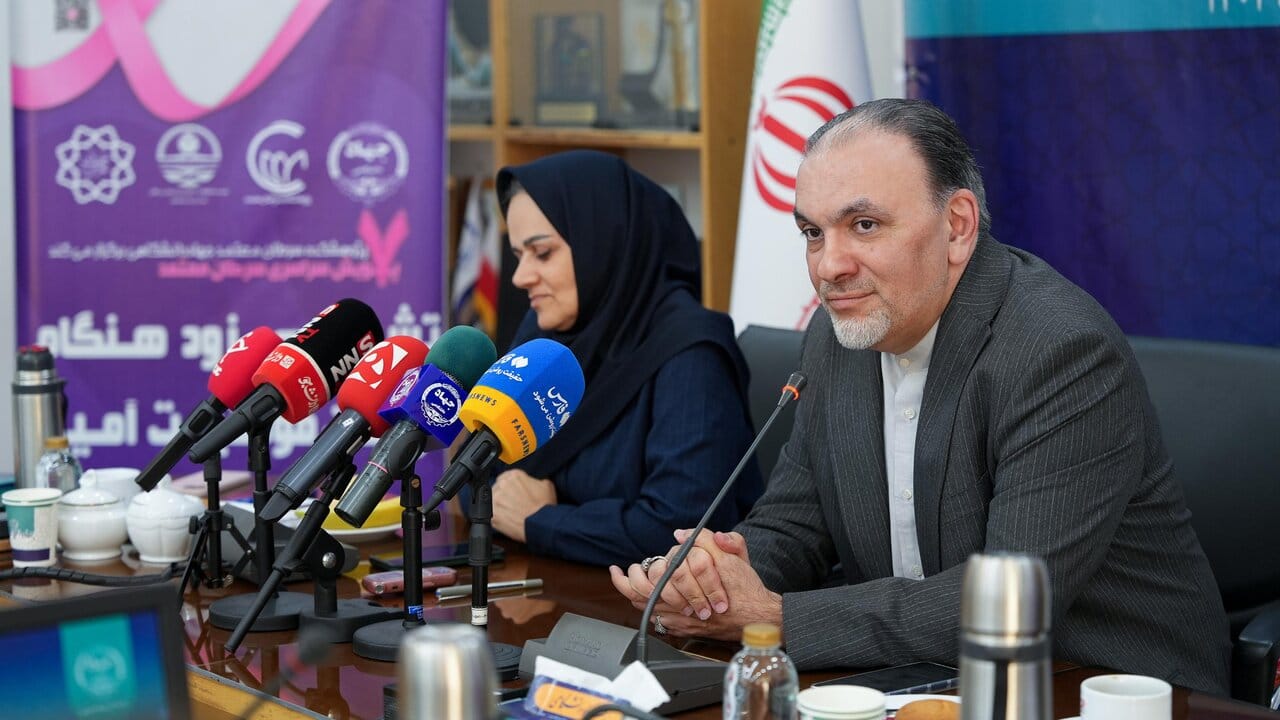
In this regard, a press conference was held on October 13th (Monday) to coincide with Breast Cancer Awareness Month (October), and the 7th National Cancer Screening Campaign for Women was announced.
The event was attended by Dr. Zahra Sheikh, Deputy Director of Research and Technology at ACECR. Dr. Ramin Salami Foroushani, Director of the Motamed Cancer Research Institute, and Deputy Director of Research and Education at the Institute, Dr. Asiye Olfat Bakhsh.
Dr. Ramin Salami Forshani, Director of ACECR Motamed Cancer Institute, with the support of ACECR Board of Directors, Central Headquarters and Deputy Director for Research and Technology, announced that the center has been officially elevated to the status of National Cancer Institute of Iran.
He explained that under the new structure, three specialized research centers will be operated under the umbrella of the National Cancer Center: the Institute for Advanced Regenerative Medicine and Cancer Treatment, the Institute for Cancer Fusion Technology, and the Institute for Personalized Medicine and Quality of Life, making up a total of approximately 10 research departments.
Prof. Salami Forshani added that this important achievement is the result of 30 years of dedicated efforts by ACECR scientists and researchers, and expressed the hope that with continued support from the national authorities, the Institute will become a major national hub for the development of innovative technologies in the field of cancer.
cancer innovation tower
Elsewhere in his remarks, Salami-Forshani announced the start of construction of a 15-story cancer innovation tower and advanced treatment ecosystem in Tehran.
He said the project was launched with the strong support of Congress, especially the Health Committee, the Planning and Budget Organization, and the Vice President for Science, Technology and Knowledge Economy. A portion of the funding has already been secured and the upper floors of the tower will be dedicated to producing innovative technology for advanced cancer treatment.
He emphasized that maintaining ACECR’s cultural identity alongside technological development remains the institute’s core value. He added: “While focusing on innovation, we continue to embed cultural principles in all our scientific and health-related endeavors. This is the hallmark of ACECR’s approach at Motamed Cancer Institute.”
National program for early cancer detection underway
Professor Salami Forshani also said that a national program for early detection of cancer is being implemented and highlighted the institute’s 30 years of experience in cancer screening and diagnosis.
He pointed out that the institute’s activities began nearly 30 years ago as a small clinic on Shaheed Nazari Street, when the concepts of early detection and cancer screening were not widely recognized in Iran.
Today, this mission continues in the form of a comprehensive, scientific, and national program implemented in collaboration with ACECR’s Research, Medical, and Cultural Division.
He went on to say that the National Cancer Institute is the result of a long-term dedication that transformed a small clinic into a national science and technology center dedicated to improving public health.
He also announced the launch of the National Breast Cancer Awareness Campaign to coincide with World Breast Cancer Awareness Month (October), saying the campaign is being rolled out across three main axes: promotion, education and treatment to provide concrete and accessible health services to the public.
The campaign will include awareness activities such as iconic city-wide events, educational workshops for healthcare professionals, and free testing and treatment services for diagnosed patients.
She emphasized that breast cancer remains the most prevalent cancer among women worldwide and that early detection can significantly improve survival rates and significantly reduce treatment costs. He added that the average size of tumors at diagnosis in Iran remains around 32 mm, compared to the global average of 8 mm, stressing the need for stronger early detection strategies.
He thanked the efforts of researchers, clinicians, cultural experts and volunteers involved in the national campaign and concluded by stressing that supporting women through education and early detection is actually about supporting the foundations of families and society as a whole.