
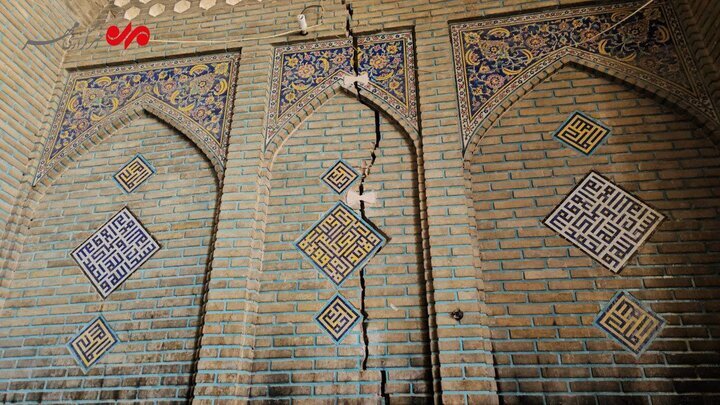
TEHRAN – The Iranian government cabinet has approved the formation of a national task force to combat the sinking, operated under the supervision of the First Vice President, to protect the oversight of the historical monument and World Heritage of Amir Kalamzadeh, the head of the Isfahan Cultural Heritage division.
According to Mehr’s press, he mentioned aspects of the land subsidence crisis in the historic texture of Isfahan and the measures taken by the state’s Cultural Heritage Department to combat this phenomenon.
“The issue of subsidence is taken into consideration not only from a scientific perspective, but also at the level of the country’s macro-control, and the groundbreaking building in Isfahan is seriously at risk.”
The subsidence rates published in the historic region of Isfahan are set based on scientific and specialized research, but “We investigated the issues of subsidence in the field and worked with the basin management organization and the governor’s crisis headquarters in detail.
These aquifers provided groundwater resources for centuries, but he noted that today, extensive extraction and halting the flow of the Zayande River has empty the underground aquifer and holes in the ground.
“This task force, which operates under the chairmanship of the first vice president, is intended to provide a fundamental solution to curb this crisis. The formation of such a task force indicates that the issue of subsidence has gone beyond the boundaries of the state and is of national concern.”
Karamzadeh added: “We in the state proposed approximately 300 billion rial ($3.3 million) of credit for the region and sent it to the country’s crisis management headquarters. With the serious support of Sardar Joséin Sajedynia as head of this headquarters, appropriate financial resources will be allocated to prevent the capacity of our citizens.
“Our overall estimates show that at least 1000 billion rials ($1.1 million) of credit is required to fully retrofit the Isfahan historic monument to subside. This figure is estimated solely in the city of Isfahan, indicating that the extent of the crisis exceeds the local capacity.”
Expert research shows that different buildings have different amounts of sinking. In some places, it is recorded from 2-3 cm to 15 cm in some historical textures.
He said the biggest concerns relate to Naqsh-e Jahan Square, Imam Mosque and parts of the historic bazaar. “For this reason, the issue of emergency reinforcement is a priority to prevent the possibility of collapse. These measures are not temporary, but if implemented correctly, they can control the process of destruction.”
Kalamzadeh pointed to the special vulnerability to the subsidence of Isfahan’s historic minaret, saying, “The minarets are at great risk due to their special foundations and heights. If they tilt slightly under the foundations or sinking occurs, the chances of destruction will be greatly increased. Implementation.”
“If these measures are not taken in a timely manner, even small earthquakes can pose serious risks to the minarets. Therefore, attention must be paid to earthquake renovations, along with precautions against subsidence.
KD