
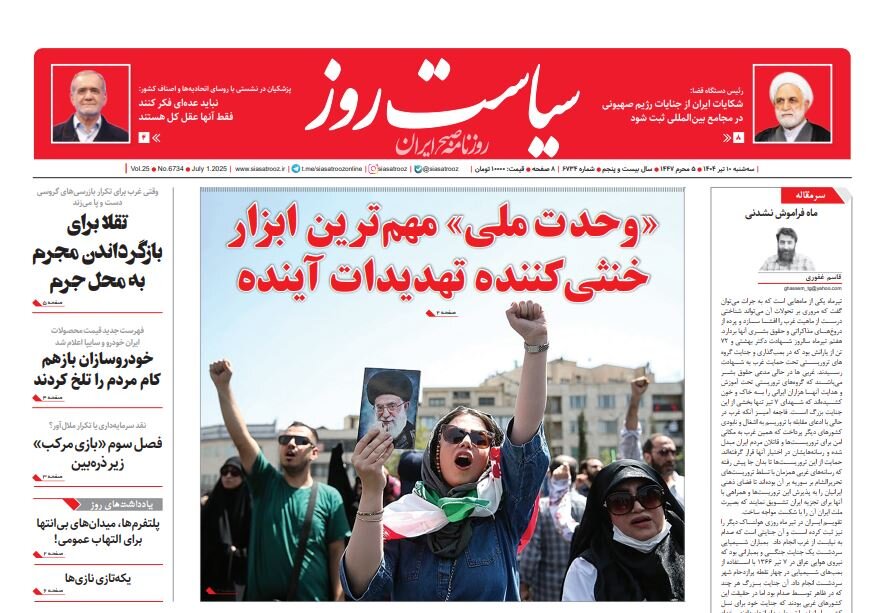
Tehran-Siasat-e-Rooz dedicated his headline to the unification of the nation in difficult circumstances, writing:
With the open support of the United States, and especially President Donald Trump, the Zionist administration launched a massive operation against Iran with the aim of weakening Iran’s defense capabilities and creating a division in Iranian society. Invasions, including attacks on military, nuclear and residential areas, not only tried to hit Iran’s defence infrastructure, but also incited the public and caused internal unrest. Despite all these attacks, Islamic Iran relies on its military power and social cohesion, and is able to withstand the most complex external threats. The operation, “The True Promise III and the Herald of Victory,” was a manifestation of Iran’s national power and determination, along with the participation of millions of people in the funerals of martial artists. However, given the challenges, particularly the enemy’s efforts to create social division, it remains serious, and maintaining national unity and vigilance against enemy psychological warfare is key to Iran’s success on this path.
Javan: Shameless Europe
In the article, Jawan said the European trio in Britain, Germany and France are acting shamelessly on issues related to Iran’s nuclear program. It writes as follows: Three European countries, which are members of the JCPOA, have turned their eyes on all betrayal, especially by the IAEA. They unanimously called for continued cooperation with the Tehranian institution, returning to the negotiation table and accusing Iran of threatening greenery. In response to such a position, Iran has emphasized that Iran is not threatening Grossi, but the IAEA should know that there is no prospect of Tehran’s cooperation if the current situation continues, such as the new threat of military strikes against Iran’s nuclear power plants and the ongoing disregard of the IAEA’s technical and legal actions. While Americans are still opposed to how destructive the attacks on Iran’s nuclear facilities are, Europeans are fully defending the performance of the International Atomic Energy Agency. In their formal response, Iranian officials criticize Grossi’s political actions, but raise the question of holding Grossi accountable for failing to fulfill his legal and technical obligations, pose no threat to him.
Resalat: Postwar political achievements
In the analysis, Resalat reviewed Iran’s achievements following Iran’s war with Iran. During the 12-day war between Iran and Israel, Iran gained political support. The debate atmosphere of Iranphobia created by the enemy has shifted to Iranphilia. People in America and Europe, as well as even governments in Islamic, Arab and other countries around the world, have expressed Iran’s second solidarity and support (by Israel and the US) in the face of this open attack. Tehran and Washington). This experience serves as a lesson for political authorities both in Iran and abroad. Iran actually demonstrates that it acts with power and dignity in the political field and does not sign an agreement that does not serve its national interests. Iran’s friends and allysadors are distanced from hostile states, and Iran’s diplomacy dynamism is proven in action. Iran successfully defended its legitimate position on the UN Security Council and its Council.
Etterat: Will Israel attack Pakistan after Iran?
Evidence suggests that Pakistan, as the only Islamic State with nuclear weapons, could become Israel’s next target. For this reason, the need for cooperation between Pakistan and Iran is important. Over the past decades, the Middle East has repeatedly witnessed direct and indirect conflicts between regional and international actors as a hotbed of global tensions. In the meantime, Israel has been one of the military forces in the region and has played an important role in causing these tensions. After years of focusing on Iran’s nuclear program and attempting to weaken the country, recent evidence and statements show that Israel may turn its attention to Pakistan, another nuclear force in the Islamic world that does not have friendly ties with Tel Aviv. Feeling threatened by Israel, Pakistan has provided political support to Tehran amidst Iran-Israel tensions. But political support alone is not enough. Military cooperation with Iran can help Pakistan and Iran resist the threat from Israel and its allies, particularly India, and defend its national interests.