
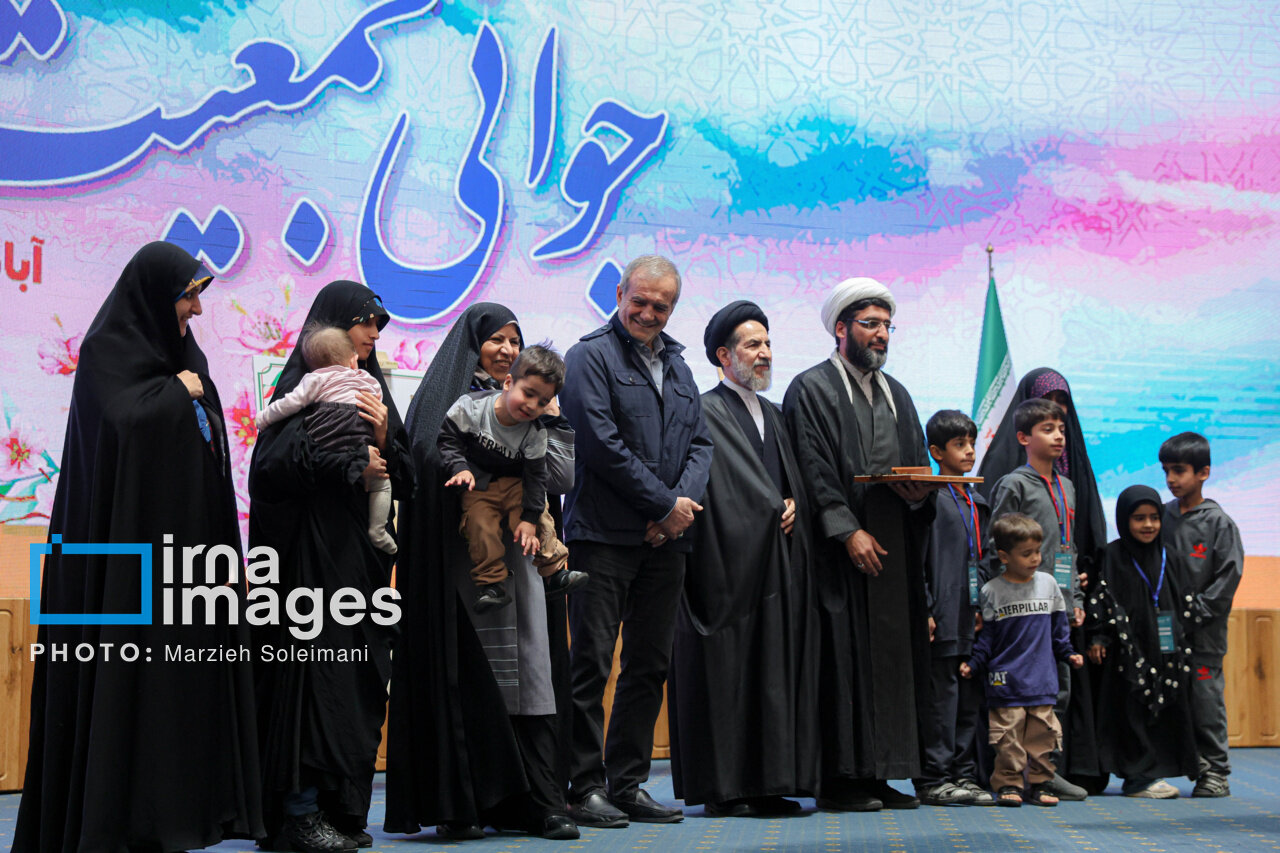
TEHRAN – The 3rd National Youth Population Awards were held today in the presence of President Masoud Pezeshkian.
The event highlighted the important role of neighborhoods and mosques in removing barriers to childbirth and addressing family issues in cities.
The performance of relevant organizations was evaluated based on two main criteria, including legal and internal obligations, and the best ideas, photos and films focusing on family and childbirth were selected.
Youth population law
The enactment of the Youth Population Law has stabilized the total fertility rate, and the general fertility index has increased slightly over the past two years. The birthrate has declined by about 20% over seven years, but is now stable at around 1.6.
The total fertility rate has been declining rapidly since Iranian calendar year 1394 (2015-2016), with the number of births reaching 1.057 million in 1402 (2023-2024) from 1.57 million in 1394. However, since 1401 in the Iranian calendar (March 2022 to March 2023), the birth rate has been on the decline. Stop.
However, there are growing concerns about the declining trend of population growth in the coming years and the possibility of Iran becoming one of the oldest countries in the world, IRIB reported, citing Mohammad Javad Mahmoudi, an official at the Civil Registration Agency.
“With a total fertility rate of 2.5, Iran’s population will, at best, reach 102.89 million by the next seven years,” Mahmoudi said.
An important factor contributing to the country’s declining birth rate is the cost of living. In fact, many families are choosing to reduce their family size due to high inflation rates and an expensive real estate sector. The current one-child trend is prevalent among young Iranian families, many of whom also have to support their aging parents.
Due to economic constraints, later marriage is also a new trend. Late marriage and longer birth intervals are also contributing factors.
MT/MG