
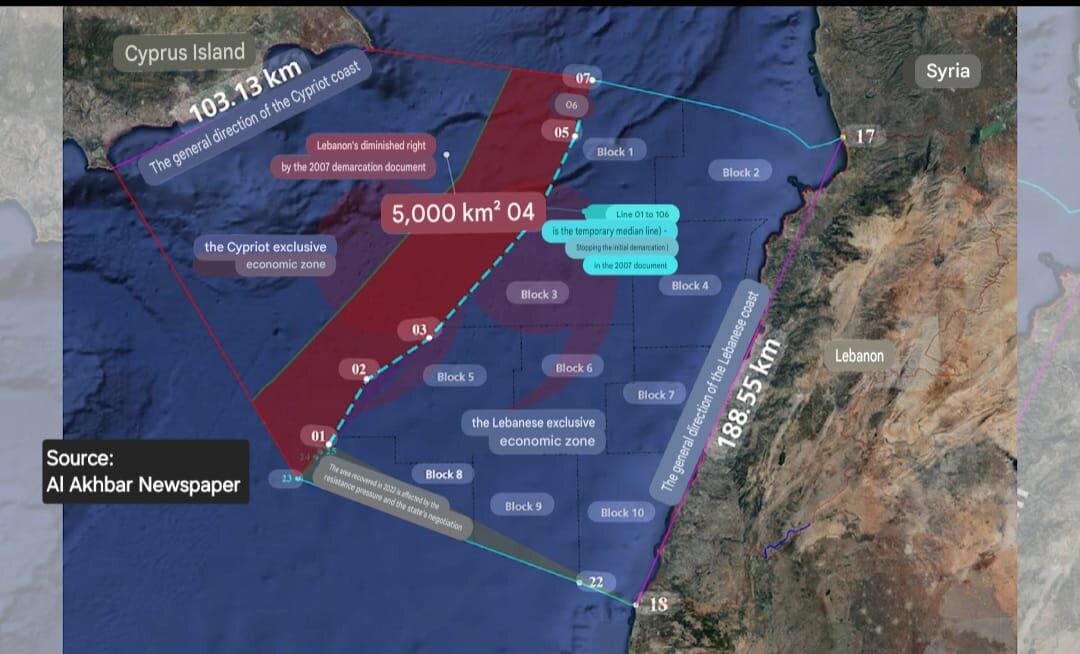
BEIRUT — On October 23, 2025, Lebanon crossed a dangerous threshold under the leadership of Nawaf Salam, and his cabinet seemed almost dedicated to national self-destruction.
Unable to stem Lebanon’s financial collapse and social despair, Salam’s cabinet created a strategic disaster by recklessly managing maritime demarcation with Cyprus and oil exploration in the south – a signature not of error but of subjugation.
This blunder was not a management error. It is, in every practical sense, serving the interests of Israel’s enemies and the dictators in Washington who have sought to impose a fait accompli on the Eastern Mediterranean, a political servitude that expands Israel’s space to blockade Lebanon and plunder the region’s gas fields with a “legal” smile.
The government’s decision to adopt the 2007 maritime agreement with Cyprus “as is” in line with the so-called median line will effectively give up nearly 5,000 square kilometers of Lebanese maritime territory – territory that the military and research studies have identified as part of Lebanon’s natural continental shelf.
In layman’s terms, this means transferring potential gas fields to indirect Israeli control through the 2010 Cyprus-Israel agreement.
Incredibly, Lebanese military representatives, naval officer Mazen Basbous, and legal consultant Najib Masihi justified this capitulation by claiming that “international arbitration does not change anything” and that the amendments to Decree 6433 were meaningless.
Salam’s cabinet’s logic will only please Tel Aviv because it ignores the very spirit of international maritime law, which demands fair outcomes rather than arithmetical symmetry.
Articles 74 and 83 of the United Nations Convention on the Law of the Sea (UNCLOS), along with a mountain of international precedent, affirm that equity, not geometry, determines delimitation.
Equity takes into account coastline, geography, and proportionality. Lebanon, with its modest coastline, cannot be equated with an island like Cyprus, surrounded by open sea.
By treating the “Middle Line” as divine scripture, the government reduced Lebanon’s maritime rights while expanding Cyprus’ share and, conveniently, Israel’s reach.
Through a 2010 agreement with Nicosia, Tel Aviv had already bypassed Point 1 in Lebanon to form a disputed triangle south of Point 23 – the same zone that is now rife with Israel’s energy ambitions.
The farce deepens when we remember that Cyprus itself is a divided entity, divided between Greek and Turkish administrations, dotted with two British sovereign bases, and stripped of full independence.
How does Lebanon justify a binding maritime agreement with a country that cannot even control its own coast?! But there is little room for logic in Prime Minister Salam’s cabinet, with the compass pointing only to the den of American spies (the embassy).
The Oct. 23 session had Washington’s fingerprints all over it. Lebanon’s “technical decision” was nothing short of a political capitulation, a compliance law designed to secure Western consent while abandoning the country’s maritime future.
The same pattern follows the government’s approach to oil and gas exploration in Block 8. The French company Total, whose loyalties to Paris and Tel Aviv outweigh its interests in Beirut, was awarded exploration rights, only to request a three-year delay.
Eager to oblige, the government ignored and approved a pro bono offer from the Norwegian-American company TGS to carry out 3D surveys covering 1,200 square kilometers for free. This is a case study of how to block your own economy to avoid impeding Israeli drilling.
This is not just negligence. It’s a policy. Lebanon’s rulers have mastered the art of surrender, disguising betrayal as diplomacy and foreign pressure as “stability.” However, this so-called stability is nothing but Israel’s superiority dressed up as Western PR.
Salam’s government has acted more like a local branch of the US State Department than a sovereign authority. It ignored military reservations, silenced domestic experts, and promoted the abdication as a “routine household chore.”
What it actually did was a quiet liquidation of Lebanon’s shipping assets. The sale took place behind closed doors and the price was paid in silence.
If this trajectory continues, Lebanon will soon lose not only its gas fields but also its last shreds of sovereignty. Each concession in the oceans mirrors a concession in politics, and both sail under the same flag of dependence.
As neighboring countries rush to protect their resources, Lebanon has perfected the art of self-annihilation, handing over its treasures to its enemies one by one, decree by decree. But what is lost in ink can be regained by will. We can redraw the map, but first we need to rediscover our dignity.
Only when Lebanon decides that its seas are not for sale and that its sovereignty can be defended in trenches rather than conscripted into embassies, will the tide change.
Until that day, Nawaf Salam’s cabinet will be remembered not as a government but as a footnote in a long and shameful record of national abandonment.