
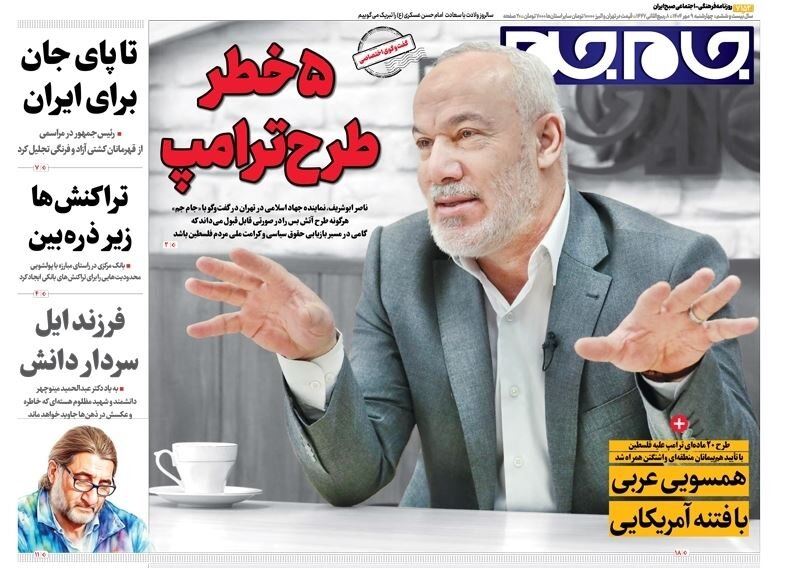
Tehran – Jammu et Jammu discussed the hidden dynamics of the country’s political structure in an interview with Mohammad Reza Bahonar, Secretary-General of the Association of Islamic Engineers.
He said: China and the United States are negotiating with each other despite serious competition, despite the war in Ukraine. This confirms the approach that it is possible to negotiate with the US by observing certain conditions. We can negotiate with countries that share common interests, even hostile countries. It must not be forgotten that the US has a large Iranian lobby. Even American companies are willing to avoid US sanctions when common interests are defined. In this context, principled views help us. Before the 12-day war imposed, we were negotiating, but were attacked. This type of negotiation task is clear. Negotiation that one side says you should not have the rights and you should not even protect yourself is no longer a negotiation, but pure surrender. We must reach a point where we can negotiate in a victory position for both sides by integrating internal unity and unity, as well as strengthening the country’s deterrence and economic foundations. The negotiation area must guarantee our national interests.
Vatan-e-Emrooz: Snapback and move towards a new multipolar world order
Vatan-e-Emrooz wrote: At first glance, the actions of the European trio in calling snapback sanctions that restored the anti-Iranian UN Security Council resolution appeared to be a political and security challenge between Iran, Europe, and the United States. However, Russia and China were strongly opposed to a non-rejectable snapback mechanism. It is very important to question snapback sanctions caused by the forces of two worlds. This is evidence that eastern powers are taking serious challenges to existing world orders and accelerating their activities to establish new orders in the emerging multipolar world. In this situation, Iran has a great opportunity to come. Iranian foreign policy decision-makers must understand new circumstances, define strategies and be able to receive increasingly support from countries that are driving the establishment of a new world order.
Iran: Iran and China’s outlook for cooperation after snapback
The Iranian newspaper spoke with Hamed Vafaei, a senior researcher on China’s issues, about the country’s policies regarding snapback mechanisms. He said: From a Chinese perspective, the legitimacy of the snapback remains questionable and has not yet been accepted as a decisive measure within the framework of the Security Council and the international system. Relations with China should not be limited to trade. This cooperation should extend to geopolitical, geopolitical and even geocultural areas. How Iran’s framework for cooperation with China is formed is a question that depends on the decisions and deliberations of the Islamic Republic. Iran has a wide range of capabilities in working with China, from energy and new technologies to civilization areas and initiatives related to global governance. Therefore, a portion of Beijing’s foreign trade is always allocated to Iran. But how much of this share and how much quality it is depends on the strategic outlook and planning. The sooner you enter a common dialogue with China in your operating and geopolitical regions, the more likely you will form sustainable and balanced cooperation.
Khorasan: Intervention Plan
In the memo, Horasan said he believes he can join Abraham’s unity by working on Trump’s goals. (At a White House press conference in Washington next to Israeli Prime Minister Benjamin Netanyahu, Trump said, “Maybe even Iran can get in there… I think they’re open to it. I think they really believe it. But they could become members,” writes Khorasan. The main goal is not for Iran to participate in the Abraham agreement, but for the creation of doubt, spiritual conflict and incite internal cleavage. The very fact that creating such an impossible statement was a former unprecedented unclear. Part of the target manipulation with a good intention. He is very well aware that the Islamic Republic will never succumb to an agreement that will strengthen Israel and weaken Iran’s national interests. It is therefore logical to view this statement as an indication of an attempt to continue the sabotage project that failed at an earlier stage, including during the 12-day war. This statement has a purpose beyond the statement intended to generate doubt, weaken cohesion and provide a basis for intelligence and security for future intervention. It should be carefully monitored and analyzed by competent institutions.