
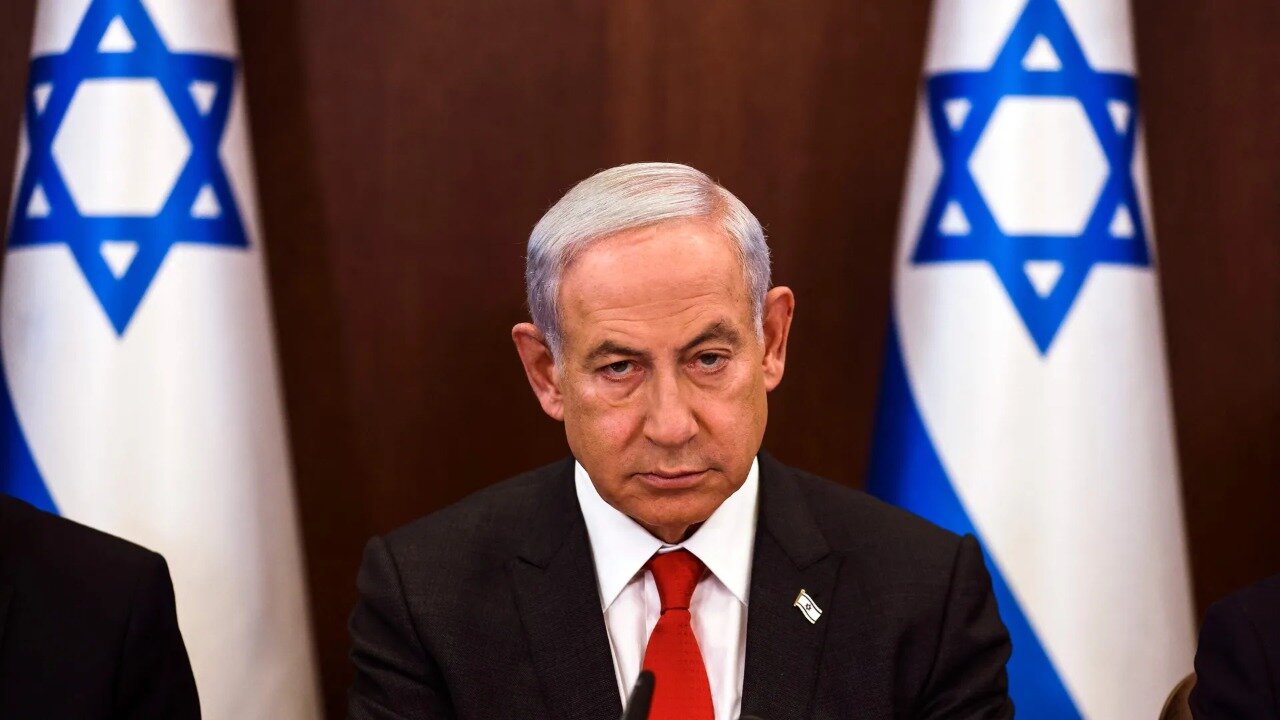
Islamabad – Benjamin Netanyahu’s latest act on the world stage was played like a moral story, except that morality was hypocrisy written in blood. Shot in studio lights, the Israeli Prime Minister crowned himself the savior of the Iranian people and vowed to “save countless lives” from the cruelty of water shortages.
Shaking Iran’s water statistics as a prophecy, he warned of the refugee souls of 50 million people and praised Israel’s “solution” to the declared enemy. But when his words travel the airwaves, only 70km away, the children of Gaza are dying of thirst, blocked by the very condition that their water claims to save strangers from water shortages.
When those words were used and the internet spread, Gaza children were consuming a brackish watery taste that contaminated the water when they could even drink. The area of the surrounded strip had no clean running water in months at a time. The pipeline, shattered and buried underneath the tiles, is in a bombed district. The Gaza Ministry of Health, UNICEF and UNRWA say water shortages combined with hunger caused by lockdown-related hunger have claimed at least 315 lives in recent months, half of which are under five.
Certainly, inhumanity is not by chance, but by policy. The Israeli Defense Minister outlined the full siege of Gaza two days later, providing similar information that “no electricity, food, no fuel, everything is closed.” It’s not spoken, but water was understood. Israeli officials have closed Mekorot, the state water company. The result was an artificial drought in one of the most populous lands on our planet.
According to OCHA, the average daily water available in Gaza in December 2023 fell to less than 3 liters of water per person. By March 2024, residents of northern Gaza had endured less than a litre per day, which in most cases are not even able to drink. Up to 65 water wells were bombed, as well as three major desalination plants and more than 50 kilometers of water pipes. Fuel shortages and disabled pump station.
This is an obvious crime in accordance with international humanitarian law. Article 54 of the Additional Protocol I to the Geneva Convention “prohibits the attack, destruction, removal or rendering of useless objects essential to the survival of civilians. The International Committee of the Red Cross considers it to be one of the war crimes if it is employed as a means to starve civilians, or as a means to drive them away. In April 2024, Human Rights Watch published a report entitled “Hopeless, Hungry, Beckoned.” This concludes that Israel has turned water and food deprivation into a weapon of war as the lockdown caused an epidemic level of disease that disproportionately killed children and elderly people. UNICEF’s UN Children’s Fund calls it the impending death sentence for Gaza children.
The most harmful numbers are counted in human life, not using liters. UNICEF’s March 2025 assessment reported a 45% increase in diarrhea disease for children under the age of 5 compared to prewar levels. In the first year of the siege by the Palestinian Ministry of Health, at least 120 cases of infant mortality due to dehydration and waterborne diseases were recorded.
The story of Mariam, the six-year-old child of Karn Eunice, who died drinking contaminated water collected in a rooftop tank due to a lack of bottled water in January 2025, is a sad commentary on the lives of the children around Karn Eunice due to a lack of water. Her mother told Al Jazeera: “She cried all night with stomach pain. By the next morning, she was gone.” In Beit Rahia, 70-year-old Hassan, who had already survived four Israeli attacks, succumbed to kidney failure due to the closure of the dialysis machine due to lack of sterile water. Doctors at Kamal Adwan Hospital reported 70% cancellations of dialysis sessions north of the Gaza Strip, due to the inability to ensure water safety.
This is not the first time that water can be used as a weapon. During the 2014 Operation Protection Edge, an Israeli attack damaged Gaza’s biggest wastewater treatment plant, causing raw sewage to flow into the aquifer. In 2021, the EU-funded desalination plant was bombed. On every occasion, reconstruction was not technically difficult, but was supported by Israel’s import control of the necessary supplies. Gaza Water Authorities have always warned that, even after the war, full healing will take years, as long as the lockdown is lifted. Even talking about rehabilitation can be nonsense if there is no fuel, spare parts, or chemicals to treat.
Netanyahu’s message to Iranians is designed to fit international views. But hypocrisy is clear. Gaza, just 70 kilometres away in Tel Aviv, is deliberately denied the highly water storage technology Israel displays at the International Exposition. The same can be said about the death of a Palestinian journalist at the hands of Israel, Iranian Foreign Minister Abbas Aragut said: Netanyahu is trying to undermine Iran’s unity, an important barrier to Iran’s invasion.
This policy is explained by Global South. Pakistan has criticised the blockade as a war crime fixed by siege tactics. China and Russia have urged the United Nations to investigate the deliberate targeting of water infrastructure, highlighting violations of international humanitarian law. Their demand comes even in conflict where attacks on key water facilities in Gaza have directly harmed civilians.
Air strikes have been called by Iran an environmental war against people. In contrast, Washington and the European capitals protect Israel. All resolutions issued by the Security Council to restore Gaza utilities have been rejected by the US. The countries that fund the Palestinian water project, primarily Europeans, have refused to publicly punish Israel for the destruction of the project, but they are engaged in quiet dialogue that makes no difference.
Almost 90% of the wastewater is reused in Israel. This is the highest percentage worldwide. Drip irrigation was invented and commercialized. Netanyahu uses these numbers to pose as a savior of a climate disaster. Nevertheless, as one Palestinian engineer took refuge in Beit Hanong, “they want to be remembered as a country that blooms the desert, but they changed our home to come and create the desert.”
Propaganda may shape the story, but images coming out of Gaza (the empty jerrykan, mother boiling brackish water, and hospital wards are closed due to lack of sterile equipment) endure much longer than Netanyahu’s speech.
The siege of Gaza is the best documented example of the recent humanitarian crisis. Evidence exists in the form of UN cables, satellite photographs, and hospital death certificates. Although not read in a history book about Netanyahu making this offer in the spirit of Christianity, rather, a horrifying expression of hypocrites, in history, a man reaches out to a foreigner while standing on the throat of his neighbor, preventing them from drinking that water. And when the world hears his hymns, we must not forget the unmarked graves of Gaza children who have died with dry lips.
Muhammad Akumal Khan is a Pakistani journalist and foreign analyst. He writes about South Asia and the Middle Eastern Relations, conflict diplomacy, and media freedom under war.