
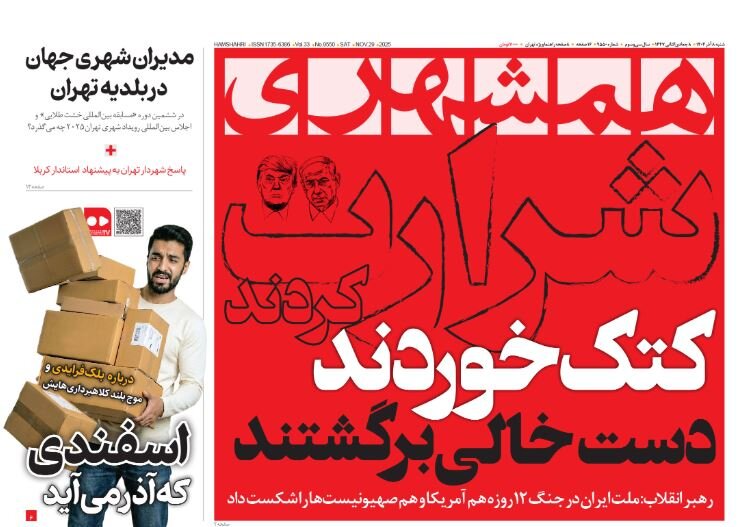
TEHRAN – In his analysis, Prime Minister Hamshahari referred to claims that Iran sent a message to the US government through the Saudi crown prince, who recently visited Washington.
“While senior Islamic Republic officials have repeatedly denied sending any messages to Washington through the Saudi crown prince in recent days, Western and opposition narratives continue to construct a scenario that portrays Iran as weak and seeks to portray the country as “eager to negotiate with the United States,” the newspaper said. The culmination of the media hype and speculation about the negotiations was the leader of the Islamic Revolution’s televised address to the Iranian people on Thursday night, in which he said the alleged message was a lie. Nevertheless, the claims did not end there. The anti-Iranian channel “Iran International” reported that the US reiterated three preconditions in response to a message allegedly sent by President Pezeshikian via Riyadh. Such claims, intended to portray Iran as weak, come despite Tehran’s repeated emphasis in recent days that “zero enrichment and limits on Iran’s missile range” are red lines that should not be crossed, and that the Islamic Republic will not participate in any talks based on such preconditions.
Siasate Ruth: The key to cognitive warfare to ensure your enemy’s defeat
In its commentary, Siasat-e-Rus highlighted statements by former Israeli military spokesperson Daniel Hagari, who acknowledged that Israel had lost in the court of public opinion. The paper said that Daniel Hagari, one of the key figures in the Zionist regime’s propaganda machine, publicly declared in Washington that “Israel has lost the battle on social media.” This statement is not just a media confession. This is the first strategic document that openly reveals the collapse of the regime’s propaganda machine. To take advantage of this opportunity, a series of coordinated and multi-layered actions must be taken. First, it is necessary to strengthen the people’s content production capabilities. In addition to this, media and cultural institutions need to create strategic content through precise planning. This unprecedented moment should be used as a launching pad for establishing superiority in cognitive warfare. If we act now, we can turn our enemy’s defeat into a sustainable trend. But if we delay, the enemy will rebuild its propaganda machine and regain control. It is therefore our historical duty to act with vigilance, unity and speed, to turn this opportunity into a strategic victory and reorient the future struggle to the benefit of regional states and resistance movements.
Ham Mihan: Policy review is essential
Foreign Minister Ham Mihan, quoting international affairs analyst Mohammad Qasem Moheb Ali, discussed Foreign Minister Abbas Araghchi’s negotiations with European officials, saying: “These talks with Europe could be a prelude to dialogue with the United States, given European countries insist that Iran should negotiate with the United States.” If these negotiations have a positive outcome, there is hope that Iran and the United States will eventually engage directly and that Europe will work with the United States to reach a deal with Iran that normalizes its nuclear program and lifts sanctions. However, it seems that the nuclear issue is not the only topic on the agenda. Everything depends on the will of both parties. If we want to avoid new conflicts, escalation of tensions and the risk of military conflict, we need to move towards dialogue. The agenda for consultations should be set jointly and discussions should focus on mutually agreed upon topics. Currently, the situation in Iran and its policies require serious reconsideration both domestically and internationally. A true and thorough evaluation of past policies must be undertaken, and any revisions must be in line with the current foreign policy landscape so that Iran can achieve the economic development it most urgently needs.
Sazandegi: Successful Tehran-Paris trip requires smart engagement
Iran’s foreign minister’s visit to France comes at a delicate time, with the nuclear file, regional development and bilateral relations with world powers all at a critical juncture. The visit provides Iran with an opportunity to advance its national interests while creating space to reduce regional and international tensions. However, the impact of the visit will only become visible if its true limitations and opportunities are carefully assessed. In recent years, Iran has taken two different foreign policy approaches simultaneously. One is security-oriented, emphasizing confrontation and deterrence, and the other is focused on diplomacy, dialogue, and de-escalation. The Iranian government’s increasing diplomatic visits, from Pakistan to France to the United States, demonstrate Iran’s efforts to balance these two trends. The success of your trip between Tehran and Paris depends on your smart moves. This path can only be successful through a combination of active diplomacy, realism in international relations and protection of national interests. With a realistic understanding of the current situation, Iran must be able to protect both its legitimate right to self-defense and its regional and economic interests, while maintaining constructive interaction with the international community.