
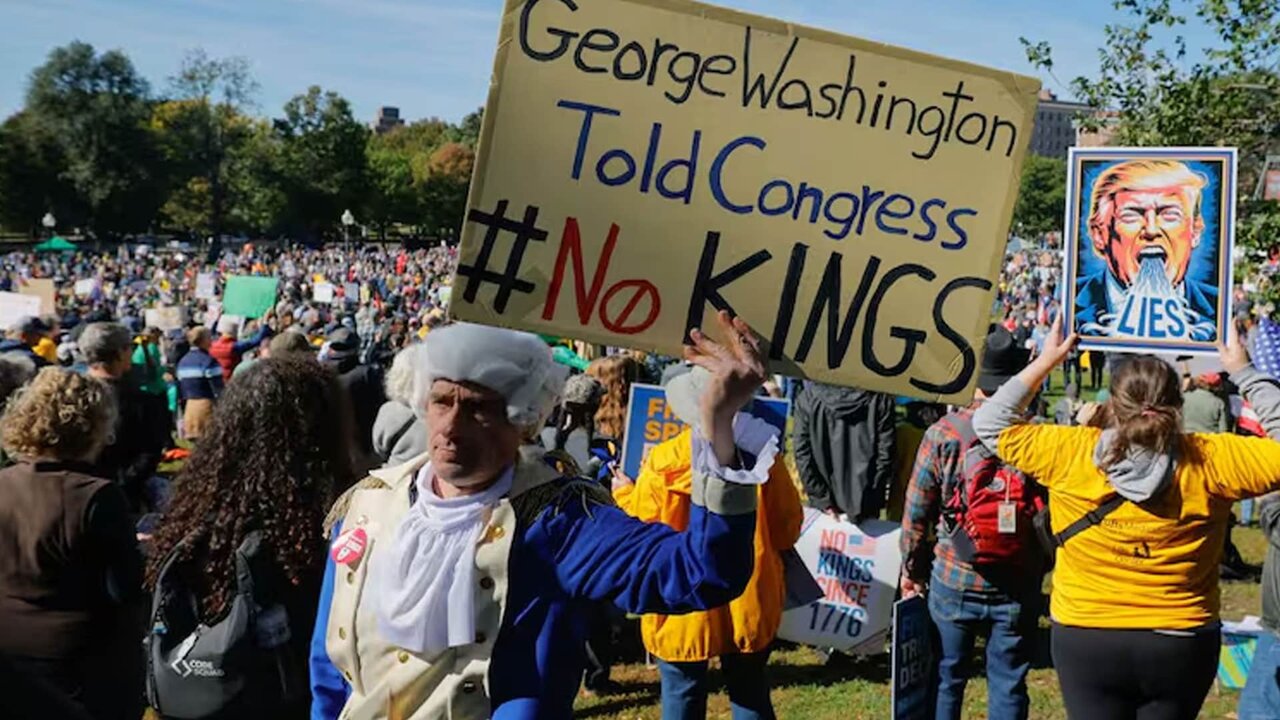
TEHRAN – The “No Kings” protests that erupted across the United States on Saturday revealed more than opposition to President Donald Trump’s policies, exposing the country’s deep political, social and ideological divisions.
From big cities to small towns, the demonstrations highlighted growing concerns about the centralization of executive power, the role of Congress, and the overall state of American democracy. The protests brought together citizens expressing their concerns about the direction of governance and the balance of authority in the country.
Demonstrations took place in major cities such as New York, Boston, Chicago, Los Angeles, and Washington, as well as small towns. Demonstrators held signs that read “Resist Fascism,” “The Constitution is Not Arbitrary,” and “There’s nothing more patriotic than protesting,” demonstrating widespread unease over government overreach, immigration policies, health care cuts, and perceived threats to democratic institutions. The term “No Kings” reflects the belief among participants that President Trump and some members of his administration are behaving more like monarchs than elected officials accountable to the people.
In Washington, Iraq War Marine veteran Sean Howard told The Associated Press that he had never participated in a protest before, but felt he had to act. “These are un-American,” he said, citing the detention of immigrants without due process and the deployment of troops into American cities as worrying signs of the erosion of democracy. “We wanted to show that the government’s disregard for the law is unacceptable.”

Massimo Mascoli, a 68-year-old retired electronics engineer from New Jersey who grew up in Italy, told the BBC he joined the protests because he feared the United States would follow the same path as his home country last century. “You can’t rely on the Supreme Court or the government,” he said. “We can’t rely on Congress. We now have the entire legislative, executive and judicial branch over the American people. That’s why we’re fighting.” Mascoli cited immigration enforcement and health care cuts as the main concerns motivating his activism.
Some Democratic leaders expressed support for the protests as an expression of citizen participation rather than partisan opposition. “There are no dictators in America, and we will not allow President Trump to continue to erode our democracy,” Senate Minority Leader Chuck Schumer posted on X, along with a photo of himself holding a health care placard in New York. Sen. Bernie Sanders of Vermont told the crowd in Washington, “We’re not here because we hate America, we’re here because we love America,” underscoring the patriotic motives behind the demonstrations. Sens. Cory Booker, Adam Schiff, and Chris Murphy also acknowledged the protests, shared images and videos of large-scale participation in their states, and thanked Americans for participating.
Republican officials, meanwhile, dismissed the demonstrations as “Hate America” rallies and labeled participants as “communists” and “Marxists,” highlighting partisan differences over public protests and the ongoing government shutdown.
This move attracted international attention. Solidarity demonstrations were also reported in Berlin, Madrid and Rome, with hundreds of protesters gathering outside the US embassy in London. In Toronto, demonstrators near the U.S. consulate waved signs that read “Keep your hands off Canada,” reflecting global concerns about U.S. policy and recognition of growing political instability.
Saturday’s protests marked a significant increase in citizen mobilization. April’s national march against Trump and Elon Musk included 1,300 registration locations, and the first “No Kings” day in June reached 2,100. Organizers said Saturday’s 7 million participants reflected the growing reach of the movement and the strength of public concern about the national government’s path.
Observers say the protests are a sign of broader unease about the president’s growing powers. Since returning to the White House in January, Trump has increasingly used executive orders to reorganize federal agencies, deploying the National Guard into cities despite opposition from state governors and publicly pressuring law enforcement against targets he views as political opponents. Supporters say the measures were necessary to manage a country in crisis, while critics warn they challenge constitutional limits and the balance of power at the core of the American system.
Featuring the voices of veterans, immigrants, retirees, and international advocates, the protests highlight the scale of political polarization in the United States and the enduring role of civic activism in shaping the national debate. Analysts have suggested that the incident could influence public debate about executive power and the responsibilities of elected officials in the coming months.